Average response time: under 24 hours
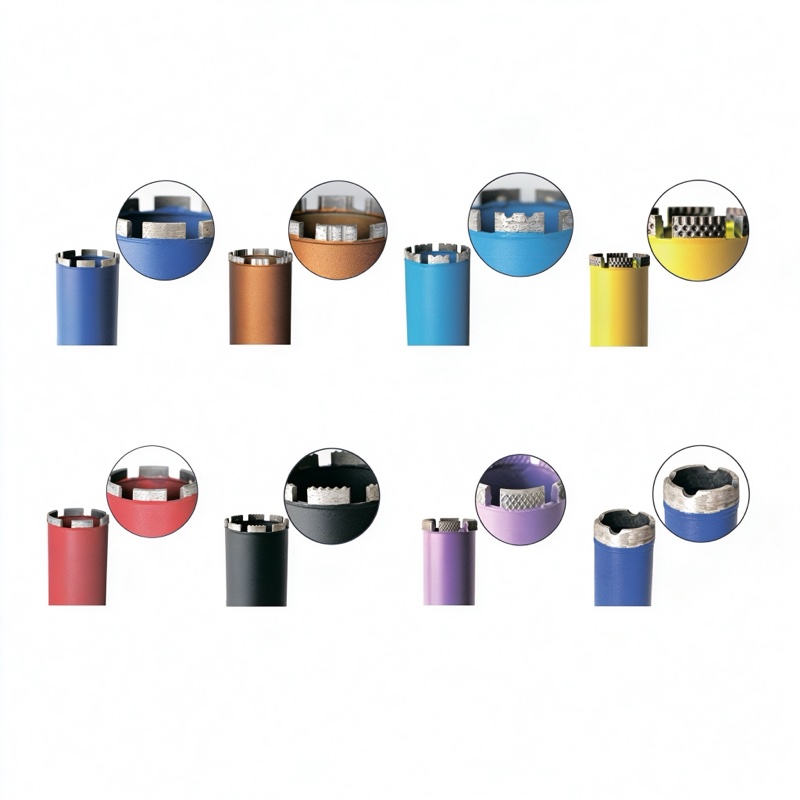
A diamond core bit lasts longest when it is matched to the material, run at the right RPM and feed, cooled properly, and dressed when glazed. Inspect segments after every job, clean the barrel, store it straight on a rack, and never switch a wet-rated bit to dry. Simple habits like these can double the life of a diamond core drill bit and keep holes round and fast across hundreds of cuts.
A diamond segment is a matrix of metal powder holding diamond crystals. As the bit cuts, the diamond dulls, the matrix wears, and new diamond is exposed. When the matrix wears faster than the diamond, segments drop off early. When the matrix wears too slowly, the diamonds are never exposed and the bit glazes over. Both failure modes are preventable by choosing the right bond for the material.
Segments wear unevenly if the drill is tilted, the RPM is wrong, or the rig is not perpendicular. One side of the barrel wears faster, the hole becomes oval, and the bit binds. Correct alignment at the start of every cut is the cheapest maintenance you can do.
If segments are discolored blue or brown, the bit overheated during use. Heat kills diamond and softens the matrix; overheated bits should be retired early because the remaining segments will not hold. See core drill accessories for thread protectors and storage racks.
Glazing happens when the bond is too hard for the material and the diamond never releases. The bit spins, heats, and polishes smooth. To dress it, cut a soft abrasive material such as a concrete cinder block, a brick, or a dressing stone for 10-20 seconds under light feed and water. The abrasive opens the matrix, exposes fresh diamond, and the bit cuts normally again.
Do not dress a bit on granite or hard concrete; that makes the glaze worse. Do not run a glazed bit against the side of the hole; it will burn the barrel. If dressing does not restore cut after two attempts, the bit is too worn and should be replaced.
| Symptom | Cause | Fix |
|---|---|---|
| Glazed, shiny segments | Bond too hard, dry cut | Dress on cinder block, add water |
| Segments drop off | Bond too soft, too hard material | Switch to harder bond bit |
| Uneven wear | Rig not perpendicular | Re-align rig, reduce feed |
| Blue/brown segments | Overheated, no water | Retire bit, check water feed |
| Slow cut from new | Wrong bond for material | Replace with matched bond |
| Oval hole | Worn segments or bent barrel | Replace bit |
Rinse the barrel with water after every job, especially after wet drilling concrete or stone. Concrete slurry dries hard and weighs the barrel down; steel barrels also rust if left wet. Use a wire brush on the inner core to remove built-up cuttings. Grease the shank thread lightly to prevent galling, and store the bit upright on a rack, never lying on its side under other tools, which can bend the thin barrel.
Transport bits in a case or tube. A bent barrel does not cut true, and a chipped segment edge catches the next cut and breaks off. For long shank or long barrels, use the matching storage tube so the shank does not bend.
Match RPM to diameter: small bits spin faster, large bits spin slower. Run within the manufacturer's recommended range, usually 800-1500 RPM under 2 inches, 400-800 for 2-4 inches, and 200-400 above 6 inches. Feed steadily, never force. Pull back every 15 seconds to flush cuttings. Cut wet when the bit is rated wet; if you need a dry bit, use a dry diamond core bit, not a wet one run dry.
Track holes per bit. Most contractors log the number of linear feet a barrel cuts before segments wear to the steel. When a bit takes twice as long per hole as a new one, or the hole starts to bind halfway through, it is reaching end of life. Pushing a worn bit does not save money; it burns water, time, and the rig motor, and the rough hole damages rebar anchors and sleeves.
Retire a bit early if segments are discolored, the barrel is warped, or the shank thread is stripped. A small savings on a worn bit is not worth binding the rig mid-cut in a finished room or on a facade where extraction is difficult. Treat the bit as a wearing part, not a permanent tool.
A well-matched bit will cut 50-100 holes of 4 inches in 4000 psi concrete before segments are worn to the barrel. Poor matching and dry cutting can cut that to 5-10 holes.
Some shops offer re-segmenting for large barrels. For small barrels, the cost often equals a new bit, so replacement is usually more economical.
Run a wet-rated bit dry, force-feed through rebar, or spin at too high RPM. Any one of these glazes or overheats the segments within minutes.
When segments wear flush with the steel barrel, the cut slows and the barrel begins to bind. It is time to replace, not to force more holes.
Diamond core bits are precision tools, not consumables. Match the bond, cool the cut, inspect every job, dress when glazed, and store straight, and the bit will deliver hundreds of clean holes before retiring.
Written and reviewed by JOY TECH — an SGS & BV audited, CE/RoHS certified diamond tools manufacturer founded in 2004, exporting to 50+ countries.
Our factory and QMS are audited by SGS and Bureau Veritas. Products meet CE/RoHS requirements and every piece is 100% inspected before packing.
Verified Certificates
