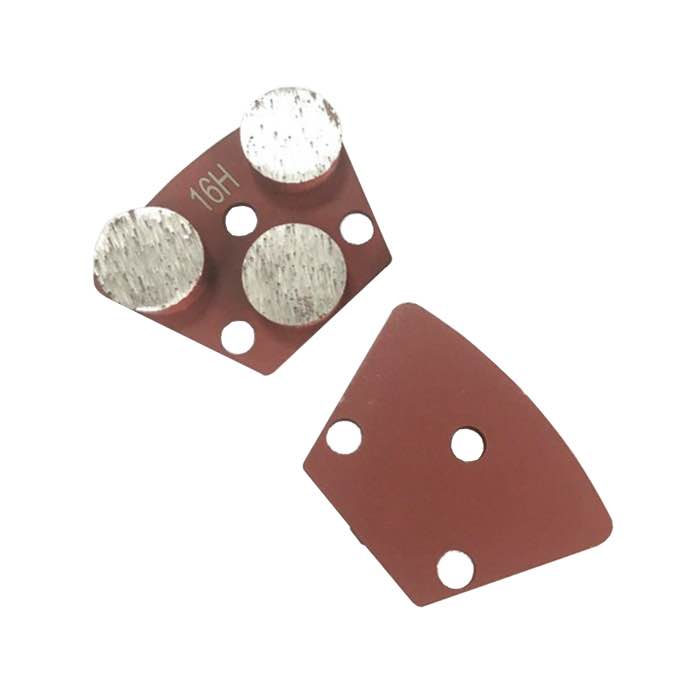
On a bare concrete floor, start with 16/18 or 30/40 grit depending on the slab’s condition: use 16/18 for rough, troweled, laitance-heavy, or aggregate-exposing work, and 30/40 for clean, flat floors that just need opening up before polishing. The grit is not a choice—it is set by how much material you must remove. If you start too fine (60/80) on a rough slab, you will glaze the diamonds and spend hours chasing flatness. If you start too coarse on a polished-ready floor, you will leave deep scratches that take four later steps to remove. Choose the coarsest grit that removes the defect in one or two passes, then step down through 60/80, 120, and resin bonds. Tools like Double Zigzag Segment Trapezoid Disc (JOY-TP-ZG2) and Single Rhombus Segment Trapezoid Disc (JOY-TP-RH1) are common starting-pass shoes.
| Floor condition | First metal bond grit | Why |
|---|---|---|
| New troweled slab, laitance, saw finish | 16/18 | Need to cut through cream and open surface |
| Moderately rough, with minor scratches | 30/40 | Balances stock removal and scratch control |
| Already flat, light coat, polishing prep | 60/80 | Only profiling needed |
| Exposing aggregate / salt-and-pepper | 16/18 or 14/20 | Must cut past mortar to reveal stone |
The correct first grit is the one that removes the worst defect on the floor in two passes. Look at the surface before you start:
You can always go coarser later, but you cannot uncut a deep scratch pattern without re-grinding every step.
A 30/40 hard bond behaves differently from a 30/40 soft bond. On hard concrete, a soft bond refreshes diamonds; on soft concrete, a hard bond preserves them. A zigzag-segment trapezoid disc clears swarf well on the first aggressive pass, while Single Rhombus Segment Trapezoid Disc (JOY-TP-RH1) tracks smoothly on medium slabs.
Even with the right grit, a new shoe can glaze on its first minutes against very smooth concrete. Keep a concrete dressing brick (or a rough, broken-up slab section) on the truck. Run the grinder on the brick for 20–30 seconds to open the segment face, and the diamonds will bite immediately. Do this every time you switch to a harder bond or start on a polished, sealed slab. It takes almost no time and saves the frustration of wondering why your brand-new shoes are not cutting.
Take photos of the scratch pattern after each grit step and compare them side by side. This habit catches skipped grits early, before the polish stage hides them. On larger jobs, mark test squares with tape so you can return and inspect under angled light after every step.
A: New slabs have a weak laitance layer. Start with 30/40 unless the slab is heavily troweled; 16/18 is for aggressive laitance or aggregate exposure.
A: Usually no. The 30/40 step removes the 16/18 scratch pattern. Skipping it leaves deep micro-scratches that show through the final polish.
A: Your bond is too hard for the concrete. Drop to a softer bond, or use a dressing brick to open the segment face.
A: No—the grit decision is based on the floor. Wet grinding reduces heat and dust but does not let you start finer than the surface requires.
Pick the first grit by the worst defect on the floor, not by habit: 16/18 for rough or aggregate-reveal work, 30/40 for most standard prep, and 60/80 only for clean, already-flat slabs. Match the bond to the concrete hardness, then step down evenly so each grit removes the scratches of the one before.
