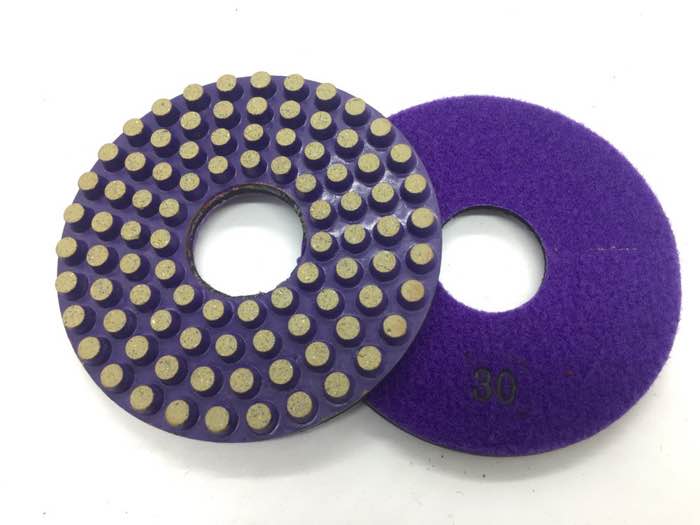
To polish a concrete countertop or sink, demold after proper curing, grind through a wet diamond resin pad sequence by hand on a variable-speed angle grinder, then seal. Because countertops are vertical, curved and irregular, you use flexible diamond resin discs (commonly 3-inch) used wet, working from 50 through 3000 grit, with special attention to rounded edges and sink cutouts. The same pad system works for both the flat top and the interior of the sink, though curved areas require smaller pads and hand finishing.
Polishing begins with a well-cured, demolded piece. Freshly cast concrete needs at least 5-7 days of curing before aggressive grinding; polishing too early pulls aggregate out. First, use a metal-bond diamond cup or puck to remove mold release, fins and high spots, and to open the surface. On edges and inside the sink, use a small grinder or hand sanding block because the angle grinder disc will not reach into tight radii.
Countertop work is almost always wet polishing: it controls dust, prevents the resin from loading, and produces the clarity concrete designers want. Use a variable-speed polisher at low RPM (around 2000-3000) and keep the surface wet. Recommended flexible discs:
Progress 50 / 100 / 200 / 400 / 800 / 1500 / 3000, fully removing each scratch pattern before advancing. Keep the pad flat and moving; on vertical sink walls, work in sections and wipe slurry frequently to see your progress.
| Area | Tooling | Note |
|---|---|---|
| Flat top | 3-5 inch resin disc | Wet, low speed |
| Bullnose edge | Flexible disc / hand pad | Match radius, follow curves |
| Sink interior | Small 3-inch disc | Work from bottom up |
| Tight corners | Hand pad / sanding block | Hand-finish to avoid flat spots |
Raw polished concrete is porous. Once the piece is fully dry, apply an impregnating sealer and, for food-contact surfaces, a food-safe topical finish. The sealer protects against wine, coffee and water rings - especially important on a sink. Polish only as wet as needed; residual water trapped in pores ruins the sealer bond, so let the piece dry fully before sealing.
The flat top of a countertop is the easy part; the edges and sink interior are where amateurs struggle. Bullnose and eased edges need flexible discs that conform to the radius, plus frequent wiping so you can see whether you are leveling the profile evenly. Inside a sink, work in small sections from the bottom up, because slurry pools and hides your progress. Use a small 3-inch disc and keep it moving.
Do not rush the sealing step. Concrete holds water in its pores, and a freshly wet-polished piece can take several days to dry fully. Sealing too early traps moisture that later causes cloudy, discolored patches. Weigh a sample piece or use a moisture test; only seal when the piece has stabilized. On food-contact surfaces, choose a food-safe sealer and follow the cure time before use.
For sinks and curved edges, keep a set of small flexible hand pads and a rubber sanding block for tight corners where a grinder cannot reach. Work wet, keep water flowing, and wipe often to reveal your progress. Patience on the curves is what makes a concrete sink look manufactured rather than DIY.
Between grits, wipe the piece with a damp cloth to check for remaining scratches before advancing. It is easy to miss them on a curved sink wall, and catching them early saves rework.
Plan for a 30-day cure before putting the countertop into service. Rushed use on an unsealed piece stains the porous concrete permanently.
A: You can with dust extraction, but wet polishing gives clearer results and protects the resin pads from overheating on small parts.
Wait at least 5-7 days of proper curing. Too early and aggregate pulls out; too late and the concrete is much harder to grind.
They follow the same sequence, but flexible pads and hand work are needed so you do not flatten the profile.
A polished concrete countertop or sink is a hand-finished, wet process: open it, refine through the full resin grit range, conform to curves, then seal. Quality flexible diamond pads make the difference between a scratchy top and a glass-smooth one. The takeaway is that concrete countertop polishing is a patient, wet, hand-finished process. Flexible pads, full grit progression and proper drying before sealing are what produce a smooth, durable piece clients love. Contact JOY TECH for a quote on countertop resin pads and edge tooling.
