Quick Answer
Orange peel on concrete comes from trowel marks, sealer reactions, or uneven grinding — remove it by grinding with metal bond pads (30–50#) until the texture is flat, then re-running the full sequence (transitional + resin) to restore a smooth polished finish.
What Causes Orange Peel
- Trowel burn / trowel marks — hard-troweled surfaces with ridges.
- Sealer reaction — some sealers or densifiers react unevenly and raise a texture.
- Uneven grinding — skipping grits or worn pads leaves a rippled surface.
How to Fix It
- Identify the cause — if it's a sealer reaction, strip the sealer first.
- Grind flat with metal bond — 30–50# metal bond on a planetary grinder until the texture is gone.
- Check with a straightedge — don't assume it's flat; the ripple can be deeper than it looks.
- Re-polish — run transitional and resin steps in order, finishing with 1500#+.
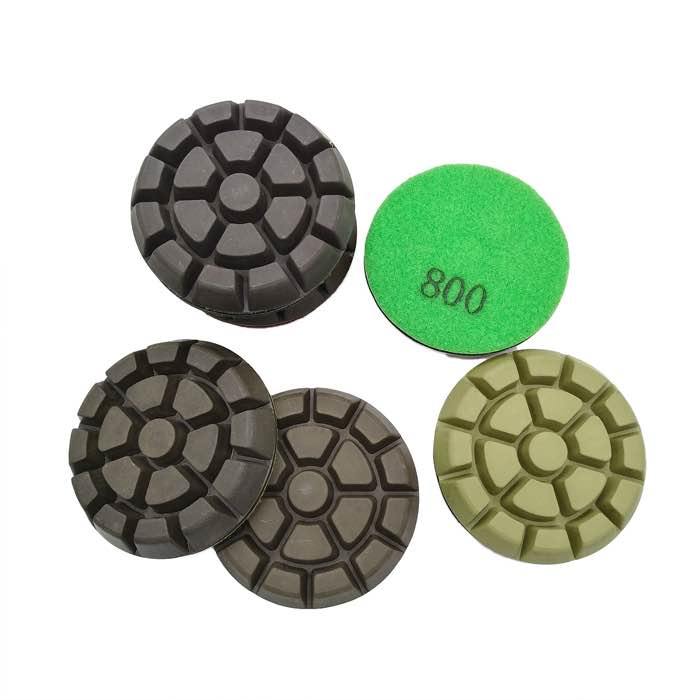
Use metal bond grinding discs to level, then copper bond transitional pads before resin.
Prevention Tips
- Don't skip grit steps — each step must remove the previous scratches.
- Keep pads flat and evenly loaded.
- Apply sealers per the manufacturer's rate — over-application causes reactions.
Frequently Asked Questions
Q: Can I fix orange peel without re-grinding the whole floor?
If the texture is light, a 100–200# metal bond pass may suffice. Heavy texture needs a full 30–50# re-grind.
Q: Will resin pads remove orange peel?
No — resin pads polish; they don't cut enough to level a texture. Use metal bond first.
Q: How do I know when the orange peel is fully gone?
Stop grinding periodically and look across the surface at a low angle — any remaining ripple catches the light. A straightedge check confirms flatness.
Conclusion
Orange peel is fixed by cutting, not polishing: metal bond grind it flat, then re-run the sequence. Identify the cause first so you don't polish over a problem. JOY TECH's metal bond discs handle the cut for any concrete surface correction.