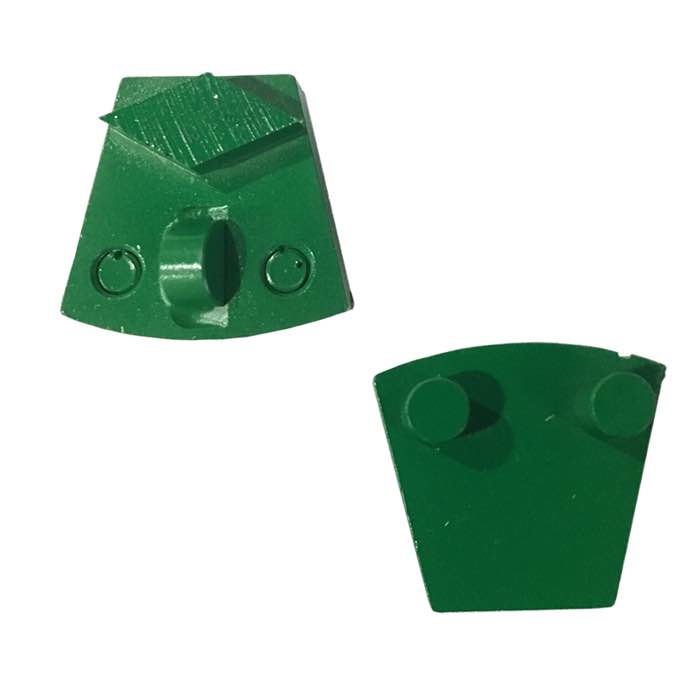
Yes — you remove old epoxy by grinding it off, but not with a standard diamond metal disc. First strip the soft epoxy with PCD (polycrystalline diamond) tools, which tear the coating off in sheets rather than melting it. Once the slab is bare, clean residual film with a 30/46-grit metal-bond disc, then 80/120 grit to open the floor for a new coating. Expect 5-15 m² per pass set, depending on coating thickness.
Standard metal-bond diamond segments are designed to cut hard mineral. On soft epoxy, the resin coating smears over the diamonds, glazing the disc almost instantly. You end up pushing a hot, gummy puck around the floor. PCD tools solve this: they are made of synthetic diamond that shears cured epoxy and polyurethanes without loading up.
| Step | Tool | Goal |
|---|---|---|
| 1 | PCD chip/half-moon tooling | Strip bulk epoxy in ribbons |
| 2 | PCD + small diamond segment | Clean residual film and level |
| 3 | Metal bond 30/46 | Open concrete, remove smear |
| 4 | Metal bond 80/120 | Profile for new coating |
On a WerkMaster-style plate, PCD epoxy-removal tooling is designed to bite through 2-5 mm self-level epoxy. On Husqvarna Redi-Lock plates, the Redi Lock PCD grinding disc pairs a PCD chip with a diamond segment to finish as it strips.
Keep the grinder moving at a steady walking pace. Do not dwell — PCDs dig aggressively and can gouge soft spots. For thick or troweled epoxy, make two cross-passes. After PCD stripping, sweep/vacuum the floor; the epoxy ribbons come off in chunks. Then switch to a standard metal-bond disc and grind until the floor shows 100% uniform exposure with no glossy patches left.
The walk-behind leaves a 100-150 mm band along walls. Clean that with an angle grinder fitted with a PCD cup wheel such as the 6-PCD floor-prep cup wheel before switching to a regular diamond cup wheel for the final profile.
Buildings often have layered floors: old tile adhesive, then a primer, then epoxy. Run a PCD pass first, then inspect. If a ghost film remains, do not jump straight to fine metal — make a second PCD pass over the residue, then move to 30/46 metal. Trying to remove two millimeters of epoxy with a metal disc wastes a set of segments and takes twice as long as two targeted PCD passes.
The walk-behind leaves a perimeter band. Use an angle grinder with a PCD cup wheel on this band before switching to a regular diamond cup wheel for the final profile. Work outward from the wall so the hand-ground area blends into the machine ground floor. Columns and drains need a hand PCD cup — do not try to pivot the walk-behind around them.
Peeled epoxy ribbons and grindings are non-hazardous in most regions but should go to construction waste, not general recycling. Ventilate the room; heating epoxy can release fumes. If the building is pre-1980 and the mastic is black cutback, assume asbestos until tested and use wet methods with HEPA extraction — do not dry-grind.
PCD tooling handles 0.5-3 mm coatings in one pass. Thicker self-level epoxy over 3 mm may need two passes or heating. Never force the grinder to dig deeper — let the machine walk across the surface. If a coating is elastomeric or polyurethane, standard PCD can struggle; ask for a chip-style PCD with aggressive rake. After stripping, the floor should feel like clean concrete, not a dark film.
A: Start at 30/46 metal bond to remove smear, then move to 80/120 to create the profile needed for the new coating (ITR/CSP). For a bare polished floor, continue through the usual resin sequence.
A: On small spots yes, but it melts and re-bonds the epoxy. Grinding with PCD is faster and cleaner for whole rooms.
A: A single 600 mm grinder strips roughly 15-30 m² per hour through light epoxy; thick self-level epoxies run slower.
A: Yes — once you reach a CSP 2-3 profile, vacuum thoroughly and apply the new coating within 24 h before dusting re-accumulates.
Epoxy removal is a two-tool job: PCD to take it off, diamond metal bond to leave the right profile. Trying to skip the PCD step wastes discs and hours. Contact JOY TECH for PCD tooling and metal discs matched to your plate system.
