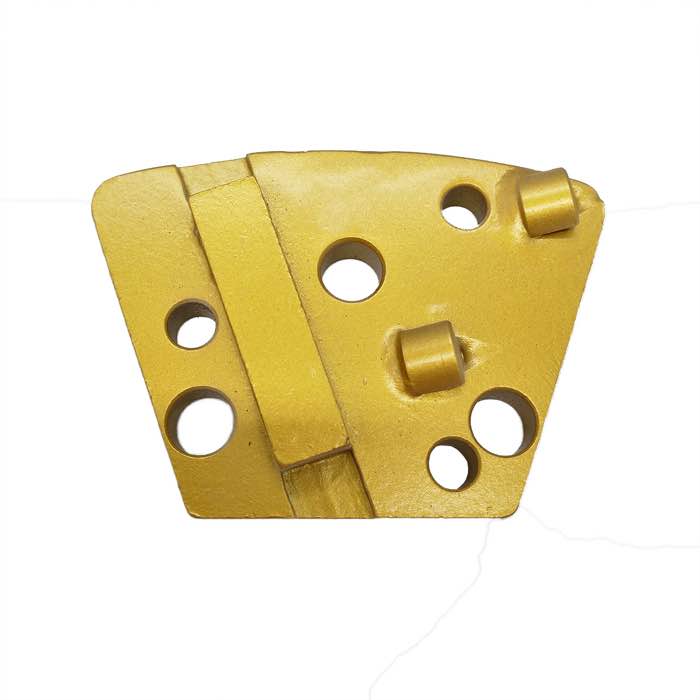
The fastest way to remove rubber gym flooring adhesive and black rubber residue from concrete is to grind it off with PCD (polycrystalline diamond) tooling on a walk-behind planetary grinder, followed by a 30/40 grit metal-bond pass. Rubber and its adhesive are soft and thermoplastic, so ordinary diamond segments glaze over in minutes. PCD chips shear through the rubber before it melts and loads the tool. For gym floors, playground underlayment and basketball courts, start with chip-style PCD at low RPM, then finish with a metal-bond disc like Diamond Trapezoid Grinding Disc (JOY-TP-R3) to open the concrete to CSP 2–3. Hand scraping and chemical strippers work for small patches but cannot match a PCD grinder on open floors.
Rubber residue comes in several forms, each needing a slightly different approach:
Metal-bond diamond segments cut by abrading hard material. Rubber is soft and elastic: instead of being cut, it deforms, heats up from friction, and sticks to the diamonds. In minutes the segment face is coated with a black, gummy layer that stops cutting. PCD solves this because the diamond layer is a hard, sharp edge that shears rubber like a blade, and the tungsten chip ahead of it curls the material away before it can melt.
| Pass | Tool | Goal |
|---|---|---|
| 1 | Chip-style PCD shoes | Peel rubber and thick mastic |
| 2 | Flat PCD bar | Remove thin residue and smear |
| 3 | 30/40 metal-bond disc | Open concrete, remove black stain |
| 4 | 60/80 metal-bond disc | Final CSP 2–3 profile |
Tooling such as WerkMaster PCD Epoxy Tooling (JOY-WM-PCD1S1) is a proven chip-style PCD for rubber and thick epoxy. For the cleanup pass, a disc like Diamond Trapezoid Grinding Disc (JOY-TP-R3) or WerkMaster Single S Segment (JOY-WMS-S1) opens the concrete without leaving the black gummy film behind.
Citrus or soy-based strippers help on small patches, corners and under fixed equipment where a grinder cannot reach. Apply, dwell, then scrape. They are not a replacement for PCD grinding on open floors—slow, messy and ventilation-heavy. Always neutralize and rinse before grinding, and let the slab dry fully.
A: Chip-style PCD grinding shoes on a walk-behind planetary grinder. They shear through rubber and mastic without loading up, unlike metal-bond diamond discs. Finish with a 30/40 metal-bond pass.
A: Yes, for edges, corners and patches. For open gym floors, a walk-behind grinder with PCD shoes outproduces hand work many times over and leaves a flatter profile.
A: PCD wears slowly on soft material; expect 500–1,500 m² per set of 3 shoes, depending on how much concrete is beneath the adhesive. The tungsten chips wear faster than the diamond layer.
A: Yes. PCD leaves a smear and light scratch. Follow with 30/40 and 60/80 metal-bond to reach CSP 2–3, the profile needed for new epoxy, tile or polished concrete.
Rubber residue is a coating-removal problem, not a concrete-grinding problem. Lead with chip-style PCD like WerkMaster PCD Epoxy Tooling (JOY-WM-PCD1S1) at low RPM, peel the rubber in ribbons, then open the slab with metal-bond discs like Diamond Trapezoid Grinding Disc (JOY-TP-R3) and WerkMaster Single S Segment (JOY-WMS-S1) to CSP 2–3. Whether you are renovating a gym, a playground or an old warehouse, the right PCD setup turns a sticky, glazed, slow job into a clean, fast production run.
