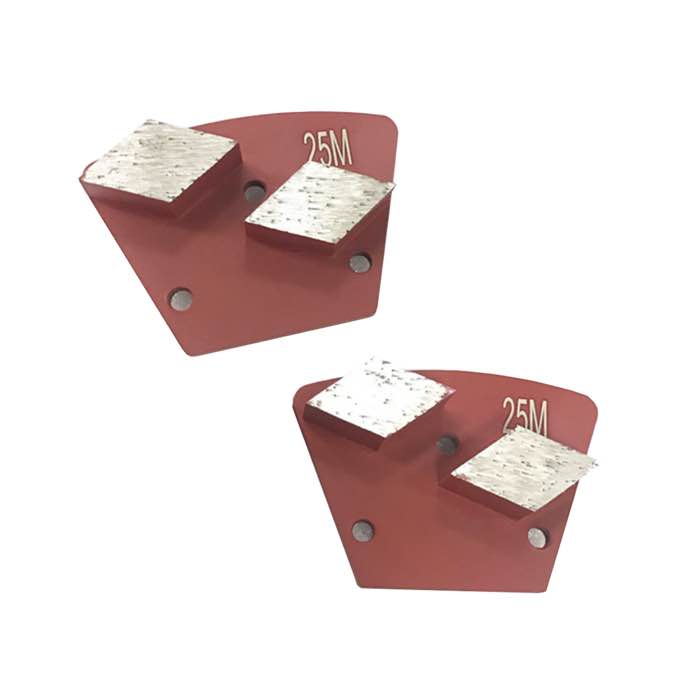
The fastest way to smooth a pitted, rough basement slab is to grind it flat with a planetary floor grinder, starting with 30/40 grit metal-bond diamonds and finishing at 120–200 grit, then patch active holes with a cement repair mortar before installing epoxy, tile or a polished finish. Hand angle grinders work only for edges and patches; open basement floors need a 270–580 mm walk-behind grinder with a dust shroud and HEPA vacuum. Expect to remove 0.3–1.0 mm to eliminate trowel marks, bugholes and laitance. Use medium to soft bond discs like Double Rhombus Trapezoid Disc (JOY-TP-RH2) on older, hard basement concrete, and take time to fix moisture issues before any coating goes down.
Basement slabs are often rough because they were placed as a structural sub-floor, never intended for finishing. Common defects:
Do not start the grinder yet. Below-grade work has extra traps:
| Pass | Grit / tool | Goal |
|---|---|---|
| 1 | PCD or 16/20 metal-bond | Remove old glue, cutback, coatings |
| 2 | 30/40 metal-bond disc | Level high spots, open laitance |
| 3 | 60/80 metal-bond | Smooth scratch pattern |
| 4 | 120/150 metal-bond or resin | Final profile for coating |
| 5 (optional) | 50/100/200 resin + densifier | Polished concrete finish |
Tooling like Double Rhombus Trapezoid Disc (JOY-TP-RH2) handles the middle grinding stages on medium-hard basement concrete; for very old, hard slabs, drop to a softer bond. For coating removal on old basement adhesive, WerkMaster PCD Tooling (JOY-WM-PCD1R1) PCD tooling clears cutback and mastic before diamond grinding begins.
Grinding alone cannot fill pits larger than a few millimeters. The right sequence:
Basements have poor ventilation. Silica dust plus trapped moisture is a respiratory and drying hazard. Run:
A: You can skim-coat with a self-leveling overlay, but the slab must still be profiled (ground or shot-blasted) for the overlay to bond. Grinding is the fastest, cheapest route.
A: Roughly 0.3–1.0 mm. Enough to remove laitance, trowel marks and old adhesive, but not so much that you weaken the slab. If aggregate starts popping out, you are going too deep.
A: That is laitance or a weak surface. Grind until you hit sound concrete, then apply a lithium densifier before coating. Dusting that returns after grinding usually means high moisture—address the source.
A: Yes, but keep the space above 10°C for grinding and coating. Cold slurry freezes on tools and slows cement patch curing.
Smoothing a rough basement floor is a four-step job: solve moisture, patch cracks, grind from coarse to fine, then coat. A walk-behind grinder with discs like Double Rhombus Trapezoid Disc (JOY-TP-RH2) and PCD tooling like WerkMaster PCD Tooling (JOY-WM-PCD1R1) will turn a pitted slab into a clean, flat surface ready for epoxy, tile or polished concrete—far faster and flatter than hand angle grinding alone.
