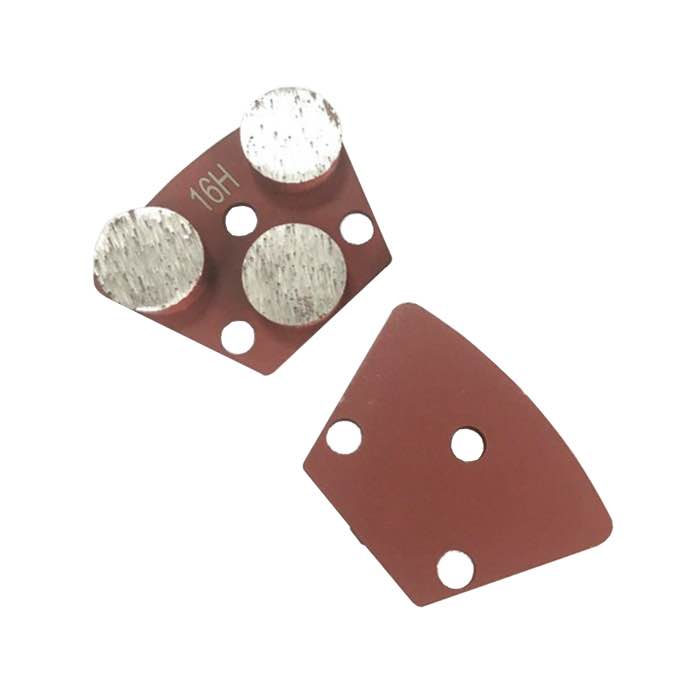
Standard metal-bond tooling cuts soft and medium concrete easily. On very hard concrete (compressive strength above 50 MPa, hard aggregate such as flint or chert), standard bonds glaze over and stop cutting within square meters. The fix is a softer bond, not more pressure. Test by running a fresh disc for 2 minutes: if it leaves a polished, shiny scratch instead of a coarse groove, the concrete is too hard for your bond.
Diamond tools work by wearing the bond matrix, exposing new diamonds as old ones dull. On hard concrete, the bond wears too slowly, so the diamonds never get replaced. A softer bond wears faster and keeps fresh diamonds exposed. Our R3 round-segment shoes is offered in soft, medium and hard bonds—tell us your concrete and we will ship the right one.
Browse concrete grinding discs category to request bond variants.
No. Aggregate hardness matters as much as compressive strength. A 35 MPa slab with flint aggregate can be harder to grind than a 50 MPa slab with limestone.
Yes, as a temporary fix. If it re-glazes within minutes, switch to a softer bond.
Sometimes. Higher concentration with a soft bond is the standard combination.
If your discs glaze, do not push harder—change the bond. Tell us the aggregate type and strength and we will match the bond. contact JOY TECH for bond recommendation.
