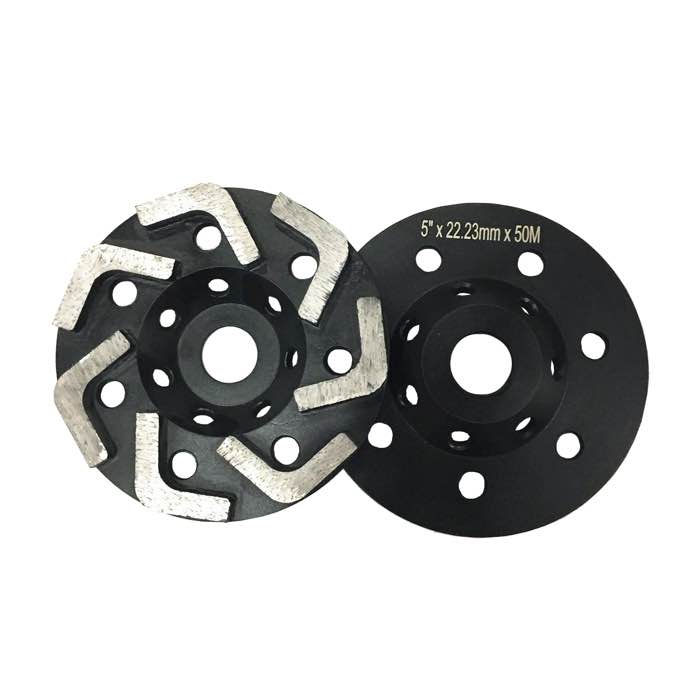
Use metal-bond diamond discs for aggressive stock removal, leveling, and initial scratch removal. Use resin-bond diamond pads for refining, smoothing, and polishing. In a typical job you run metal bonds first (30-150 grit) to flatten the floor, then switch to resin bonds (150-3000 grit) to produce the finish. The two are not interchangeable: resin pads cannot remove deep metal scratches, and metal discs cannot produce a polished shine.
The "bond" is the matrix that holds the diamond crystals. A metal bond is a hard sintered powder-metallurgy matrix: diamonds stay locked in until they fracture, exposing fresh ones. It cuts aggressively but leaves deep, directional scratches. A resin bond uses resin to hold diamonds more softly, so they release sooner and the pad cuts with a milder, finer action that builds gloss.
| Feature | Metal Bond | Resin Bond |
|---|---|---|
| Cutting speed | Fast, aggressive | Slower, refining |
| Scratch depth | Deep | Fine |
| Best use | Flatten, remove coatings, open surface | Smooth, polish, gloss |
| Life on soft concrete | Long | Moderate |
| Wet or dry | Mostly dry (some wet) | Both, often wet or dry polish |
| Typical grits | 6-150 | 50-3000 |
Metal bonds are for the opening stages: removing high spots, flattening trowel marks, exposing aggregate, and grinding off thin overlays. On a floor grinder, trapezoid or Redi-Lock metal segments like the Lavina single-bar segment disc carry the load. For hand angle-grinder work, a metal-bond cup wheel such as the double-row cup wheel does the same job on edges.
Resin pads come in after the floor is flat and the scratch pattern is even. They live on a velcro-backed backing pad and are stepped up in grit. For floor grinders, resin pads like the HTC resin polishing pad run on a velcro adapter; for hand work, 3-4 inch resin pads on a backing holder refine countertops and edges.
The hardest step in concrete refinement is the jump from 150-grit metal to 150-grit resin. Because the bonds cut differently, a 150 resin often cannot remove a 150 metal scratch. Contractors solve this with:
Between pure metal and pure resin sits a growing family of transitional tools: copper-bond, ceramic-bond and hybrid resin pads. These are designed specifically to remove the last of the metal scratch pattern without the long dwell a pure 150-grit resin pad requires. On hard concrete, a hybrid pad at 120-220 grit often halves the time spent bridging the gap. Consider them when the metal-to-resin handoff leaves a stubborn scratch line.
Metal discs are more expensive per unit but last through hundreds of square meters, so the per-square-meter tool cost is low. Resin pads are cheap but wear faster — expect tens of square meters per pad at coarse grits and hundreds at fine grits. Budgeting should reflect this: the metal stage is a small fraction of abrasive cost, while resin pads accumulate as you climb to high gloss.
Heavier grinders need a more durable bond because pressure is high; light walk-behinds benefit from a freer-cutting bond. Always buy discs in matched sets for the whole plate — mixing a new segment with half-worn ones leaves a washboard pattern. When you reorder, send photos of your plate so the supplier matches the exact connection (Redi-Lock, bolt-on, velcro).
The most common failure is running metal discs long after the floor is flat. Once the scratch pattern is uniform, every extra metal pass just deepens scratches you must later remove with resin. Stop the metal stage when the floor looks evenly scuffed, not when it looks "smooth." Conversely, starting resin too early leaves a haze that takes hours to chase. Learn the trigger point on a test patch and reproduce it on the job.
A: No. Resin loads up and glazes on soft coatings. Use a PCD tool first, then metal bond, then resin.
A: Yes — a metal disc may last through hundreds of square meters, while a resin pad covers tens to low hundreds of square meters depending on grit.
A: Some metal bonds are rated wet, but most floor prep is dry with vacuum extraction. Resin polishing is more often wet or damp.
A: Manufacturers print grit numbers and colors on the backing so operators can grab the right step without stopping to read each pad.
Metal bond does the heavy lifting; resin bond does the finishing. Respect that division of labor and you avoid the two most common failures — trying to polish too early, and trying to cut too much with a finishing pad. Contact JOY TECH to build a matched metal + resin set for your grinder.
