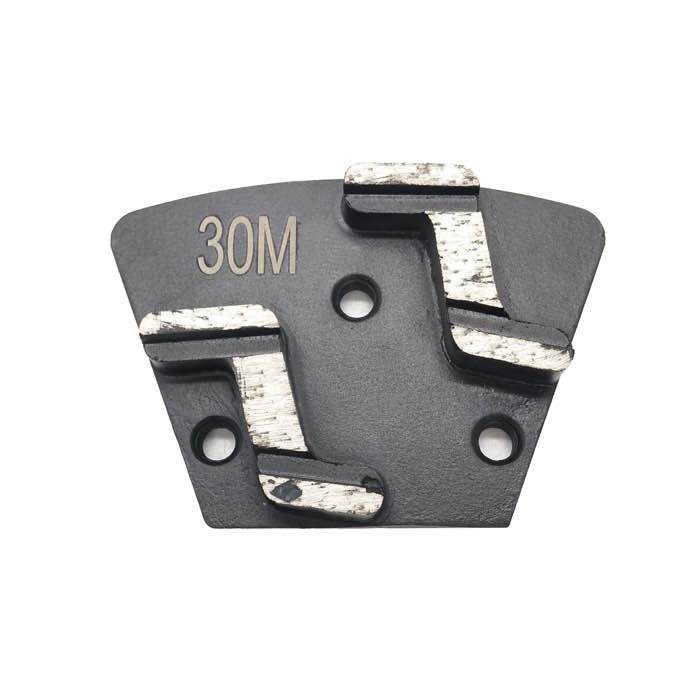
Use metal bond tools for aggressive grinding, coating removal and cutting — they last 5-10x longer and remove material fast. Use resin bond tools for polishing and fine finishing — they produce the smooth, high-gloss surface metal tools cannot achieve. Most concrete floor jobs run metal bond for surface prep (16#-80# grit) and resin bond for polishing (100#-3000# grit).
Metal-bonded diamond tools use a sintered metal matrix — usually copper, iron, cobalt or nickel alloys — that holds diamond particles in place. The tool self-sharpens as the metal wears at a controlled rate, exposing fresh diamond crystals. Metal bond segments are rigid, durable and aggressive, making them ideal for the grinding, cutting and drilling stages of a job.
Resin-bonded tools (often called resin pads) use a phenolic or epoxy matrix with a much softer structure. The resin wears faster and the diamond particles are held less rigidly, producing a finer, more controlled cut. Resin bond is flexible and conforms to uneven surfaces, which is exactly what you need for polishing concrete or stone to a high gloss.
| Feature | Metal Bond | Resin Bond |
|---|---|---|
| Matrix Material | Sintered metal powder (Cu, Fe, Co, Ni) | Phenolic or epoxy resin |
| Primary Use | Grinding, cutting, coating removal | Polishing, fine finishing, honing |
| Durability | Very high (5-10x longer) | Moderate |
| Cutting Speed | Aggressive, fast material removal | Moderate, refining action |
| Surface Finish | Rough to medium (16#-120#) | Smooth to high gloss (200#-3000#) |
| Flexibility | Rigid | Flexible, conforms to uneven surfaces |
| Cost per m² | Lower (longer life) | Higher (faster wear) |
| Best For | Surface prep, leveling, densifying prep | Final polish, gloss, sealing prep |
For a complete metal bond selection, browse JOY TECH's grinding segments and discs, from trapezoid and rhombus segments to diamond cup wheels for edge work.
The best concrete floor process uses both. Typical sequence: metal bond at 30#-40# to grind and level → metal bond 80# to smooth → resin bond 100#-200# to refine → resin bond 400#-800# for sheen → resin bond 1500#-3000# for high gloss. Skipping the metal bond stage and jumping straight to resin pads wastes expensive resin pads on aggressive work they weren't designed for.
A: No. Resin pads are too soft for coating removal. Use metal bond or PCD tools first, then switch to resin for polishing.
A: Metal bond tools typically last 5-10 times longer than resin pads. Resin pads wear because they are designed to break down for a fine finish.
A: Metal bond tools polish only up to a medium sheen (about 120#-200# equivalent). For a high-gloss finish, you need resin bond pads from 400# up.
A: Switch after the surface is flat and scratch-free from metal grinding (typically after 80#-120# metal bond), then start resin polishing at 100#-200#.
Metal bond and resin bond tools are not competitors — they are partners in the same process. Metal bond does the heavy work: grinding, cutting, coating removal. Resin bond delivers the finish. Choose metal for speed and durability, resin for gloss, and use both in sequence for professional results. Start with a well-matched metal bond grinding segment set, then finish with resin pads for a floor that sells itself.
