Average response time: under 24 hours
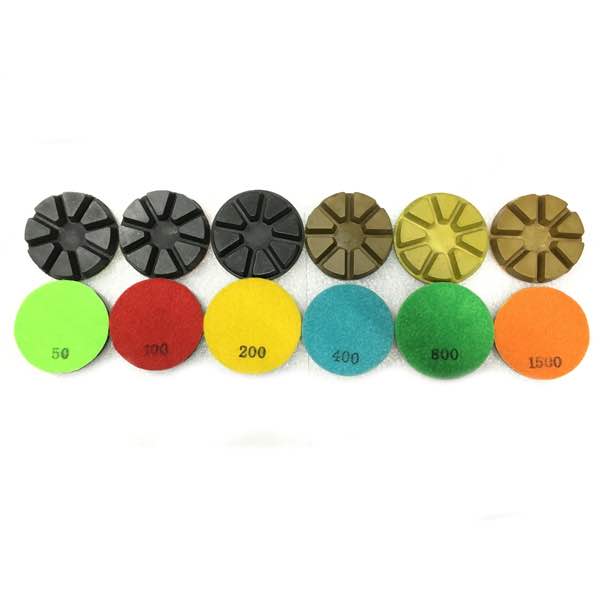
After metal-bond grinding (16–120 grit), you cannot jump straight to resin polishing — the deep metal scratches will show through. A copper-bond or hybrid transition pad (50, 100, 200 grit) removes the metal scratches in 1–2 passes each and prepares the surface for resin. Without hybrid pads, you need 3–4 extra resin steps and you still get visible scratch marks under raking light. Hybrid pads cut the grit sequence by 30 %.
Metal-bond grinding discs leave scratches that are 0.05–0.1 mm deep. Resin polishing pads are soft and conformable; they polish the peaks but cannot pull out those deep scratches. If you go from a 120-grit metal disc straight to a 100-grit resin pad, the resin pad wears itself flat trying to keep up, and the floor looks hazy under raking light. Hybrid pads — copper-bond or resin-over-grit — are hard enough to cut but soft enough to transition into resin steps.
| Step | Bond type | Grit | Purpose |
|---|---|---|---|
| 1–3 | Metal bond | 16 / 30 / 60 | Level, open the slab |
| 4 | Metal bond | 120 | Final metal scratch pattern |
| 5 | Copper / hybrid | 50 / 100 / 200 | Remove metal scratches |
| 6–8 | Resin | 400 / 800 / 1500 | Gloss build |
| 9 | Resin / burnish | 3000 | Mirror finish |
Copper-bond transition pads hold diamond in a copper matrix that wears faster than metal but slower than resin. They cut the floor in 1–2 passes and leave a surface that the resin pad can immediately polish. Our typhoon-type hybrid pads combine copper and resin in the same puck so one pad covers both transition and first resin step, cutting the pad count.
On very soft concrete (below C25), or when you are starting at 120 grit metal bond on an already-polished floor, hybrid pads are sometimes skipped. Also on a honed (matte) finish that stops at 400 grit, hybrid pads may be unnecessary. For any floor you plan to polish above 800 grit, hybrid pads are not optional — they pay back on pad count alone.
Match the hybrid grit to the last metal grit you ran. If you finished metal at 120 grit, start hybrid at 100–150 grit, then move to 200. If you finished metal at 60 grit (aggressive grind), start hybrid at 50. White resin pads after hybrid give the cleanest contrast on dark concrete; natural grey resin on light slabs is fine. Ask the factory for a sample set so you can test the sequence on your own slab before committing to a full order.
A: 1–2 passes, same as a resin step. If you need more than 2, your metal bond left too deep a scratch pattern.
A: Yes, most copper-bond transition pads are water-compatible. Wet use extends pad life but slows cutting slightly.
A: Yes — a set of 3 hybrid grits costs less than the 4–5 resin pads you would otherwise burn through.
A: Yes, that is exactly their purpose. They are designed to take over from metal bond.
Hybrid pads cost roughly USD 4–8 per pad, depending on size and grit. A typical 700 mm grinder carries 6–8 pucks, so a full set of three hybrid grits costs about USD 100–180. Without hybrid pads, you burn 3–4 extra resin pads per step at USD 6–10 each, plus the extra machine time. On a 500 m² floor, the hybrid route is USD 80–120 cheaper per job — before counting the lower defect rate. The only scenario where hybrid pads do not pay back is a honed floor that stops at 400 grit, where the scratch pattern is not visible anyway.
Hybrid pads are the bridge between grinding and polishing. Skip them and you pay in extra resin pads and hazy floors. Specify them in every polishing sequence above 400 grit. Contact JOY TECH for a hybrid pad sample set matched to your machine and slab.
Written and reviewed by JOY TECH — an SGS & BV audited, CE/RoHS certified diamond tools manufacturer founded in 2004, exporting to 50+ countries.
Our factory and QMS are audited by SGS and Bureau Veritas. Products meet CE/RoHS requirements and every piece is 100% inspected before packing.
Verified Certificates
