Average response time: under 24 hours
OEM means the factory makes your own specification - you own the formula, drawings and tooling; ODM means you pick the factory proven design and put your brand on it. The short decision rule: choose ODM if you are testing a new category, want speed and low upfront cost, and have no engineering resources; choose OEM once you have proven volume, a performance need off-the-shelf tooling cannot meet, and want competitors unable to copy your tooling. Most distributors start ODM and move to OEM as volume grows.
| Dimension | OEM (your spec, factory makes) | ODM (factory design, your brand) |
|---|---|---|
| Cost structure | Higher unit price at low volume plus one-time tooling or development cost; best unit price at 500-1,000+ pcs per SKU | Low entry cost; no tooling fee; unit price flat from 100-200 pcs per SKU |
| Intellectual property | You own the formula, drawings and molds (get it in writing, sign NDA); differentiation is defensible | The factory design stays in its catalog - competitors can source the same tool |
| Speed to market | Slower: 8-14 weeks including sample rounds and tooling | Fast: 2-4 weeks from catalog selection to shipping |
| Control over the product | Full: bond, grit, geometry, packaging all to your drawing | Limited: cosmetic branding (logo, box) plus small tweaks like segment height or bond hardness |
| Risk profile | Higher upfront risk: development cost tied up; lower market-copy risk once proven | Low financial risk: test a market with small orders; risk of commoditization |
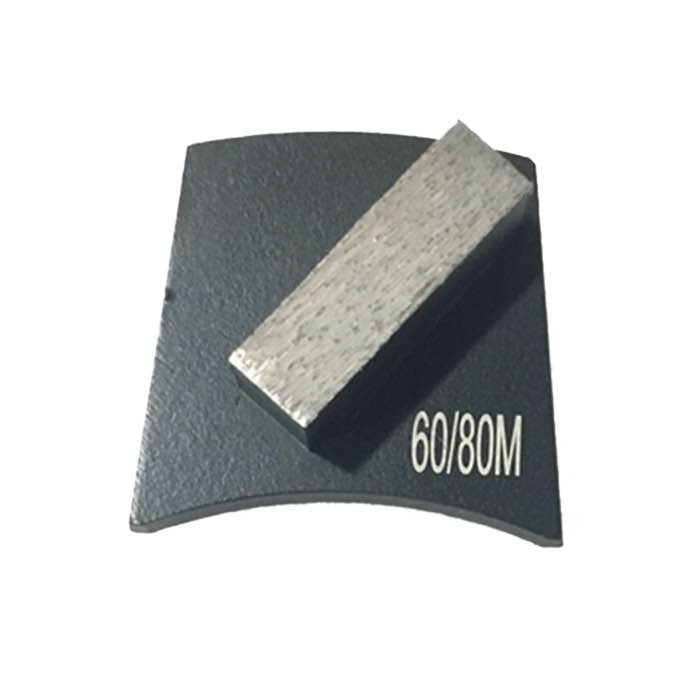
A distributor entering concrete grinding tooling for the first time usually picks ODM: stock discs and pads with logo marking, tested on a few key accounts, then reordered. A flooring contractor building a private-label consumables line - grinding shoes such as the Diamond Trapezoid Grinding Disc (JOY-TP-R3) and polishing pads Diamond Resin Polishing Pads for Concrete Terrazzo Floor (JOY-RFP-01) - usually lands between: ODM products now, OEM tuning later as crews standardize. A specialist brand selling into one demanding application - core drilling, or stone cutting like the Marble Saw Blade (J-Slot) - JOY-MS-J range - usually goes OEM from the start, because the application itself is the brand.
You do not have to choose forever. The common path is ODM to validate market fit - pick proven tooling, brand it, sell it, learn what your customers actually complain about - then OEM to lock in the winners: tune the bond for your local concrete, change the segment layout, and own that version. This sequence de-risks development: tooling money is spent only on SKUs that already sell.
A: No. OEM starts from a few hundred pieces per SKU plus a one-time tooling fee (indicative $300-$2,000 per mold). What matters more than size is a spec worth making: a drawing, a sample to match, or clear performance targets.
A: Yes, because ODM tooling comes from the factory existing catalog. That is why ODM wins on speed and entry cost, while OEM wins on defensible differentiation. OEM tooling and formula should be contractually yours, with an NDA and written IP clauses.
A: As an indicative range: ODM ships in 2-4 weeks from a confirmed order; OEM runs 8-14 weeks the first time (brief, sample rounds, tooling), then repeat orders drop back to 25-40 days because the tooling exists.
A: OEM, once you are at 500-1,000+ pieces per SKU: the factory skips catalog markup and tunes the bond to your exact application, usually giving both a better price and longer tool life. Below roughly 300 pieces per SKU, ODM is almost always cheaper because no tooling fee needs amortizing.
Use the comparison table: ODM for fast, low-risk market entry; OEM for volume, differentiation and defensible IP. JOY TECH offers both paths - ODM programs from stock lines like grinding discs, polishing pads and Diamond Core Drill Bits (Wet) - JOY-DCB-W with logo marking, and OEM programs for buyers who send a drawing or a sample to match. Tell the factory your annual volume and what makes your customers choose you, and it will recommend which path fits.
Written and reviewed by JOY TECH — an SGS & BV audited, CE/RoHS certified diamond tools manufacturer founded in 2004, exporting to 50+ countries.
Our factory and QMS are audited by SGS and Bureau Veritas. Products meet CE/RoHS requirements and every piece is 100% inspected before packing.
Verified Certificates
