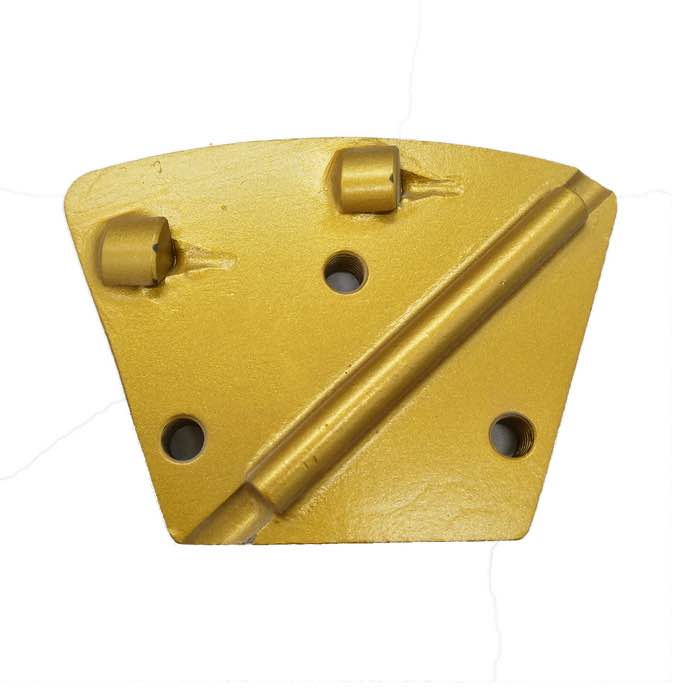
For thick epoxy (over 2 mm), self-leveling urethane, and soft mastic, double-row PCD shoes remove coating faster than single-row because two cutters engage the film at once. Single-row or one-piece PCD blades work better on thin varnishes, glue residues, and when you need a clean scrape that does not dig into the concrete beneath. Double-row PCD also builds up less heat because the cutters cool between passes, which reduces resin loading. Choose double-row for heavy industrial build-outs and single-row for light maintenance and edge work.
Polycrystalline diamond (PCD) is a sintered diamond layer brazed onto a steel blank. Unlike metal-bond diamond segments, PCD does not grind concrete; it chips and shears the coating. That is why PCD glazes quickly on bare concrete and why it is always followed by a metal-bond diamond step to refinish the slab.
| Feature | Single-Row PCD | Double-Row PCD |
|---|---|---|
| Cutting edge | One PCD strip | Two staggered PCD strips |
| Best coating thickness | 0.1-1.5 mm | 1.5-5 mm and above |
| Concrete aggression | Lower, cleaner scrape | Higher, can scratch slab |
| Heat buildup | Higher | Lower, staggered gaps cool |
| Production rate | Moderate | Up to 2x faster on thick film |
Products like the WerkMaster PCD Tooling for Coating Removing (JOY-WM-PCD1R1) and WerkMaster PCD Tooling for Epoxy Floor Removing (JOY-WM-PCD1S1) are engineered as dedicated coating-removal PCD sets, while standard trapezoid PCD blades such as the Double Zigzag Segment Diamond Trapezoid Grinding Disc (JOY-TP-ZG2) style are a flexible choice for mixed jobs.
A: Usually not in one pass. Take two or three shallow passes to avoid loading the PCD and overheating the machine motor.
A: Yes, lightly. Follow with a 30/40 or 40/60 metal-bond pass to remove the scratch pattern before applying new coating.
A: On thick epoxy, expect 200-500 m2 per set depending on coating type. On bare concrete, PCD wears almost instantly, so do not use it as a grinding tool.
A: Dry with dust extraction is standard. Wetting softens some mastics but creates slurry and can clog the PCD gaps.
PCD shoes are more expensive up front than metal-bond diamonds, but on thick coatings they pay for themselves in hours because a PCD set strips more square meters per shift. Keep two sets per machine: one working, one dressed and cooling. When a PCD stops biting, do not push harder; dress it on an abrasive concrete test pad for thirty seconds to clear loaded resin. On long coating-removal contracts, ask your supplier about PCD segments with a cooling slot, which reduces heat buildup and extends life by roughly 20% on hot summer jobs.
When sourcing PCD tooling, ask whether the diamonds are brazed or sintered onto the carrier. Brazed PCD chips off under heavy load; sintered PCD lasts longer but costs more. For coating-removal crews running multiple machines, the sintered option almost always wins on total cost.
For crews new to PCD, start with a single-row set to learn the feel, then move to double-row once you can judge coating thickness by eye. The learning curve is short and saves expensive mistakes on thick industrial coatings.
Match the PCD row count to the film thickness: double-row for heavy epoxy and self-levelers, single-row for thin residue and cleanup work. Always budget a follow-up metal-bond grinding pass, and dress loaded PCD on a dressing brick rather than forcing the cut.
