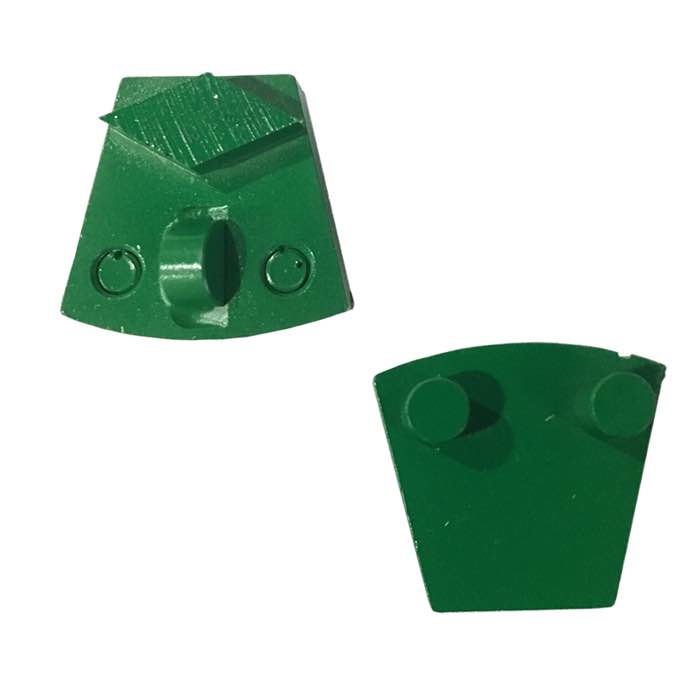
For 2 mm and thicker epoxy or self-leveling polyurethane, chip-style PCD usually outperforms flat PCD bars. The chip's tungsten-carbide leading edge bites and curls the coating before the PCD face takes over, which prevents soft epoxy from melting and loading the diamonds. A flat (full) PCD bar cuts best on thin films, tacky adhesives and residue left after a first pass. For a typical warehouse recoat over 2–3 mm old epoxy, start with chip PCD at low RPM, then finish with flat PCD or a 30/40 metal-bond disc to remove smear. Tooling such as WerkMaster PCD Epoxy Tooling (JOY-WM-PCD1S1) is a proven chip-style PCD for WerkMaster and compatible planetary grinders; WerkMaster PCD Tooling (JOY-WM-PCD1R1) is the flatter bar used for residue and thin coatings.
PCD stands for polycrystalline diamond: a layer of synthetic diamond particles sintered onto a tungsten-carbide substrate. Unlike metal-bond diamond segments, PCD does not rely on bond wear to expose new diamonds—the diamond layer is enormous and sharp, so it shears through soft coatings like a blade. It is the right tool for any non-concrete material: epoxy, PU, polyurethane, mastic, glue, rubber, bitumen and waterproof membranes.
| Feature | Flat PCD bar | Chip PCD |
|---|---|---|
| Leading edge | Straight PCD face | Tungsten chip + PCD face |
| Best coating thickness | <1 mm, residue, glue | 1–5 mm epoxy, PU, self-leveler |
| Cutting action | Scrapes/peels | Bites and curls |
| Resists loading | Good on thin films | Excellent on thick, soft film |
| Concrete aggression | Moderate | High—use light pressure |
| Speed on 2 mm epoxy | Slow, loads up | Fast, continuous peel |
Thick epoxy is thermoplastic: friction heats it, it softens, and it sticks to the tool. A flat PCD bar relies on the diamond face to shear, but when the epoxy melts, it coats the diamond layer and stops the cut. The chip-style design puts a small tungsten tooth ahead of the PCD. That tooth:
On 2 mm self-leveling epoxy, crews using chip PCD typically cover 60–120 m²/hour; flat PCD on the same coating often drops to 20–40 m²/hour before loading.
Do not default to chip PCD. Flat PCD is the right choice when:
A: Yes. At 2 mm and above, chip-style PCD peels the coating in ribbons and resists loading far better than a flat PCD bar. Reserve flat PCD for residue and films under 1 mm.
A: On 2 mm epoxy, expect 300–800 m² per set of 3 shoes, depending on coating hardness and concrete abrasiveness. Concrete below the coating wears the tungsten chips over time.
A: Yes, with a PCD cup wheel. It is slower than a planetary grinder but works for edges, stairs and patches. For open floors, a walk-behind grinder with WerkMaster PCD Epoxy Tooling (JOY-WM-PCD1S1) outproduces hand work many times over.
A: Yes. PCD leaves a smear and a light scratch. Follow with a 30/40 or 6/16 grit metal-bond disc to open the concrete to the CSP profile your new coating requires.
For thick epoxy removal, choose chip-style PCD as the primary tool and flat PCD or metal-bond for cleanup. The chip's tungsten leading edge is the difference between a fast peel and a loaded-up wheel. Build your workflow around WerkMaster PCD Epoxy Tooling (JOY-WM-PCD1S1) for the first pass and WerkMaster PCD Tooling (JOY-WM-PCD1R1) or WerkMaster Single S Segment (JOY-WMS-S1) for the second, and you will strip 2 mm epoxy faster and cleaner than crews still relying on flat PCD bars.
