Average response time: under 24 hours
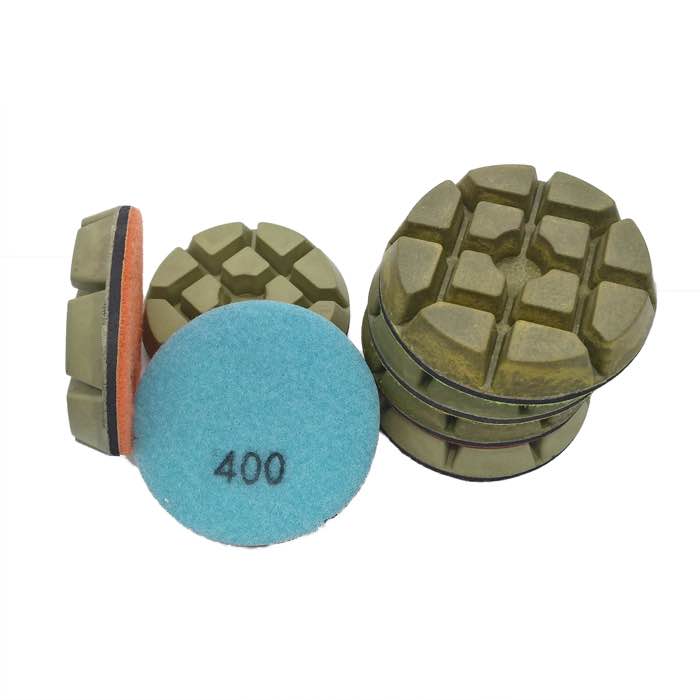
Yes, you can polish a small concrete area up to about 30 m² with a standard 17-inch floor buffer running at 175-350 RPM, using diamond resin pads from 50 grit through 1500 or 3000 grit, with a lithium densifier applied between the 100 and 400 grit steps. Expect 6-8 pad changes and roughly 2 hours of work for a 20 m² garage. The buffer will not match the flatness of a planetary grinder on large floors, but it is perfectly adequate for garages, basements, and small utility rooms.
A single-disc floor buffer spins at roughly 175 RPM on low speed or 350 RPM on high speed. It applies pressure through the operator, not through a weighted head. That means it will grind and polish, but it will not remove high spots, cure an uneven slab, or open up a scratched old floor like a three-head planetary grinder. Use it on a reasonably flat slab that has already been ground with a walk-behind grinder, or on a newer slab that only needs polishing.
For small patches, garage corners, or touch-ups after a larger job, a buffer is the right tool. It is lighter, cheaper to rent, and easier to maneuver than a planetary machine. On larger floors, however, the single-disc path leaves visible swirl patterns that the planetary cross-hatch would have hidden.
Look for a 1.5 hp or larger motor, a pad driver that accepts hook-and-loop diamond pads, and a weight of at least 35 kg. The diamond resin polishing pad set from JOY TECH uses a 17-inch diameter that fits standard buffer drivers. Avoid cheap household buffers under one horsepower; they will bog down under load and leave uneven swirls. A variable-speed buffer lets you slow down for coarse grits and speed up for final burnishing.
Run the pads in strict grit order; skipping a grit leaves scratches that later pads cannot remove. Never jump more than one grit size between passes. A standard sequence for a small garage floor is 50 grit to open the slab and remove trowel marks, then 100 grit to refine and prepare for densifier. Apply lithium densifier, let it dwell, and burnish off excess. Continue with 200 grit, then 400 grit after the densifier has cured, then 800 grit, 1500 grit, and 3000 grit for a high shine.
Do not skip densifier between 100 and 400 grit. Without it, the surface will not harden enough to take a mirror finish, and the floor will dust for years. The resin floor pad progression is designed to work with the densifier step, and the bond hardness is matched to concrete slabs.
Each diamond pad removes the scratches left by the previous pad. If you jump from 100 grit straight to 400, the 400 pad cannot cut deep enough to remove the 100-grit scratch pattern. Those scratches become visible in the afternoon sun and in artificial light at night. The cost of one extra pad pass is 10 minutes; the cost of going back to repair a skipped grit is half a day.
Start by sweeping and mopping the slab. Any grit left on the floor will scratch the finish. Put the 50-grit pad on the driver, lower the buffer, and walk it slowly across the floor in overlapping passes. Walk at about one meter per minute, not faster. Pick the slurry up with a wet-dry vacuum between grit steps. After 100 grit, spray the lithium densifier on at about 5 m² per liter.
Let the densifier soak in for 20-40 minutes, misting with water if it starts to dry. Burnish the residual slurry with a white pad, then proceed through 200, 400, 800, 1500, and 3000 grit. Finish with a burnishing pad at high speed for the final gloss. Walk the floor at grazing light between pads to check for missed scratches.
A true polish requires resin pads through 800 grit or finer. A simple burnish, by contrast, uses a high-speed machine at 1500 RPM with a brown or black pad on a slab that has already been densified. If you only need a sheen for a showroom floor, burnishing alone is enough. If you need the reflective mirror look, you must go through the full resin pad sequence.
If the slab has noticeable lippage, deep trowel marks, or a previously coated surface, the buffer will not flatten it. Rent a two-head or three-head planetary grinder for the first 50-100 grit passes, then switch to the buffer for polishing. For a small garage where the slab is already flat, the buffer alone will do. If you need a denser pad for the transition grind, a 3-step resin pad set shortens the sequence without sacrificing the final gloss.
Rinse each pad with water after use and hang it to dry. Pads last roughly 1,500-3,000 m² depending on concrete hardness. Inspect the hook-and-loop backing every few jobs; once the hooks wear out, the pad will spin on the driver and leave circular marks. Store pads flat, not rolled, to keep them from cupping on one edge.
Written and reviewed by JOY TECH — an SGS & BV audited, CE/RoHS certified diamond tools manufacturer founded in 2004, exporting to 50+ countries.
Our factory and QMS are audited by SGS and Bureau Veritas. Products meet CE/RoHS requirements and every piece is 100% inspected before packing.
Verified Certificates
