Average response time: under 24 hours
A gloss meter reads how much 60-degree light reflects off your polished concrete in gloss units, or GU. Floor under 30 GU is honed, 40-60 GU is moderately polished, 70-90 GU is high-polish, and anything over 90 GU usually means a burnished floor. Take 5 to 10 readings per 100 square meters, average them, and judge uniformity from the spread: a good floor reads within about 5 GU of its average. Low or uneven readings almost always trace back to pad pressure, grind history, or trapped moisture, not to bad concrete.
A handheld gloss meter fires a beam at a fixed angle, usually 60 degrees, and measures the light that bounces straight back. On polished concrete the reading is in gloss units, where 0 is flat matte and 100 is a near-mirror. Most manufacturers of floor meters calibrate on a black glass reference tile around 93 to 95 GU, so numbers from different meters on the same slab will usually agree within 2 to 3 GU. Do not compare a 20 degree reading with a 60 degree reading; they measure different things.
Concrete is not glass. Aggregate pockets, trowel marks, densifier patches, and footprints of equipment all scatter light differently. A floor that looks stunning under work lights can still show a 10 GU spread when measured properly. That spread, not the peak reading, is what clients notice on delivery day. If the average is 65 GU but one corner reads 42 GU, you have a uniformity problem to chase down before signing off.
Readings below 30 GU describe a floor that has been metal-grinded to at most a 200 or 400 grit resin pass. It looks matte to satin, reflects furniture only as a blurred shape, and shows little or no mirror. This is the look you want for retail feature floors that hide dust, or for industrial floors where glare would interfere with VDT work. If the contract specified a polished floor at 40 GU minimum and you read 22 GU, the floor is one or two resin grit steps short.
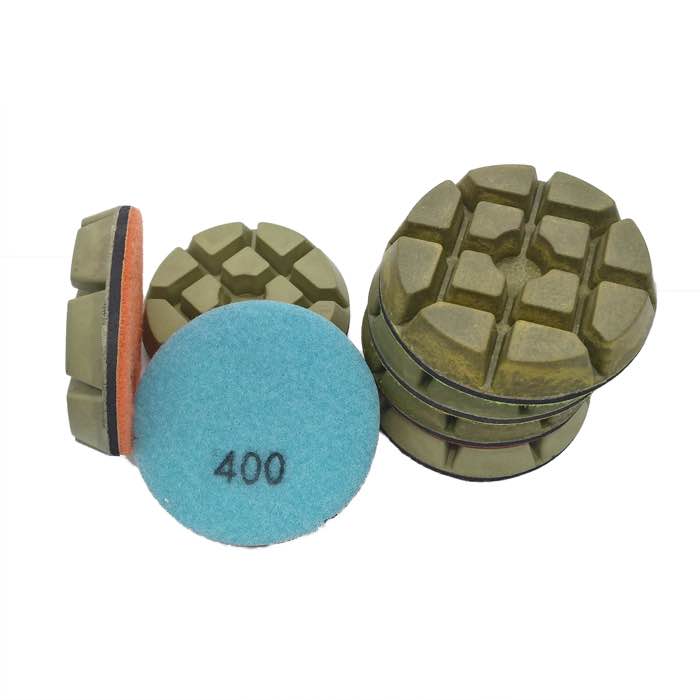
The commercial sweet spot for most warehouses, showrooms, and grocery stores sits between 40 and 60 GU. This is the range you reach after a 400, 800, and 1500 grit resin sequence with a lithium densifier applied at the 200 or 400 step. At 50 to 60 GU, light fixtures show up as soft reflections and people read the floor as glossy but not mirror-like. To get here reliably, run your resin sequence on a JOY RFP-01 diamond-resin pad set, which is the standard 7-step progression for terrazzo and retail slabs.
Above 70 GU the floor starts to throw sharp reflections of lights, columns, and people. This level needs a full sequence up to 3000 grit, usually with a densifier reapplication between the 800 and 1500 steps. At 80 GU and above you are bordering on burnish territory; most contractors finish with a dedicated pad like the JOY RFP-02 resin pad at the final step rather than pushing the same pad past its life.
A wet slab reads artificially high, because the water film acts like a clear coat. Dust, sealer overspray, and cleaner residue also skew readings: oily residue can knock 10 GU off a spot, while a fresh burnish on a dirty pad can read 20 GU hot for an hour. Always read the floor dry and clean, at least 24 hours after any wet process. If numbers look too good to be true, wipe a square meter with denatured alcohol, let it dry 10 minutes, and re-read. A genuine mirror floor will hold; a residue floor will drop back to its real number.
The most common hidden defect is skipped grit. A floor ground 30, 80, then jumped straight to 400 will read 35 GU in open areas but 55 GU next to walls where the machine overlapped longer. The fix is never more pads; it is re-running the missing grit. Walk the slab with the meter, mark the low spots, and grind them back to the last full grit before continuing. When you are rebuilding a progression, matching grit density across the whole area with sharp resin pads keeps readings consistent lane to lane.
Your goal on delivery is a documented average plus spread, not a single flashy peak. Before applying guard or densifier, read the floor at the 400 grit step. If you already sit at 35 GU here, you will finish around 60 GU after 800 and 1500. If you sit at 22 GU, the slab is hard or your metal bond is too soft; adjust before wasting resin pads. A practical progression:
After the final resin step, many contractors chase extra gloss with a high-speed burnish. A JOY RFP-02 floor polishing pad at 1500 rpm adds 5 to 10 GU but costs some of the floor's natural depth. Use it when the client wants shine, not as a rescue for a floor that reads low.
Measure in the morning before sun hits the slab, because direct sun shifts readings by 8 to 12 GU on dark aggregate. Hold the meter flat, take three readings within one meter of each point, and log them. Compare the average to the spec, then compare the spread to 5 GU. Deliver both numbers to the client on a printed sheet. If the floor needs a top-up after a season of traffic, a burnishing pad like the JOY RFP-BP2 on a 700 to 1500 rpm machine is the standard way to recover 6 to 10 GU without grinding. When readings still will not stabilize on a new slab, talk to your densifier supplier before applying sealer; densifier and sealer choices change the numbers permanently.
Written and reviewed by JOY TECH — an SGS & BV audited, CE/RoHS certified diamond tools manufacturer founded in 2004, exporting to 50+ countries.
Our factory and QMS are audited by SGS and Bureau Veritas. Products meet CE/RoHS requirements and every piece is 100% inspected before packing.
Verified Certificates
