Average response time: under 24 hours
Grind and polish the existing slab when the concrete is sound and you want the most durable, lowest-cost result. Use an overlay when the slab is badly damaged, too thin, or has a surface you cannot expose, and you need a fresh level surface. Overlays add 3-10 mm of material and a new polishable face; grinding keeps the original slab but cannot fix deep damage, cracks, or a surface with heavy contamination. Cost usually favours grinding; overlay favours damaged slabs.
Grinding and polishing the existing slab is cheaper, faster, and more durable because there is no bonded layer to delaminate. It works when the slab is flat enough (within about 3-5 mm over 3 m), the surface is not deeply contaminated, and the concrete is dense enough to polish. Grinding exposes the aggregate and produces the classic polished concrete look with the floor's own stone. Repairs such as crack filling and patching are done first, then the whole floor is ground to one level.
Choose an overlay when the slab has spalled, scaled, or badly stained surfaces that would need excessive grinding, when the slab is too thin to grind without hitting the reinforcement, or when the floor must gain a defined height. Overlays also fix uneven slabs by levelling in one step. A self-levelling or trowelled cementitious overlay of 3-10 mm is applied, cured, then polished like a new slab. Overlays suit commercial makeovers where the original concrete is past saving, and they give a consistent new surface over mixed or patched substrates.
| Factor | Grind existing slab | Overlay |
|---|---|---|
| Cost | Lower | Higher |
| Thickness added | None (removes 1-3 mm) | 3-10 mm |
| Fixes deep damage | No | Yes |
| Fixes uneven floor | Small dips only | Yes |
| Durability | Excellent | Good, bond-dependent |
Grinding is usually 20-40% cheaper per square metre than a quality overlay, because overlay adds material, labour for placement, curing time, and surface preparation for bond. But a badly damaged slab may need so much repair before grinding that overlay becomes competitive. Get both priced on the actual floor: grind includes crack filling and patching; overlay includes substrate repair, primer, and the overlay material. The polish stages after either option cost the same.
An overlay is only as good as its bond. The substrate must be clean, sound, and profiled: grind or shot-blast the old surface, vacuum thoroughly, and apply a bonding primer before the overlay. Failure to bond causes delamination and blisters. Grinding the existing slab has no bond risk because there is no new layer. If the overlay will be polished, its aggregate content and curing time decide the gloss and wear life; a densifier and resin polishing pads finish it to the same standard as a ground slab.
Assess the slab first: check for deep damage, measure flatness, test for moisture and contamination, and locate the reinforcement depth. If the surface is sound and flat enough, grind and polish. If the concrete is poor or the floor needs levelling, overlay. For borderline cases, a thin levelling overlay over a ground substrate combines both: grind to open the pores, overlay 3-5 mm to level, then polish. Whatever the route, the polish system, densifier, and sealing steps stay the same.
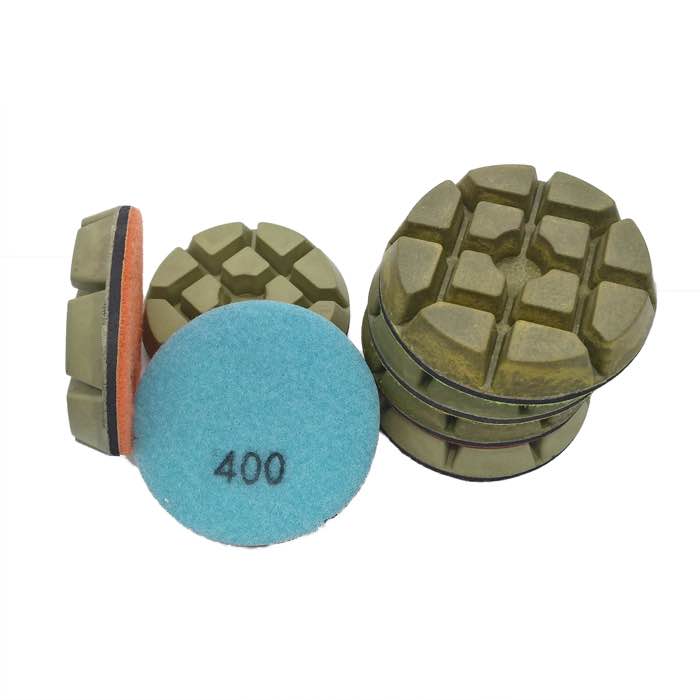
For an even gloss, work through diamond resin polishing pads in the correct grit sequence.
Keep resin floor polishing pads on hand so the finish stages of the floor stay consistent.
Written and reviewed by JOY TECH — an SGS & BV audited, CE/RoHS certified diamond tools manufacturer founded in 2004, exporting to 50+ countries.
Our factory and QMS are audited by SGS and Bureau Veritas. Products meet CE/RoHS requirements and every piece is 100% inspected before packing.
Verified Certificates
