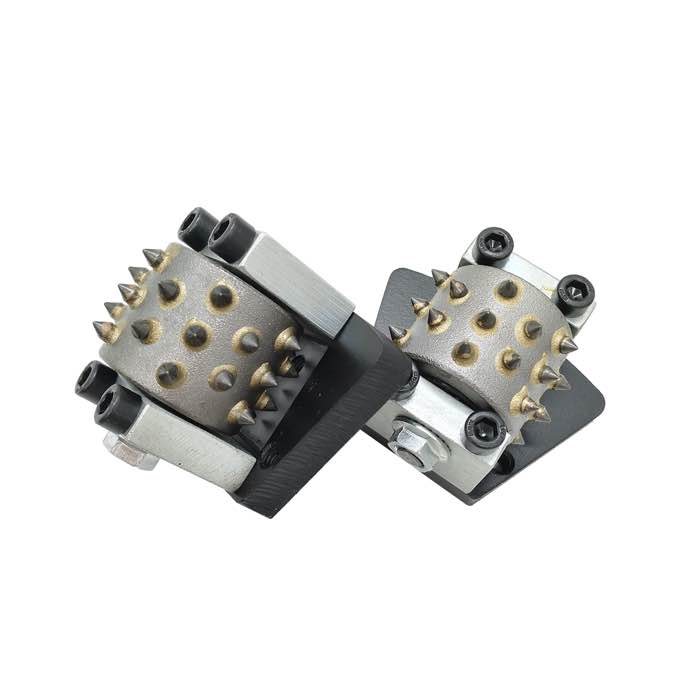
Redi-Lock (also called quick-change or clip-on) plates use spring-loaded pockets that grip a steel lug on the back of the shoe; they are standard on newer HTC, Scanmaskin, and ASL-style machines. Bolt-on plates have two or three through-bolts and are common on older Edco, Blastrac, and Klindex-style equipment. You cannot directly mix the two systems, but many manufacturers sell adapter rings that let Redi-Lock shoes mount onto a bolt-on plate and vice versa. If your grinder is post-2010, it almost certainly uses Redi-Lock; if it pre-dates 2005, you are likely bolt-on. When in doubt, photograph the underside of your existing holder and compare it to the product spec.
A Redi-Lock plate has three spring clips per shoe position. The shoe drops in from above, and the clip snaps over the shoe's rear lug. To remove, you pry the clip open with a screwdriver. The system is fast on the jobsite; crews swap grits in under a minute. The tradeoff is that clips wear out after a year of heavy use and must be replaced.
Bolt-on plates use hex-head or Torx bolts through the steel shoe body into the drive disc. There are no moving clips, so the system is mechanically simple and tolerant of mud and slurry. The downside is speed: changing grits takes five minutes per set, and you need a torque wrench.
| System | Typical Machines | Swap Speed | Service Parts |
|---|---|---|---|
| Redi-Lock | HTC, Scanmaskin, ASL, new Lavina | ~30 sec per shoe | Replacement clips |
| 2-Bolt trapezoid | Edco, Blastrac, old Klindex | ~5 min per set | Loose bolts |
| 3-Bolt / pin | WerkMaster, superabrasive | ~3 min per set | Spring pins |
If you run a WerkMaster machine, tooling like the WerkMaster Single Bar Segment (JOY-WMS-B1) and WerkMaster Double Bar Segment (JOY-WMS-B2) mounts directly on the factory holder, while standard trapezoid shoes like the Diamond Trapezoid Grinding Disc (JOY-TP-R3) may need an adapter ring.
A: Not directly. You will need a bolt-on-to-Redi-Lock adapter ring, or simply order bolt-on shoes built for your existing plate.
A: Usually yes, but there are small family differences between HTC-style and Scanmaskin-style clips. Verify the lug height on your shoe before ordering.
A: Yes, by replacing the drive disc with a Redi-Lock disc. It is worth it if you own the machine long term and change grits often.
A: Worn clips let the shoe wiggle, which creates chatter marks and uneven scratch patterns. Replace clips once they no longer snap audibly into place.
Adapters are a temporary fix, not a long-term strategy. If you are running a mixed fleet of old and new grinders, it is cheaper over a year to buy a second drive disc than to keep swapping adapters. Label each shoe set with a paint marker to show which holder it belongs to; mixing shoes across machines causes rattle and premature wear. When you buy a used grinder, always budget for a fresh set of clips and bolts, because the old hardware is almost certainly fatigued and will fail on the first big job.
Another factor people overlook is thermal expansion. Aluminum drive plates grow slightly when hot, which can loosen bolt-on shoes mid-shift. If you run long shifts in summer, check torque every two hours or upgrade to steel drive discs.
Always keep a few spare clips and bolts in the toolbox. A broken clip on a Friday afternoon can shut a whole job down until Monday if you cannot source a replacement locally.
Identify your holder first, then buy shoes that match it directly rather than relying on adapters. Redi-Lock wins on speed, bolt-on wins on durability and simplicity. When you must cross systems, use a verified adapter ring and re-torque it during the first shift.
