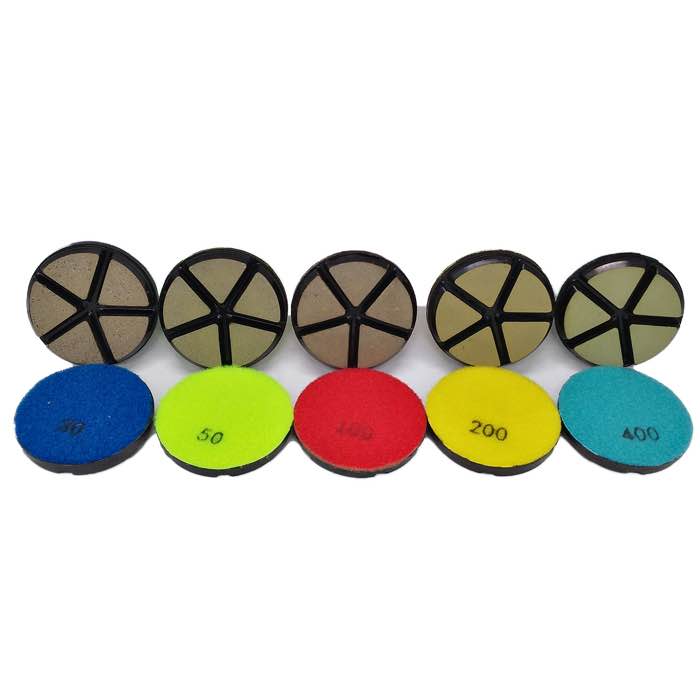
Resin bond pads are the final polishing tools — they refine scratches and produce gloss (800–3000#). Ceramic bond pads sit between metal and resin: they cut more than resin, less than metal, and bridge the scratch pattern (50–400#). Use ceramic for the transition, resin for the gloss.
| Aspect | Resin Bond | Ceramic Bond |
|---|---|---|
| Cutting power | Low — polishes | Medium — cuts and refines |
| Typical grits | 200–3000# | 50–400# |
| Role | Develop gloss | Remove metal scratches, prep for resin |
| Heat tolerance | Lower — burns dry | Higher — good for transitional work |
| Wear | Faster at coarse grits | Slower, more durable |
Our Ceramic Bond Transitional Pads and Resin Polishing Pads are designed to work as a matched pair in this sequence.
For light surface prep on soft concrete, yes. For heavy coating removal or leveling, metal bond is still needed — ceramic doesn't cut that aggressively.
No — ceramic cuts and refines; resin polishes. They're sequential, not substitutes.
Ceramic bond pads typically wear slower than resin at equivalent grits, but resin pads are cheaper and purpose-built for the gloss steps.
Ceramic bond bridges metal to resin; resin bond delivers the gloss. Buy them as a matched system and run them in sequence for clean, predictable results. JOY TECH supplies both bonds in full grit ranges for planetary grinders.
