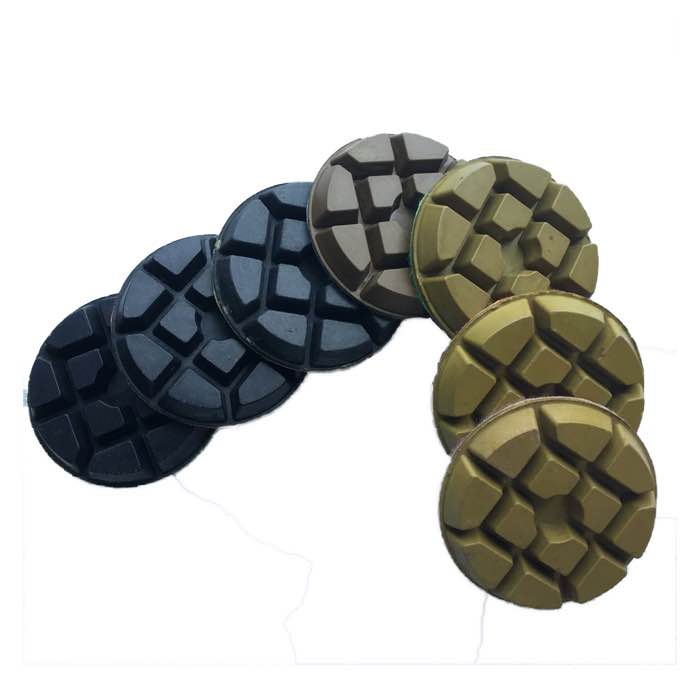
Run resin polishing pads in this order: 50, 100, 200, 400, 800, 1500, 3000 grit. Do not skip steps. Each grit removes the scratches left by the previous one. Most contractors stop at 800 for a satin finish, 1500 for a commercial gloss, and 3000 for a mirror finish.
Resin pads cut by exposing diamond particles in a flexible resin bond. If you jump from 100 to 400, the 400 pad cannot remove the deep 100-grit scratches. The floor will look hazy no matter how long you polish. Skipping grits is the number one cause of "hazy concrete" complaints.
| Grit | Purpose | Result |
|---|---|---|
| 50 | Initial resin grind, opens scratch pattern | Matte |
| 100 | Removes 50 grit scratches | Matte |
| 200 | Refines | Low sheen |
| 400 | "Hemic" gloss begins | Satin |
| 800 | Standard commercial finish | Satin gloss |
| 1500 | High gloss | Wet look |
| 3000 | Mirror finish | Reflection |
Our resin polishing pads is sold as a full 7-step set from 50 to 3000.
Explore the full range in our resin polishing pads category.
A: Yes. If the floor already has a clean 50-grit metal-bond scratch, start resin at 100. But if you can still see 30-grit scratches, go back to 50 resin.
Typically 200-500 m2 per set, depending on concrete hardness. Softer pads (50-200) wear faster; 1500-3000 last longer.
For a true mirror finish, yes. A high-friction burnishing pad at 1500+ RPM brings out the reflection after 3000 grit.
The grit sequence is non-negotiable: 50-100-200-400-800-1500-3000. Skip nothing, keep pads flat, and densify between steps. contact JOY TECH for wholesale pricing on complete resin pad sets.
