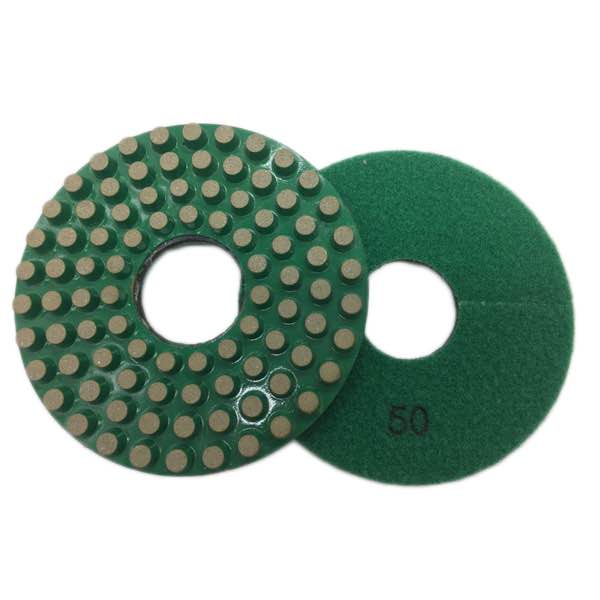
Switch from metal-bond grinding pads to resin-bond polishing pads once the floor is fully flat, open and free of high spots, usually around the 120-220 grit metal stage. The signal is a uniform scratch pattern with no remaining trowel marks, aggregate holes or waves. If you switch too early, resin pads cannot remove deep metal scratches and you waste time; if you stay on metal too long, you over-grind and cost production. A copper-bond or ceramic transitional pad between the two is the key to a clean transition.
Metal-bond diamond pads hold diamonds in a hard metal matrix. They are aggressive cutters designed to flatten, level and open raw concrete - removing mastic, trowel marks and high spots quickly. They leave a deep, uniform scratch pattern. Resin-bond pads hold diamonds in a softer resin that wears away to expose fresh grit. They cut gently and refine the surface, turning the deep scratch pattern into a smooth, reflective finish. They cannot attack the deep scratches metal leaves.
The transition is not a fixed number - it depends on flatness. Make the change when:
Many crews run metal at 30/60/120, then use a Copper Bond Transitional Pad or ceramic transition to erase the 120-grit scratch before resin begins. This bridging step is what prevents ghosting. Then move into resin at 200, 400, 800 and beyond.
| Approach | Result |
|---|---|
| Metal 120 straight to resin 200 | Resin cannot cut metal scratches; ghost marks remain |
| Metal to copper/ceramic transition to resin | Scratch depth matched, clean gloss build |
| Staying on metal too long | Wasted time, over-grinding, uneven wear |
Our Ceramic Bond Transitional Pads sit exactly in this gap - aggressive enough to remove metal scratches but refined enough to feed smoothly into resin polishing.
The biggest error is switching to resin before the floor is flat. Resin pads are not grinding tools; they simply cannot fix waves. The second error is skipping transitional tooling, which leaves the floor permanently scratched at high grit. The third is using the wrong bond hardness - on very hard concrete, a soft resin loads and glazes; on soft concrete, a hard resin polishes slowly.
The single most common cause of a cloudy final floor is a bad metal-to-resin transition. Metal-bond scratches are deep and directional; resin pads at 200 grit are too gentle to remove them, so the scratches survive all the way to 3000 grit and show through as a haze. A copper-bond or ceramic transitional pad exists precisely to bridge that gap - it cuts aggressively enough to erase the 120-grit metal pattern but refines it into a scratch that resin can finish.
Signs you skipped transition include: a floor that looks good at 400 but turns cloudy at 1500, or visible directional lines that do not disappear. If you see these, do not push on with finer pads - back up to a transitional grit and remove the metal scratches properly. Matching bond hardness across the whole sequence prevents the same kind of mismatch between resin grits too.
Run your final metal grit across a test strip, then immediately run the transitional pad. If the transitional pad changes the scratch pattern uniformly and quickly, the floor is ready. If it struggles, the metal stage needs another pass. This quick test prevents committing to resin before the substrate is truly flat.
A: No. The scratch depth is too great. Progress through metal steps and a transition first.
A: Usually after the floor is opened (around 150-200 grit metal), let it cure, then continue into resin refinement.
A: It should cut steadily without glazing or wearing in minutes. If it loads up, go softer; if it wears too fast, go harder.
Let flatness - not a fixed grit - tell you when to leave metal behind, and bridge the gap with a transitional pad before resin polishing. That discipline is what separates a cloudy floor from a clean gloss. The takeaway is that the metal-to-resin transition is the make-or-break moment. Use a transitional pad, confirm flatness, and the rest of the sequence flows smoothly. Skipping this step is the most common cause of cloudy final floors. Contact JOY TECH for a quote on metal, transitional and resin pads matched to your concrete.
