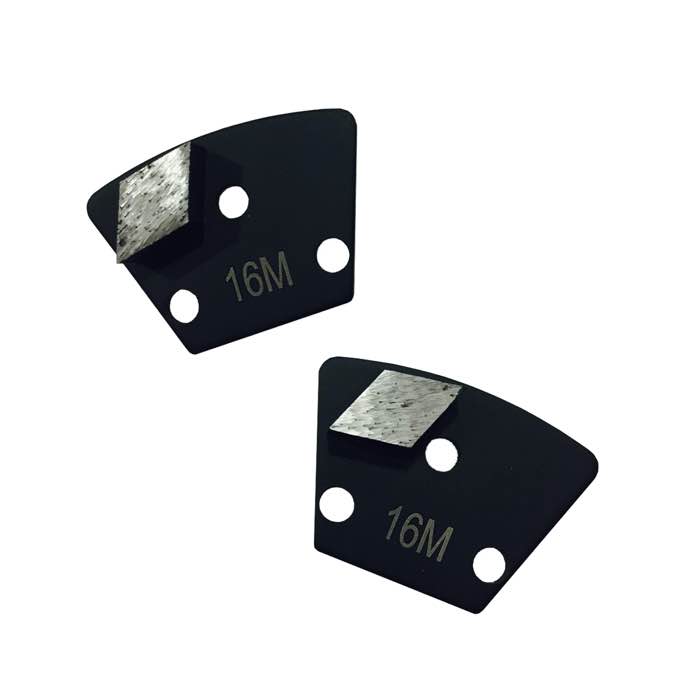
The standard concrete grinding sequence moves from coarse metal bond (30/40 or 50/60) through medium metal bond (80/100) to resin bond pads (120 → 200 → 400 → 800 → 1500 → 3000). Start coarse enough to remove the heaviest scratches, then step up grits without jumping more than one step at a time. Skipping grits is the most common mistake — it leaves deep scratches that only appear after polishing.
Each diamond grit leaves scratches of a certain depth. The next grit in the sequence must be fine enough to remove the previous scratches, but coarse enough to still cut efficiently. If you jump from 50/60 metal straight to 200 resin, the 200 grit cannot remove the deep 50/60 scratches — they will show through the final polish as grey lines. The full sequence is not optional; it is the difference between a good floor and a great one.
| Step | Grit | Tool Type | Purpose |
|---|---|---|---|
| 1 | 30/40 | Metal bond | Remove coatings residue, heavy scratches, level high spots |
| 2 | 50/60 | Metal bond | Remove 30/40 scratches, open the concrete surface |
| 3 | 80/100 | Metal bond | Refine surface, remove 50/60 scratches |
| 4 | 120 | Resin bond | Transition from grinding to honing |
| 5 | 200 | Resin bond | Honing, remove 120 scratches |
| 6 | 400 | Resin bond | Begin densifying/polishing stage |
| 7 | 800 | Resin bond | Polish, bring up sheen |
| 8 | 1500 | Resin bond | High polish |
| 9 | 3000 | Resin bond | Mirror finish (optional, wet recommended) |
Metal bond tools (steps 1–3) grind concrete aggressively and are used for surface preparation. Resin bond pads (steps 4–9) are for honing and polishing — they are softer and leave a smooth, glossy finish. The transition point (usually at 120 grit) is the most common place people fail: going into resin too early leaves metal scratches; staying in metal too long over-grinds the surface. Our single rhombus trapezoid grinding disc covers the coarse metal steps, and the spiral resin polishing pads handle the finish.
A: Sometimes you can skip the very coarsest step on soft concrete, because the surface is easier to refine. But never skip more than one grit step at a time, and check the surface between steps for visible scratches.
A: Metal bond tools grind and prepare the concrete (steps 1–3). Resin bond pads hone and polish (steps 4–9). Resin is softer, wears faster, and leaves the glossy finish; metal is aggressive and removes material.
A:It depends on the floor, machine, and how much material you need to remove. As a guide: 2–4 overlapping passes per grit on a planetary grinder, checking the surface after each pass and stopping when the previous scratches are gone.
A: Wet polishing with resin pads (especially 800 and above) gives a better mirror finish and keeps pads cooler. Dry polishing works too, but the finish is usually slightly less glossy and the pads wear faster.
A: Satin/matte finish: stop at 400–800 grit. Semi-gloss: finish at 1500. Mirror gloss: finish at 3000 (wet) and apply a polish guard. Choose the sequence length based on the finish your client specifies.
The concrete grinding sequence is simple in theory and unforgiving in practice: start coarse, step up one grit at a time, and clean between steps. From coarse metal bond segments to 3000-grit resin pads, every step removes the scratches of the last. With quality tools like our double rhombus trapezoid grinding discs and spiral resin polishing pads, you will get a uniform, professional floor every time. Contact JOY TECH for a complete grinding sequence kit matched to your machine.
