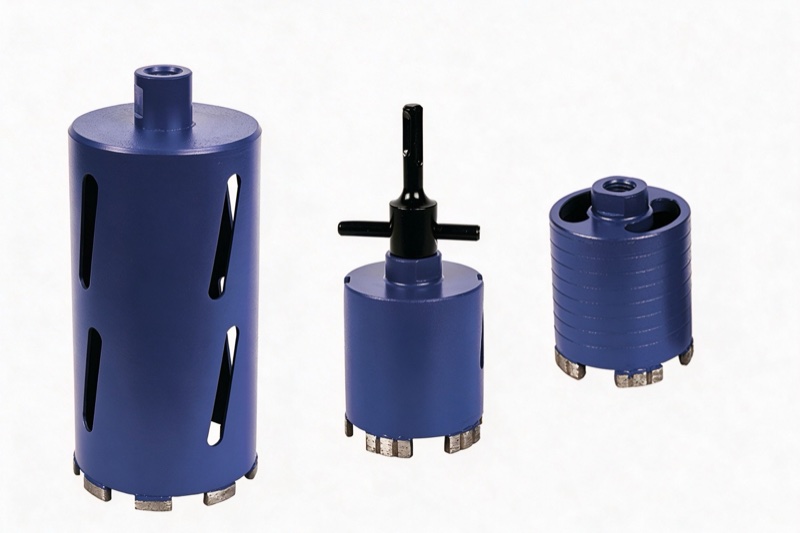
Use a wet diamond core bit for reinforced concrete, deep holes, and large diameters, because water cools the bit, flushes slurry, and extends segment life. Use a dry core bit for shallow holes in brick, block, and masonry where no water is available. The two are not interchangeable: a dry bit run wet loses its designed bond, and a wet bit run dry overheats and glazes within minutes.
A wet bit like our wet diamond core drill bit uses a medium-to-hard bond and laser-welded segments that thrive under water cooling. A dry core bit uses a softer bond and often slots or U-shaped segments to clear dust by air. Dry bits rely on air cooling and dust extraction, so they must never be run with water.
| Feature | Wet core bit | Dry core bit |
|---|---|---|
| Material | Reinforced concrete, stone | Brick, block, lightweight masonry |
| Cooling | Water flow | Air / vacuum |
| Diameter range | Up to 500 mm+ | Typically 25-150 mm |
| Depth | Deep holes with rig | Shallow, hand-held |
| Rebar | Cuts through | Avoids |
Electricians and plumbers drilling 50-110 mm holes in block walls for conduits prefer dry bits: no water mess, quick setup, and a vacuum shroud controls silica. Dry bits should not be forced through rebar; if the drill bites steel, stop and switch to wet coring.
Plumbing penetrations through reinforced slabs, core samples, and large HVAC holes demand wet coring. The bit runs on a rig with a vacuum or anchor stand, and a water feed keeps segments cool. Expect 3-5 times the life of dry work in concrete.
Wet coring carries extra set-up: water hoses, a rig stand or anchor, slurry control, and power. Factor this into quotes. Dry coring in block is faster to deploy for a handful of holes, but for production slabs wet coring wins on speed and bit life. Choose the method by the job, not by which bit happens to be in your truck.
Wet drilling leaves concrete slurry that sets like cement. Lay down a containment mat, use a wet/dry vacuum while drilling, and hose the area before slurry hardens. On finished floors or indoors, a slurry vacuum is essential to avoid permanent staining.
On renovation sites where water is banned or finishing floors must stay dry, dry coring with vacuum is the practical choice for block. On outdoor slab work, wet coring wins every time. Match the bit to the site constraints, not just the material.
Wet for reinforced concrete and deep holes; dry for block and quick runs. Never mix the two by running the wrong bit dry or wet.
Dry coring in a block wall: mark, drill, done, about 5-10 minutes per hole. Wet coring on a slab: rig anchor, water hose, slurry control, about 20 minutes of setup before the first hole. For one hole, dry wins; for twenty holes, wet wins on speed and bit life. Quote accordingly.
Wet coring indoors needs a containment ring and a wet vacuum. Dried slurry etches finished floors. Lay plastic, work small sections, and clean as you go rather than at the end of the day.
Pick wet for slabs, foundations, and reinforced concrete; pick dry for block walls and electrical runs where water is impractical. If you are unsure, ask what the next trade needs: dry holes leave no slurry cleanup, wet holes cut faster and last longer. Match the bit to the site reality.
Dry coring in block needs an industrial vacuum on the dust shroud. Silica exposure rules make this mandatory indoors. A clean vacuum also keeps the site usable for other trades.
Wet coring leaves slurry that sets like cement. Contain it, vacuum it, and hose up before it hardens. On finished floors, a wet vacuum while drilling prevents permanent staining.
Wet bits have laser-welded segments for concrete; dry bits use a softer bond for masonry. Mixing the two ruins the bit. Pick by the material and the site water supply.
A: Briefly in soft masonry, but it will glaze and overheat. Wet bits are designed for water cooling.
A: No. The bond and segment design depend on air cooling; water washes the bond and ruins the bit.
A: Wet coring in concrete is faster and more consistent because cooling lets the operator push feed without overheating.
Match the bit to the material and setup: wet for reinforced concrete and deep holes, dry for block and quick electrical runs. Mixing the two wastes money and segments. Contact JOY TECH for wet and dry diamond core bits with the diameters and threads you need.
