Average response time: under 24 hours
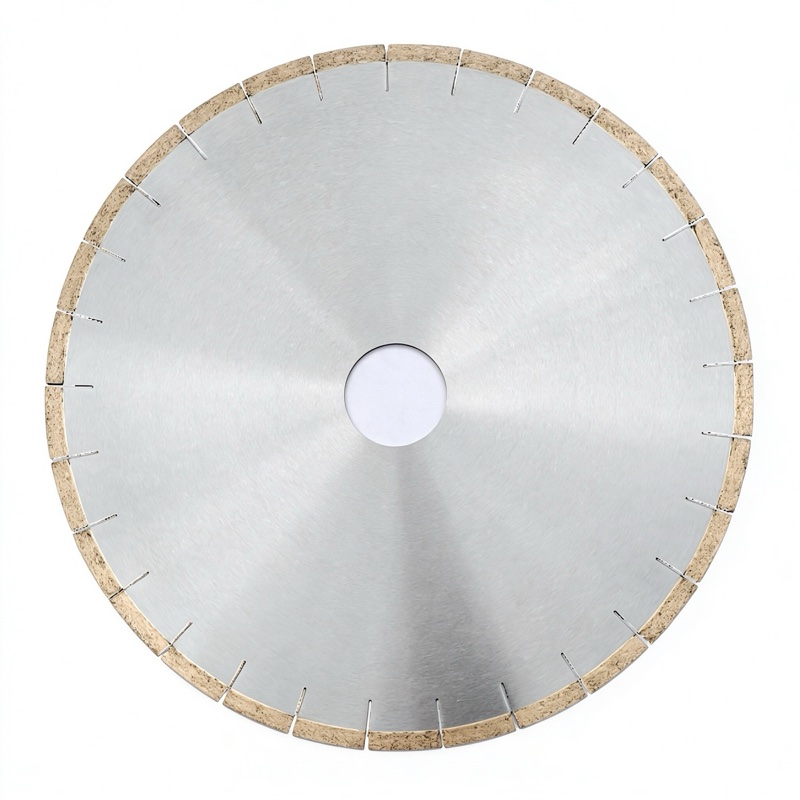
Wet cutting concrete with a diamond blade needs roughly 8 to 15 liters of water per minute on each side of the blade, split between the two water ports on a walk-behind saw and fed through both side ports on a handheld saw. The water must reach the segment at the bottom of the cut, not just spray the top of the kerf. Too little water overheats the diamonds and glazes the bond; too much floods the cut, washes the bond away too fast, and creates a slurry mess. For most 350 mm to 450 mm blades on a 13 kW walk-behind saw, about 10 L/min per side is the sweet spot.
Cutting concrete generates a lot of heat. Friction between the diamonds and the aggregate can push the segment to 300 to 400 C inside the kerf, and that heat destroys the diamond crystals and anneals the metal bond. Water carries that heat away before it can damage the segment. Without enough cooling, the blade glazes, loses cut speed, and wears in hours instead of days.
The second job of the water is to flush the cuttings out of the kerf. Concrete slurry packed between the segments acts like an abrasive grinding wheel and accelerates wear. A steady flow carries the cement paste and fine aggregate out of the cut so the diamonds are always biting fresh material. Good flush also keeps the kerf open, which reduces side load on the blade core.
There is no single number that fits every saw, but these ranges cover most field work:
Do not trust the valve setting on the saw. Disconnect the hose at the blade guard and run it into a bucket for 60 seconds. Multiply the collected liters by 60 to get liters per hour, then divide by 60 again to get liters per minute. If one side delivers less than half of the other, the hose, filter, or port is partially blocked. Clean the inline filter on the water tank before every shift; a clogged filter is the most common reason operators think they have enough water when they do not.
When the flow is below 8 L/min per side, you will see a specific pattern of failure:
These are signs of thermal shock, and they are not reversible. Once the bond has annealed, the segment will not hold diamonds again, no matter how much water you add afterward.
It is possible to over-cool a blade. Above 25 L/min per side on a 450 mm blade, the water washes the bond away before the diamonds have done useful work. The segment wears down in days, the cut widens, and you are replacing blades for no reason. Too much water also throws slurry across the job site, which creates slip hazards and cleanup costs. Aim for a steady wet mist at the bottom of the cut, not a flood. A good field test: the slurry coming out of the kerf should be a thick chocolate-brown paste, not a thin soup.
Most wet-cutting problems are plumbing problems, not blade problems. Feed water from a clean tank, not directly from a garden hose fed by street pressure, because grit in the supply clogs the ports. Use two hoses, one to each side of the blade guard, and aim the nozzles at the base of the segment where it enters the cut. Water that hits the top of the kerf never reaches the diamonds and is wasted.
On a walk-behind saw, check that the water does not leak onto the drive belt; water on the belt causes slip and loss of forward feed, which operators often blame on the blade. The JOY CA-LW laser-welded blade is designed for wet general-concrete cutting and accepts both side-ported and center-ported water feeds. Run the hoses clear of the handle so they do not drag on the slab and spray back at the operator.
Wet cutting works best on blades built for water-cooled service. The diamond saw blade catalog separates wet-only, dry-only, and wet-dry blades, and running a dry-only blade wet will not improve performance. For heavily reinforced concrete or thick slabs, the high-frequency welded JOY CA-HF blade carries the extra segment height that sustained wet cutting needs. If you cannot get enough water on site, cut shallower per pass and let the saw cool between passes rather than running a dry blade hot. Treat 10 L/min per side as the minimum for any serious slab cut, and treat 15 L/min per side as the comfortable working rate on 13 kW saws or larger.
Written and reviewed by JOY TECH — an SGS & BV audited, CE/RoHS certified diamond tools manufacturer founded in 2004, exporting to 50+ countries.
Our factory and QMS are audited by SGS and Bureau Veritas. Products meet CE/RoHS requirements and every piece is 100% inspected before packing.
Verified Certificates
