Average response time: under 24 hours
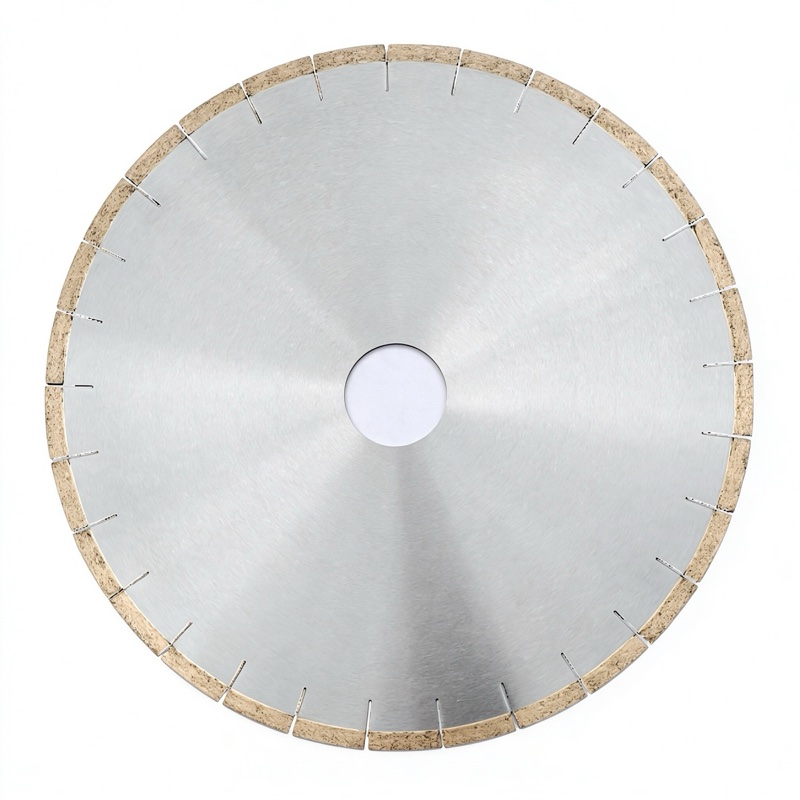
Cold-pressed sintered blades can be used dry for short, intermittent cuts in tile, porcelain and soft stone, but they are not built for long dry runs. Keep each dry cut under 20 to 30 seconds, let the blade idle in air for 5 to 10 seconds between cuts, and switch to wet cutting for any continuous run over 1 minute. If the steel core turns blue or straw-colored, or the rim starts to glaze and stop cutting, the blade has overheated and must be cooled or replaced. For long cuts in granite, hard porcelain or any masonry, use water.
Cold-pressed segments are pressed at room temperature and then sintered in a tunnel furnace. The bond reaches a slightly lower density than a hot-pressed segment, which is what makes the blade free-cutting and sharp off the shelf. The same lower density, however, means the bond softens at a lower temperature. When the blade is pushed into a long dry cut, the bond around the diamonds breaks down quickly, the diamonds fall out early, and the segment loses height in minutes.
Heat damage does not always announce itself with smoke. The first sign is usually a faint blue or straw-colored band on the steel core just behind the segment. That color comes from the tempering of the steel at temperature. Once the core is tempered, it warps under load, the cut drifts, and the blade can no longer be trued. On the rim itself, overheating shows as a glazed surface that stops biting even though the segment still has height.
Use wet cutting whenever the cut is continuous, the material is hard, or edge quality matters. On granite, hard porcelain, engineered stone, and any run longer than about 1 minute, water removes heat at the source and washes the swarf away. The JOY MS-ST straight-slot blade is designed to be run wet on rail saws and tile saws, where water feed keeps the rim cool and the edge clean. Wet cutting also keeps silica dust down, which is the bigger reason to use it indoors.
A steady flow of 2 to 4 litres per minute to the blade contact point is enough for most hand saws. The water should reach the rim on both sides of the cut, not just dribble on top. If the cut comes out dry with dry slurry at the exit, you are not feeding enough water. Too little water turns the cut into a mud slurry that drags on the blade and raises temperature anyway.
Dry cutting is fine for short, quick cuts where water would be a hassle: notching a wall tile on a jobsite, trimming a marble threshold, or doing a few cut-outs around a socket. Keep each cut under 20 to 30 seconds, and pull the blade out and let it spin in air for 5 to 10 seconds between cuts so it can cool. Do not force the saw; let the blade cut at its own pace. The cold-pressed blade range is rated for this kind of intermittent use, not for walking the saw through a 10 m concrete block wall.
Dry cutting a cold-pressed blade through reinforced concrete, hard aggregate block, or a long continuous run is a recipe for premature segment loss. The blade will glaze within minutes, the bond will wear unevenly, and you will be lucky to get a clean cut rather than a burned kerf. If the job demands that kind of work, move to a laser-welded or high-frequency welded blade built for dry heavy-load use instead of pushing a tile blade past its design limit.
A quick checklist helps on the jobsite. If the cut is under 30 seconds, you are outside, and the material is tile or soft stone, dry cutting is acceptable. If any of those change, switch to water. Long runs indoors, hard porcelain, granite, engineered stone, and any cut that will take more than a minute all demand wet cutting. It is also worth remembering that wet cutting produces slurry, which you must contain and dispose of correctly; on a driveway or public sidewalk, lay down a containment mat and collect the slurry rather than letting it wash into the drain.
A simple rule works on most jobs: if you can finish the cut in under 30 seconds and you are outdoors, dry cutting is acceptable. If the cut takes longer, if you are inside, or if the material is hard porcelain, granite or engineered stone, run water. When in doubt, ask the supplier which variant is built for your mix; the team at JOY TECH contact can confirm whether a cold-pressed blade is the right tool or whether you should switch to a welded segment design for the run.
Written and reviewed by JOY TECH — an SGS & BV audited, CE/RoHS certified diamond tools manufacturer founded in 2004, exporting to 50+ countries.
Our factory and QMS are audited by SGS and Bureau Veritas. Products meet CE/RoHS requirements and every piece is 100% inspected before packing.
Verified Certificates
