Average response time: under 24 hours
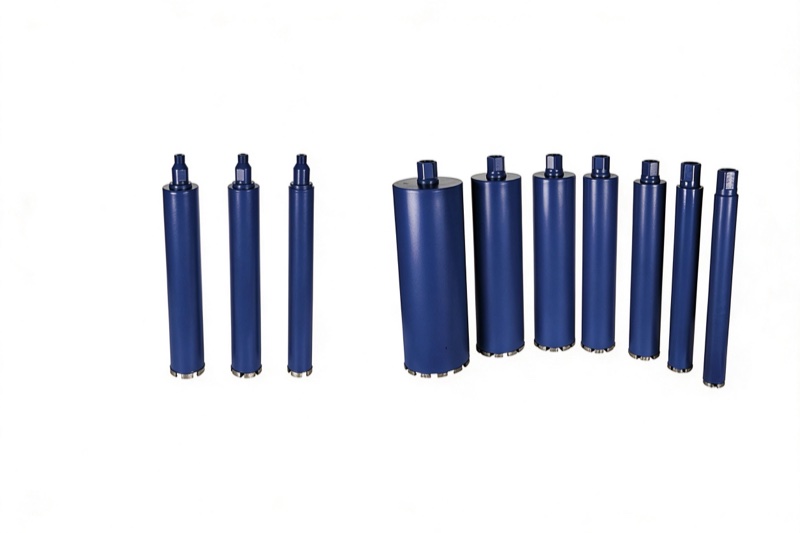
Use a wet diamond core bit for holes larger than 75 mm in reinforced concrete, for deep holes, and for production coring where the bit will run for minutes at a time. Use a dry core bit for smaller holes in block, brick, and unreinforced concrete, where water is not practical. The two bit types are not interchangeable: wet bits have a softer bond that relies on water to flush and cool; dry bits have a harder bond and segmented gullets that pull air through the barrel. Running a wet bit dry burns it out in minutes; running a dry bit in water washes the bond it needs.
Diamond core segments reach 500 C or more at the cutting edge. Water cools the segment and flushes the slurry out of the kerf so the diamonds do not grind in their own dust. A wet bit's bond is tuned to wear at that cooled rate. Without water, the segment overheats, the diamonds burn, and the bond turns glassy in a few minutes. That is why wet core rigs always include a water swivel and a controlled feed.
The wet diamond core bit is built for continuous runs in reinforced concrete, on rigs anchored to the floor or wall. The barrel carries water through the centre to the segment face, so cooling reaches the cutting edge even on a deep hole.
Wet bits run at 200-500 rpm for 100 mm diameter, slower for larger diameters. Use the table on the bit label: bigger bit, lower rpm. Forcing the feed on a wet bit is the second fastest way to break a segment, after running dry. A 150 mm bit should run near 250 rpm; a 200 mm bit near 200 rpm. Check the label because manufacturer recommendations vary by bond.
Dry bits are designed to pull air through the barrel. Their segments have gullets and gaps that carry dust out, and the bond is hard enough to wear at the air-cooled rate. Dry bits are used with a dust extraction shroud so the job is not a dust storm. They shine on block, brick, and soft unreinforced concrete where a wet setup would flood the work.
The dry diamond core bit is the right tool for hammer drills and handheld rigs on electrical, plumbing, and HVAC penetrations through masonry walls. The gulleted segment clears dust on every rotation so the bit stays cool even without water.
Dry bits run faster than wet, typically 800-1500 rpm on a 1/2-inch hammer drill. Cut in short bursts of 30 seconds, then pull the bit out to clear dust. Never force a dry bit; if it stops cutting, pull it out, clear the gullets, and let it cool. A dry bit that smokes is overheated; stop, let it sit for five minutes, and inspect the segment.
Pick the bit type by the job, not by what you have on the truck:
When the wall is reinforced and the hole is large, the segment core drill geometry gives the gullets and bond profile that wet coring demands. The segment height and the gullet spacing are tuned so slurry clears before the diamonds overheat.
Hand-held wet coring is possible on small holes, but for anything over 100 mm or over 100 mm deep, anchor the rig. A hand-held wet bit can grab and twist the operator's wrist, and the hole wanders off mark. An anchored rig gives steady feed, even pressure, and a straight hole. The small extra setup time is worth it on every production job.
The first mistake is trying to run a wet bit dry to avoid a mess. It is faster to rig a suction ring than to burn a bit. The second mistake is running a dry bit in water; dry bits need air flow to evacuate dust, and water turns the dust into paste that glazes the segment. The third mistake is using one bit for every wall; a soft block and a reinforced slab need different bond grades. Match the bond to the concrete, and the bit will last through dozens of holes instead of one. Never pry a stuck core bit out by levering on the drill; let it cool, twist it free, or split the core with a chisel.
A wet bit wears evenly and the segment face stays flat with a slight rim. A glazed wet bit shows a shiny, smooth face. A dry bit wears in shorter segments; if the gullets fill with paste, the bit has been used wet or on a floor that is too soft. Replace a bit when the segment is worn down to the barrel; continuing to cut into the steel barrel destroys the drill.
Wet for big, deep, reinforced, production work; dry for small, masonry, no-water jobs. Cool the wet bit, extract the dust on the dry bit, and never swap the two. Treat the segment and bond as matched to the method, and core drilling stops being a consumable nightmare.
Written and reviewed by JOY TECH — an SGS & BV audited, CE/RoHS certified diamond tools manufacturer founded in 2004, exporting to 50+ countries.
Our factory and QMS are audited by SGS and Bureau Veritas. Products meet CE/RoHS requirements and every piece is 100% inspected before packing.
Verified Certificates
