Average response time: under 24 hours
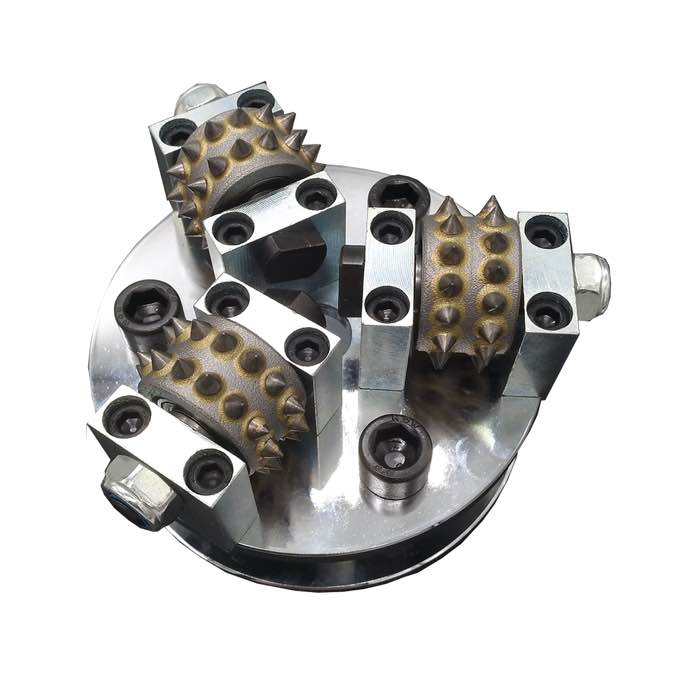
Bush hammering is the process of chiselling a concrete surface with carbide-tipped rollers or pins to create a rough, irregular “litchi” texture. It is used to add anti-slip traction on pool decks, ramps and stair treads, to create a bonding profile before overlaying, and to produce the non-slip exposed finish on precast and architectural concrete.
A bush hammer tool is covered in rows of tungsten carbide teeth. As the tool spins under pressure, the teeth chip out tiny craters in the cement paste, leaving a uniformly pitted surface — the same texture once produced by hand with a pick. Modern bush hammer plates and rollers do mechanically what masons used to do by hand, and they produce a repeatable, even texture on slabs of any size. The result is not a smooth grind or a polished floor; it is a deliberately rough, non-directional surface.
For small areas — a flight of stairs, a ramp edge, a patch of pool surround — a bush hammer plate mounted on an angle grinder is the practical choice. 5″/125mm Bush Hammer Plate with 3 Rollers (JOY-BHP-5BH) bolts straight onto a standard 125 mm angle grinder and covers about 100 mm per pass.
For large slabs, walk-behind bush hammer rollers are far more productive. A denser pin count gives a finer, more uniform texture: 45 Pins Bush Hammer Roller (JOY-BHR-45) produces a finer finish than a 30-pin roller, while 3″ Bush Hammer Roller Plate with M6 Thread (JOY-BHP-R3) adapts the roller concept to smaller floor grinders and edgers.
Bush hammering is specified to reach a defined slip rating rather than “rough enough”. Common references are the German BGR ratings R9–R13 and the wet pendulum slip test used in many countries.
| Rating | Typical use | Texture depth |
|---|---|---|
| R9–R10 | Dry indoor floors, corridors | Light bush hammer |
| R11 | Kitchens, wash-down areas, garage ramps | Standard bush hammer |
| R12 | Pool decks, dock aprons, outdoor stairs | Aggressive bush hammer |
| R13 | Heavy industrial, oily wet zones | Deep chiselled texture |
A: No. Shot blasting hurls steel balls at the surface, while bush hammering chips it with fixed carbide teeth. Bush hammering leaves a deeper, more regular “litchi” profile; shot blasting leaves a finer, more uniform etch and is more common before epoxy coatings.
A: You can, but it destroys the polish. It is better to bush hammer the slab before the polishing sequence, or to treat only the slip-critical strips such as ramp edges.
A: Yes. The tungsten carbide pins chip down with use; a 30–45-pin roller typically lasts hundreds of square metres on normal concrete. Replacement rollers are inexpensive and bolt on in minutes.
Bush hammering is the right process when a concrete surface needs deliberate roughness — for anti-slip safety, mechanical bonding before overlays, or the characteristic litchi architectural finish. Match the tool to the area: a 125 mm angle-grinder plate for stairs and edges, multi-roller plates on walk-behind grinders for decks and ramps. View our bush hammer plates and rollers to spec the right tooth density for your slip rating.
Written and reviewed by JOY TECH — an SGS & BV audited, CE/RoHS certified diamond tools manufacturer founded in 2004, exporting to 50+ countries.
Our factory and QMS are audited by SGS and Bureau Veritas. Products meet CE/RoHS requirements and every piece is 100% inspected before packing.
Verified Certificates
