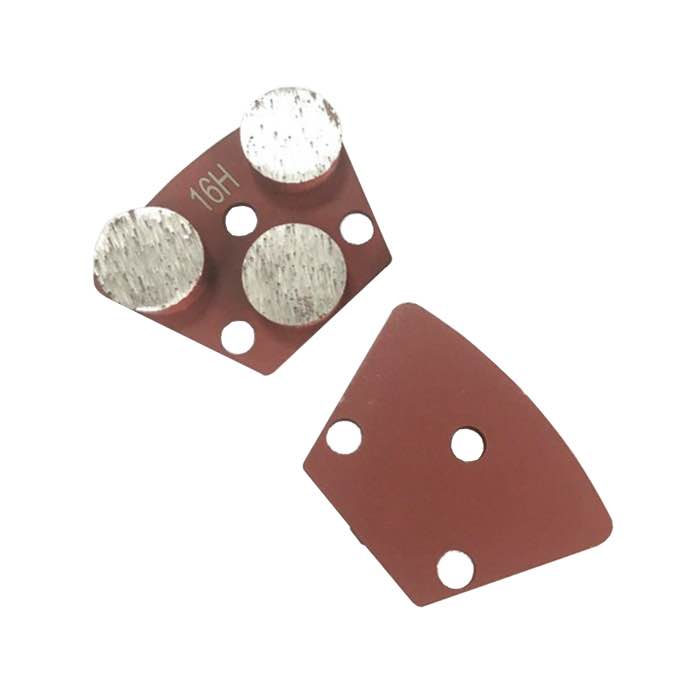
Tooling size is dictated by your machine's drive plate and shroud, not by preference. Common concrete grinders take 2-inch, 3-inch, 4-inch or 6-segment plates, while planetary machines use 9-inch or 10-inch discs. Check your machine's drive-plate bolt pattern and guard diameter first, then match tooling diameter and thickness to the manufacturer's spec — oversize tooling will not spin freely and undersize tooling leaves streaks.
| Machine Type | Typical Tooling | Best Use |
|---|---|---|
| Edger / scrubber | 2" or 3" tooling | Edges, corners, tight areas |
| Single-head grinder (220V) | 3" or 4" tooling, 6-segment plates | General grinding and polishing |
| Planetary grinder | 9" or 10" discs / 3 x 3" tooling | Large floors, high production |
| Walk-behind propane | 9" or 12" discs | Heavy coating removal |
A: Only if the drive plate and shroud physically fit. Measure the bolt pattern and guard clearance — the machine manual is the final authority.
A: No. Some planetary heads use 10-inch discs or 3 x 3-inch tooling. Check your head's spec before ordering.
A: You get uneven wear, poor contact and a non-uniform finish. The tooling should cover the full width of the head.
Matching tooling to your machine is simple when you check the drive plate, guard clearance and power spec first. For a reliable range of trapezoid and segment tooling that fits common machines, explore the Diamond Trapezoid Grinding Disc (JOY-TP-R3) or the Single Rhombus Segment Trapezoid Grinding Disc (JOY-TP-RH1).
