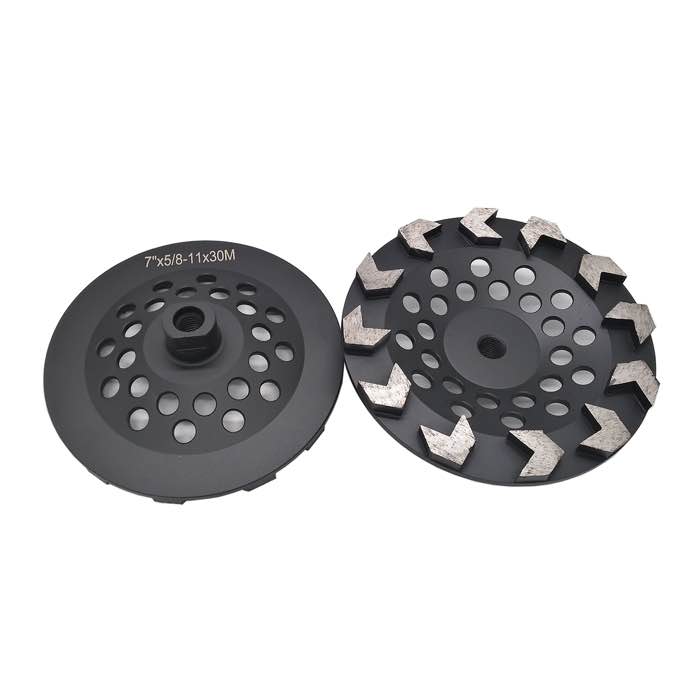
Start with a 30/46-grit metal-bond diamond disc on most slabs. On soft, abrasive concrete use 30 grit for fast stock removal; on hard, dense concrete or overlays, start at 60 grit so the disc does not glaze. Run the metal-bond sequence (30 → 60/80), then switch to resin-bond pads (150 → 300 → 500 → 800) once scratches are uniform. Never jump more than roughly two grit sizes in one step, or you will never remove the previous scratch pattern.
Grit is the diamond particle size in the metal bond. Lower numbers cut aggressively but leave deep scratches; higher numbers cut gently and leave a finer finish. Because metal-bond diamonds are held rigid, they cut fast but scratch deep. Resin bonds hold diamonds more softly, so they refine rather than cut.
| Slab condition | Start grit | Why |
|---|---|---|
| Soft, greenish, sandy concrete | 30 | Aggressive cut wears bond in fast |
| Medium, standard residential slab | 30/46 | Best all-round starting point |
| Hard, dense, imported aggregate | 60 | Prevents glazing and glazing burns |
| Thin overlay / leveling compound | 60-80 | Reduces risk of digging in |
| Previously coated floor | PCD first | Strip coating before metal grinding |
If a coating is present, strip it first with a PCD tool such as the 6-PCD floor-prep cup wheel — starting a metal disc on epoxy just loads the segments.
The most common mistake is switching from metal to resin too early. Resin pads cannot remove deep metal scratches. The handoff happens when the floor shows a uniform, even scratch pattern with no low spots or tool marks. A practical trigger point is after 80-grit metal: the floor should look evenly scuffed across 100% of the surface, with no glossy "skip" areas. Then introduce resin. Many contractors use a transitional metal-to-resin step or a hybrid copper-bond pad to bridge the gap.
On a walk-behind plate system, a proven starter disc is the HTC double-arrow segment disc in 30/46 grit, known for free cutting on medium concrete.
Concrete hardness is the missing variable in every grit question. Test it with a scratch test or a Mohs pick: if a nail scratches the surface easily, it is soft and wears discs fast — use a harder bond and a coarser start. If the surface rings like glass under a scratch awl, it is dense and hard — start finer (60 grit) with a soft bond so diamonds expose themselves. Getting this backwards is the number-one reason a brand-new disc stops cutting within an hour.
Grit size and bond hardness are two separate knobs. On soft abrasive concrete, a hard bond lasts long; on hard dense concrete, a soft bond is needed. If your 30-grit disc glazes, the problem is rarely the grit number — it is that the bond is too hard. Keep a soft-bond and a hard-bond option on the truck and switch based on the slab you are actually cutting.
Run a 1 m² test patch with your chosen starting grit. Note how fast it cuts, how much dust comes off, and whether scratches look even. If the patch looks good, roll out the whole floor. If it glazes or digs in, change grit or bond before committing a full day. This 15-minute test saves hours of rework on a 200 m² job.
A: Only if the floor is already flat and smooth. If there are trowel marks, glue or uneven patches, starting too fine wastes hours trying to cut with a disc that will not bite.
A: When 100% of the floor shows the scratch pattern of the current grit. Walk the floor at a low angle; any glossy or untouched patch tells you to keep grinding.
A: The bond is too hard for the aggregate, so diamonds wear before they expose new ones. Switch to a softer-bond 30 grit or dress the disc on an abrasive block.
A: Yes for polished floors — apply densifier after 150-300 grit metal/resin, before continuing to higher resin grits. It hardens the paste and prevents dusting.
Starting grit is the single biggest decision that controls your whole schedule. Match it to the hardness of the concrete, strip coatings first, and respect the metal-to-resin transition. Contact JOY TECH for a recommended grit and bond set for your machine and slab.
