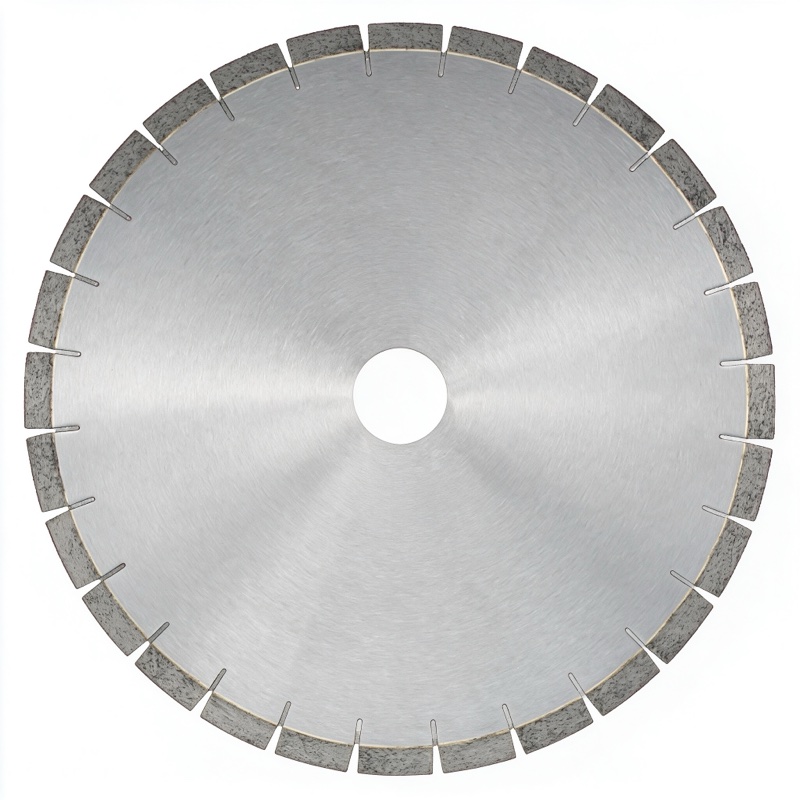
Uneven segment wear is almost always a setup problem, not a bad blade. The most common causes are: a warped blade core, wrong or dirty flanges, misaligned saw arbor, excessive feed pressure, running at wrong RPM, or a bond that is too soft for the material. One-sided wear also happens when the cut pinches on one side. Fix the setup and the wear pattern evens out.
The way a segment wears tells you what is wrong:
| Wear pattern | Likely cause |
|---|---|
| Left side thinner than right | Blade not perpendicular, or arbor misalignment |
| Segments on one half of the blade worn more | Warped core or bent shaft |
| Center of segment concave, edges intact | Too much feed pressure |
| Outer edge worn faster than inner | Wrong RPM, too slow |
| Every segment glazes on one side | Catch on one side from pinched cut |
If setup checks out and wear is still uneven, the bond may be mismatched. A hard-bond blade on soft abrasive material wears unevenly because some diamonds pull out before fresh ones are exposed. A soft bond on hard concrete wears fast and unevenly because the bond ablates before the diamonds are used. Match the bond to the material, as our spec sheets for granite blades and concrete blades describe.
In deep or curved cuts, the kerf closes and pinches the blade on one side. That side heats and wears fast. Use a wedge to hold the kerf open, or switch to a blade with wider gullets. Never force the blade sideways to straighten a cut — that is the fastest way to lose segments.
Uneven wear on a trapezoid or puck-style grinding disc usually means the grinder is not flat on the floor. Tilted pressure wears the leading edge. Also check that all three pucks on the plate are at the same height — a loose screw lifts one puck.
Once a month, measure segment height with calipers on three evenly spaced segments. Track the number. If the blade started at 12 mm and now sits at 9 mm after cutting 500 meters, you can predict it will last another 1,000 meters before reaching the 3 mm minimum. This lets you order replacements before you run out on a job. Uneven wear shows up in these measurements: if three segments measure differently by more than 1 mm, investigate flanges and runout. Keep a small notebook in the truck — this data becomes your best tool-cost estimate and your strongest evidence when comparing suppliers.
Uneven wear on one side often starts when the kerf closes and pinches the blade. In deep cuts, drive a wedge into the cut behind the blade as you go — a wooden shim or a piece of foam board holds the kerf open. On curved cuts, slow the feed and let the blade follow the guide rail; never twist the blade sideways to steer. If the blade binds, raise it, clear the kerf, and restart. Sideways pressure on a diamond blade is the fastest way to lose segments and wobble a core. Once the cut is running free, the wear pattern will even out.
After fixing the setup, re-measure segment wear on the next job. If the pattern persists, the bond may still be wrong. A side-by-side comparison of two bonds on the same slab tells you more than guessing.
A: Yes. A blade worn thinner on one side wobbles and can crack. Stop and fix it.
A: Light dressing can even the segment face, but if the core is warped, no amount of dressing fixes it. Replace the blade.
A: It prevents thermal distortion, which is a common cause. Good water flow helps.
A: A 10 mm segment on a concrete blade should last 30–60 minutes of cut time. Faster wear means wrong bond.
Uneven segment wear is the blade's way of telling you something is off. Check flanges, runout, feed, and RPM first; fix those and 90% of wear patterns normalize. Contact JOY TECH if you need a blade re-bonded to your material.
