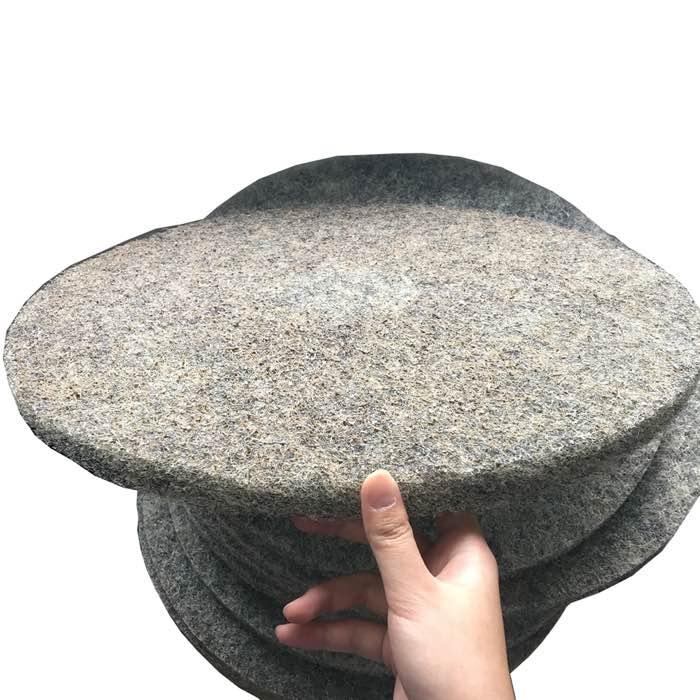
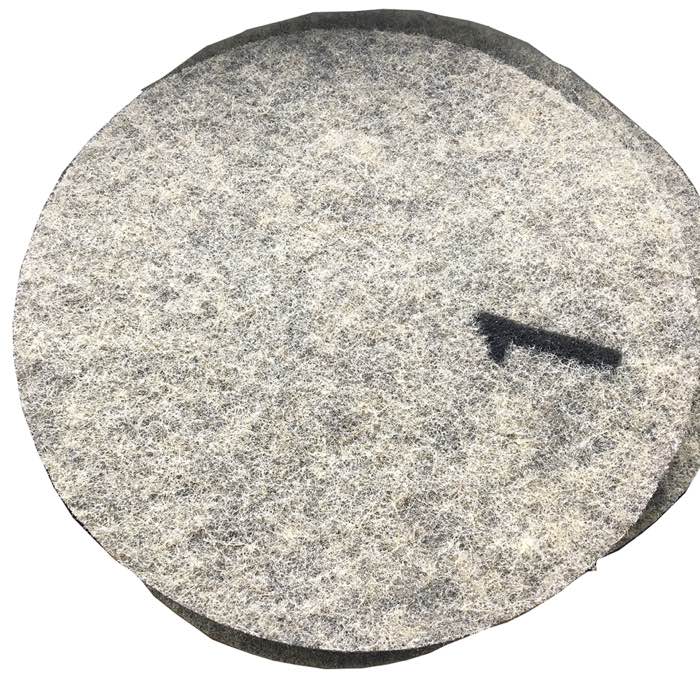
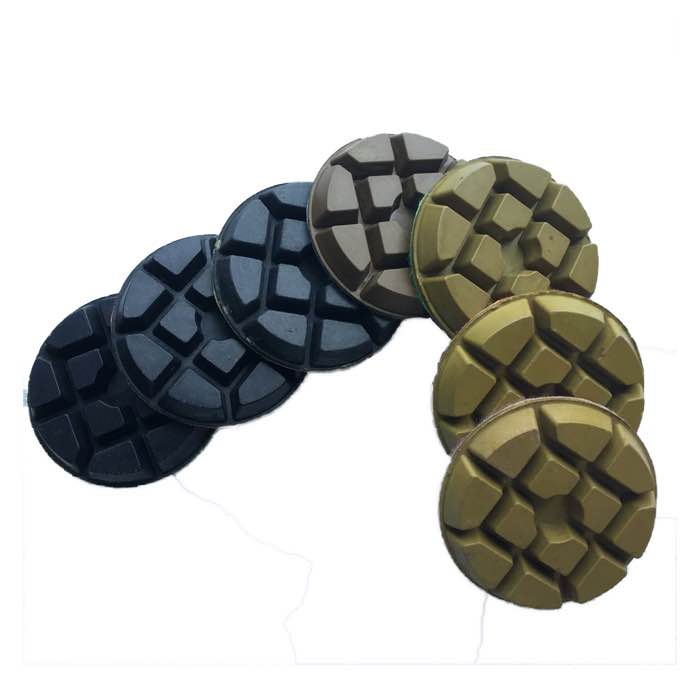
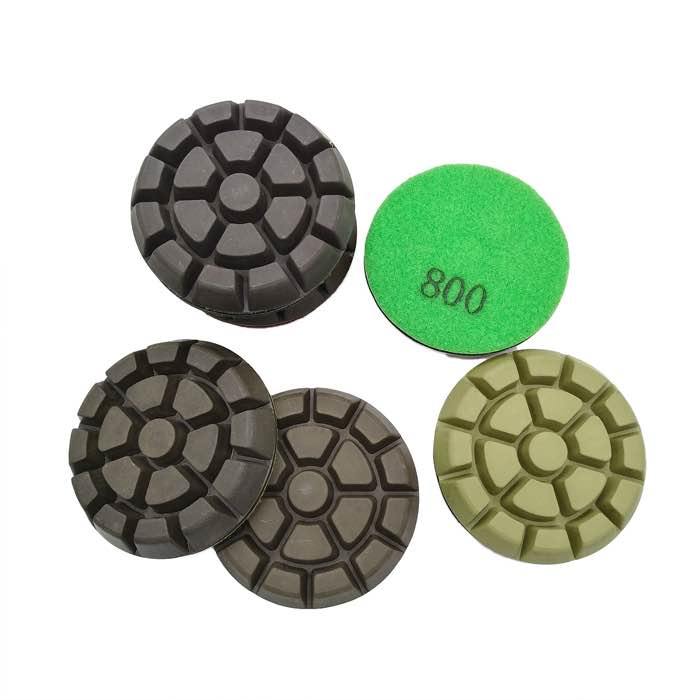
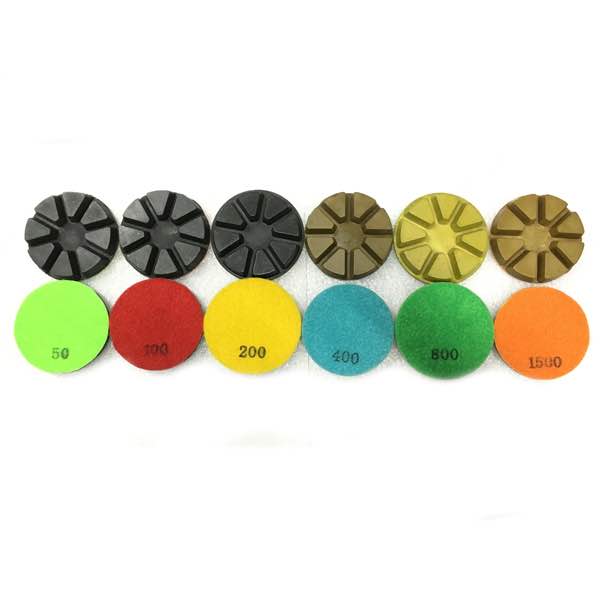
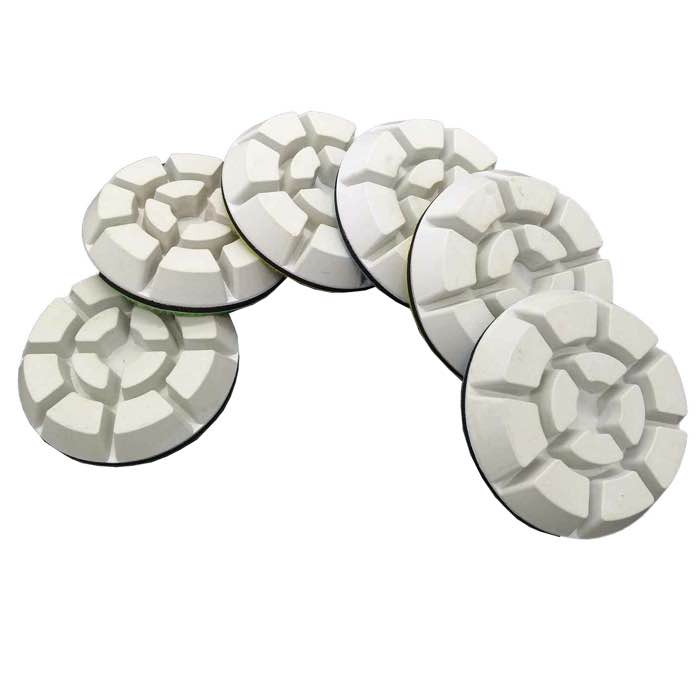
Burnishing-Pads für Betonboden Polieren (JOY-RFP-BP2)The JOY-RFP-BP2 burnishing pad is a natural-hair floor pad designed für high-speed dry burnishing - polished concrete floors. It is a spray-type hair pad: diamond grit is sprayed onto the pad surface, allowing the pad to cut, refine and impart a high-gloss sheen in a single pass. Step 1, 2 and 3 correspond to 800#, 1500# and 3000# grit respectively, covering the complete finishing range from scratch refinement to mirror-like gloss.Key Features:Natural-hair fiber pad — flexible yet resilient für consistent floor contactSpray diamond grit onto the pad für an adjustable cutting actionSteps 1/2/3 match 800#, 1500# and 3000# grit für a complete finishing sequenceUltra-sheen surface shine mit tough-surface durabilityDry polishing — no water required, clean and convenient on siteFull grit range 50#-3000# available and customizableSpecifications:ItemSpecificationPolishing MethodDry polishing - concreteDiameter4'' / 5'' / 7'' / 9'' / 11'' / 13'' / 17'' / 20'' / 27''Step 1 (Fine) — 800#Refining and light scratch removalStep 2 (Ultra-fine) — 1500#Final refinement toward high glossStep 3 (Mirror) — 3000#Mirror-polish high-gloss finishGrit Range50# / 100# / 200# / 400# / 800# / 1500# / 3000#Grit TypeSprayed diamond grit (customizable)Other sizes and grit combinations are available upon request.Applications:Trocken burnishing - polished concrete floorsHigh-gloss finishing - concrete, terrazzo and cement-based floorsRemoval - light scratches and hazing on hardened surfacesMaintenance burnishing für commercial and industrial floorsHow to Choose:Use Step 1 (800#) to refine the surface and remove fine scratches left by previous gritsFollow mit Step 2 (1500#) to build the gloss levelFinish mit Step 3 (3000#) für the highest mirror-like shineFor stronger cutting, choose coarser grits (50#-400#) or request a customized grit spraySelect the pad diameter to match your burnisher machine plateTerminology:Burnishing pad — a high-speed floor pad that polishes and shines floor surfacesSpray grit — diamond abrasive applied to the pad surface für cutting actionMesh (#) — grit number; the higher the number, the finer the abrasive and the higher the glossDry polishing — polishing without water, using machine heat to aid the finishUltra-sheen — a high-gloss, mirror-like surface finishSafety Tips:Follow the burnisher's speed and pressure settings recommended by the machine manufacturerKeep the pad flat to avoid over-pressure that can burn the concreteWork in overlapping passes für a uniform sheenStop the machine before changing pads or checking the surfaceWear dust protection when dry polishing and ventilate the work areaFrequently Asked Questions:Q: What are Steps 1, 2 and 3? A: Step 1 is 800#, Step 2 is 1500# and Step 3 is 3000# — a finishing sequence from refinement to mirror gloss.Q: How do I use this hair pad? A: Spray diamond grit onto the pad, then burnish the concrete surface dry at high speed until the desired sheen is reached.Q: What grits are available? A: 50#, 100#, 200#, 400#, 800#, 1500# and 3000#, and other grits can be customized.Q: Can it be used wet? A: It is designed für dry polishing - concrete; use water only if your machine and site allow.Q: What diameters do you offer? A: 4'', 5'', 7'', 9'', 11'', 13'', 17'', 20'' and 27''.
Overview
Diamond polishing tools use resin-bonded diamond particles to progressively refine ground surfaces into a smooth, glossy finish. Applied in a sequence of increasing grit sizes from 50# to 3000#, these pads and discs transform rough concrete or stone into a reflective, low-maintenance surface. Polishing is the final stage of decorative concrete and stone restoration, producing the high-gloss floors seen in retail stores, warehouses, showrooms, and luxury residences.
Key Features
- ✓Full grit sequence from 50# to 3000# for a complete polishing system
- ✓Resin bond provides flexibility and conformability for uniform gloss on uneven surfaces
- ✓Hook-and-loop (Velcro) or magnetic backing for fast pad changes
- ✓Suitable for both wet and dry polishing applications
- ✓Consistent color and clarity — no burnishing or chemical hardeners required for basic gloss
Specifications
| Bond Type | Resin-bonded / hybrid |
| Diamond Grit | 50# – 3000# polishing sequence |
| Backing | Hook & loop (Velcro) or magnetic |
| Working Surface | Concrete, marble, granite, terrazzo |
| Use Condition | Wet polishing recommended |
| Thickness | 3mm – 10mm working layer |
Applications
- ✓Polished concrete floor finishing
- ✓Marble and granite polishing and restoration
- ✓Terrazzo floor polishing
- ✓Countertop and vanity polishing
- ✓Stone floor maintenance and honing
How to Choose
- 1
Start with a metal-bond 50# or 100# grit to flatten the floor, then transition to resin-bond pads at 200# or 400#
- 2
For standard gloss, follow 50→100→200→400→800→1500→3000#; for satin finish stop at 800#
- 3
Use densifier (lithium or sodium silicate) after 200# grit to harden the surface and improve polish clarity
- 4
Select pad diameter matching your machine — 3" for edge polishers, 17" for floor buffers, 20–27" for planetary polishers
Terminology
Resin Bond
A phenolic or epoxy matrix that holds diamond particles for polishing. Softer than metal bond, it conforms to surface irregularities and produces a fine finish.
Grit Sequence
The progressive order of diamond grit sizes used to polish a surface. Each finer grit removes the scratches left by the previous one, building clarity and gloss.
Densifier
A chemical hardener (typically lithium silicate) applied during polishing that reacts with concrete to increase surface hardness and improve polish retention.
Clarity
The ability of a polished surface to reflect images clearly. Measured in gloss units (GU), with 3000# polished concrete typically reaching 70–90 GU.
Safety Tips
- ⚠Wear safety glasses and non-slip footwear — wet polishing creates slippery surfaces
- ⚠Ensure electrical cords are rated for wet conditions and use GFCI-protected outlets
- ⚠Keep hands and clothing away from rotating pads — use the machine handle at all times
- ⚠Change pads only after the machine has come to a complete stop
Frequently Asked Questions
What grit sequence should I follow for polished concrete?
Start with 50# metal bond, then 100#, 200# resin, 400#, 800#, 1500#, and finish at 3000# for a high-gloss surface. Skip grits only if the previous scratch pattern is fully removed. Apply densifier after 200#.
Wet vs dry polishing — which is better?
Wet polishing produces a finer finish, reduces dust, and extends pad life, but requires water management. Dry polishing is faster and more convenient on job sites without water access. Resin pads work well in both conditions.
How long do resin polishing pads last?
A resin pad typically covers 200–500 m² per grit step. Coarser grits (50–200#) wear faster than finer grits. Using water significantly extends pad life by 30–50%.
Why is my polished floor not shiny?
Common causes: skipping grit steps, insufficient passes at each grit, hardener not applied or not cured, or pads glazed over. Ensure each grit fully removes previous scratches, apply densifier after 200#, and dress pads if they stop cutting.
Can I polish outdoor concrete?
Yes, but outdoor polished concrete requires a penetrating sealer to protect from UV and weathering. Use a 800# finish (satin) rather than 3000# for better slip resistance outdoors.
What is the difference between polishing and burnishing?
Polishing uses diamond abrasives to physically cut and refine the surface. Burnishing uses a very fine abrasive or chemical to create a temporary surface shine that wears off. Polished concrete is permanent and requires no wax.
Warranty & Returns
12-Month Warranty
Every product is covered by a 12-month warranty against manufacturing defects in materials and workmanship. If a defect is confirmed, we replace the tool or refund the order — your choice.
Inspection on Delivery
Please inspect goods within 7 days of receipt. For any quality issue, send photos or a short video to our support team — we respond within 24 hours and settle replacements or returns promptly.