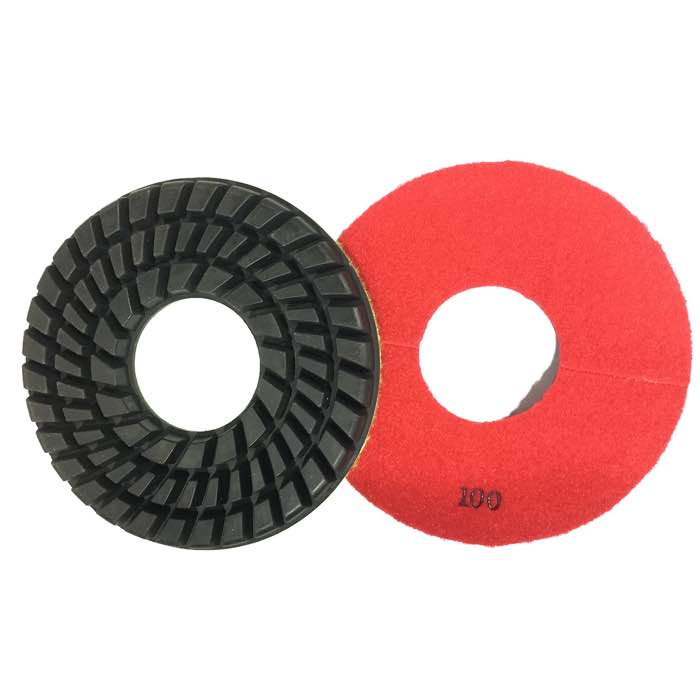
Yes, you can polish small concrete areas (under roughly 20 square meters) with an angle grinder fitted with diamond resin polishing pads backed by a velcro backing pad. It works for countertops, small floors, steps and edge work where a floor machine cannot reach. However, an angle grinder is slow and tiring on large slabs, and it is hard to keep perfectly flat - for whole floors a planetary floor grinder remains the right tool.
To hand-polish concrete safely and effectively you need:
Start by grinding flat. If the surface has trowel marks or paint, first use a metal-bond diamond cup wheel to open it. Then progress through resin grits, typically 50, 100, 200, 400, 800, 1500 and 3000. Keep the pad flat and moving - never press hard or dwell in one spot, or you will dig gouges and burn the resin. Use light, overlapping circular motions and let the tool weight do the work.
| Grit | Purpose |
|---|---|
| 50-100 | Remove heavy scratches / open surface |
| 200-400 | Refine after densifier |
| 800-1500 | Build uniformity and gloss |
| 3000 | Final high-gloss hand pass |
Wet hand-polishing is often easier on countertops because it controls dust and produces clarity, but it requires care around electricity and uses a ground fault-protected circuit. Dry work needs a proper dust shroud and HEPA vacuum.
An angle grinder cannot spin multiple heads in a flat planetary motion, so on open floors it leaves swirl marks and uneven pad pressure. It also fatigues the operator quickly. For rooms over 20 square meters, rent or use a dedicated floor grinder; reserve the angle grinder for edges, corners, stairs, countertops and touch-ups.
Angle-grinder polishing is not just a fallback - it is the right tool for specific jobs. Countertops, stair treads, window sills, column bases and the perimeter edges of a floor that a planetary machine cannot reach all require hand work. On those areas, the variable-speed grinder with flexible resin discs is faster and cleaner than trying to rig a floor pad. It is also ideal for touch-up repairs after installation damage.
The limitation is flatness on open floors. A single hand-held disc leaves circular swirl marks and uneven pressure that are hard to blend. If you must hand-polish a small room, work in overlapping, controlled passes and frequently step back to check the sheen from across the room. For anything over roughly 20 square meters, renting a small planetary floor grinder will save time and deliver a far more uniform result.
For hand work, stock a set of flexible resin discs from 50 to 3000 grit, a firm velcro backing pad, and a few spare backing pads - they wear and tear quickly. Keep a dust shroud fitted for indoor dry work. Having every grit on the truck means you never have to stop mid-job because you skipped a step.
On small jobs, carry a variable-speed polisher rather than a fixed-angle grinder. The ability to dial back RPM protects the resin pads and gives you far better control on vertical surfaces.
A: Around 2000-3500 RPM for resin pads. Full 10,000+ RPM speed will glaze and destroy the pads in minutes.
A: Yes, but use a shroud and vacuum - silica dust is hazardous. Wet polishing is cleaner for small indoor jobs.
A: On small countertop jobs a disc may last several square meters; on abrasive concrete it wears faster. Keep spares of each grit.
An angle grinder with variable speed and diamond resin pads is a practical tool for small-area and edge polishing, not a substitute for a floor machine. Match the disc size, control the speed, and follow the full grit sequence. The takeaway is that an angle grinder is the right tool for small and awkward areas, not for open floors. With variable speed, flexible discs and a full grit sequence, it delivers professional results on countertops, edges and touch-ups. Contact JOY TECH for a quote on hand polishing discs and backing pads for your angle grinder.
