Average response time: under 24 hours
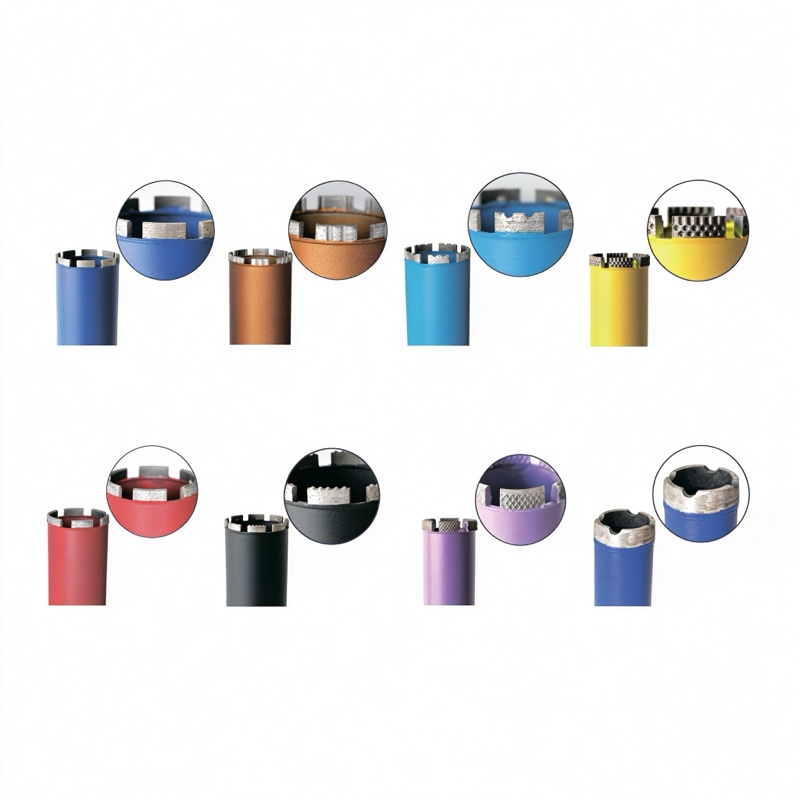
Buy direct from a factory for orders above USD 20,000 and when you need custom bonds, custom packaging, or strict QC control. Use a trading company or sourcing agent for orders below USD 10,000, when you need to mix 10+ SKUs across multiple factories (blades, core bits, grinding discs, PCD tooling), or when you want one accountable contact in English. Factories are typically 8-15% cheaper but have narrow product ranges; trading companies add 5-12% margin but consolidate shipments, handle paperwork, and absorb supplier mistakes. Most serious importers end up doing both: direct for their top 3 SKUs, trading company for long-tail SKUs.
A real diamond tool factory owns the cold press, sintering furnace, laser welding line, and tensioning jig. It can formulate a custom bond for your substrate, run a tensile test on every batch, and cut unit price as volume rises. Direct contact means engineering questions about segment height or bond grade get answered in hours, not days. For a buyer who knows the spec and wants to scale a branded diamond saw blades line, a factory is the right partner.
But factories are narrow. A Quanzhou factory may make 350mm-1,600mm granite blades well but refuse to make 20mm stone hole saw because their sintering line is tuned for large segments. A Hubei factory may specialize in core bits but not surface grinding shoes. If your catalog has 20 SKUs across 6 product families, you will be managing 5 factories, 5 PIs, 5 shipments, and 5 QC disputes.
| Dimension | Direct factory | Trading company / agent |
|---|---|---|
| Unit price | Baseline | +8-12% margin |
| Product range | 1-2 families | 10+ families, consolidated |
| MOQ flexibility | Strict per factory | Loose, spreads across factories |
| English communication | Often limited | Fluent, Western-friendly |
| QC authority | Self-reported | Independent inspection arranged |
| Dispute resolution | You vs factory | Trading company absorbs |
| Custom bond / OEM | Strong | Mediates, adds margin |
| First-order ease | High friction | Low friction |
A good trading company has 20-50 vetted factories it has worked with for years. It negotiates volume discounts you cannot get alone, arranges third-party inspection (SGS, BV, or a local inspector) at USD 150-250 per day, and consolidates cargo into one container. The margin it adds is often recovered by the better freight rate and fewer QC failures.
Many Alibaba 'factories' are actually trading companies. You can spot the difference with three questions.
After 2-3 years, most importers split the program. Top 3 SKUs (say 350mm concrete blade, 115mm tile blade, 52mm core bit) go direct to factory for price and custom bond. Long tail (a few trapezoid grinding disc trapezoid discs, a bush hammer plate plate, PCD coating-removal strips, assorted small hole saws) goes through a trading company that consolidates into the same container. This captures 80% of the factory-direct savings while keeping a one-stop contact for the rest of the catalog.
Communication quality matters more than most buyers expect. A direct factory contact who answers in broken English but knows welding parameters beats a fluent trading-company account manager who has to email the factory for every technical answer. Ask both sides the same technical question (e.g. 'what segment height do you recommend for 50 MPa reinforced concrete at 3,500 RPM?') and time the reply. The one that gives a specific, spec-aware answer in under 4 hours is the partner you want.
On unit price, yes by 8-12%. On landed cost, often no: trading companies get better ocean freight, absorb QC failures, and avoid the cost of your staff time managing multiple factories. Do the math on total landed cost per container.
Yes. Trade Assurance works the same with factories and trading companies. The difference is who is named on the contract. Name the entity you actually pay, and confirm it matches the business license.
3-5 is the sweet spot. Fewer and you have no leverage; more and you spend weeks comparing. Send the same spec sheet to all, and shortlist to 2 for sampling.
Good ones do. They have a design partner who prepares carton artwork, prints samples, and coordinates the factory's printing plates. Factories usually expect you to supply print-ready files.
The factory-vs-trading-company question is not about who is 'better'; it is about order size, product range, and your internal bandwidth. For a USD 50,000 first order across 10 SKUs, a trading company usually wins on total cost and peace of mind. Once your top 3 SKUs hit USD 50,000 per order year after year, move them direct to factory and keep the long tail with your trading partner.
Written and reviewed by JOY TECH — an SGS & BV audited, CE/RoHS certified diamond tools manufacturer founded in 2004, exporting to 50+ countries.
Our factory and QMS are audited by SGS and Bureau Veritas. Products meet CE/RoHS requirements and every piece is 100% inspected before packing.
Verified Certificates
