

Choosing Diamond Grit for Concrete Floor Polishing Start Point
Choosing Diamond Grit for Concrete Floor Polishing Start Point
Quick Answer
Start with 16 or 20 grit metal bond if the floor has coatings, high spots or a rough profile. Start with 30 or 50 grit resin if the concrete is already exposed and flat. The first grit must remove the previous scratch pattern, not just burnish the surface.
What the First Grit Must Do
The first grit sets the surface. It removes coatings, flatten high spots and opens the aggregate. If the first grit is too fine, it will polish the top of the concrete and leave the low spots untouched. The floor will look glossy in patches and dull in others.
If the first grit is too coarse, it will leave deep scratches that require extra steps to remove.
Start by Surface Condition
| Condition | Starting point |
|---|---|
| Thick coating or mastic | PCD or 16 grit metal bond |
| Thin sealer or paint | 20 to 30 grit metal bond |
| Bare, rough concrete | 20 to 30 grit metal bond |
| Bare, flat concrete | 50 grit resin |
| Terrazzo or dense polish | 50 grit resin after transition |
Aggregate and Gloss
If the spec calls for exposed aggregate, start coarse enough to cut the paste and expose the stone. If the spec calls for a cream finish, start finer and keep the paste. The starting grit is a specification decision, not only a tool choice.
For a high gloss, the sequence must be complete. A 50 grit start can still reach a high gloss if the intermediate grits are not skipped.
Frequently Asked Questions
Q: Can I start at 100 grit to save time?
A: Only if the floor is already flat and scratch-free. Starting too fine traps defects under the polish.
Q: How many grits do I need?
A: Typically 50, 100, 150 or 200, 400 and a optional 800 or 1,000 for high gloss.
Q: Why does the floor look patchy after the first cut?
A: The first grit is too fine or the machine is not covering the full width. Check the scratch pattern and the overlap.
Conclusion
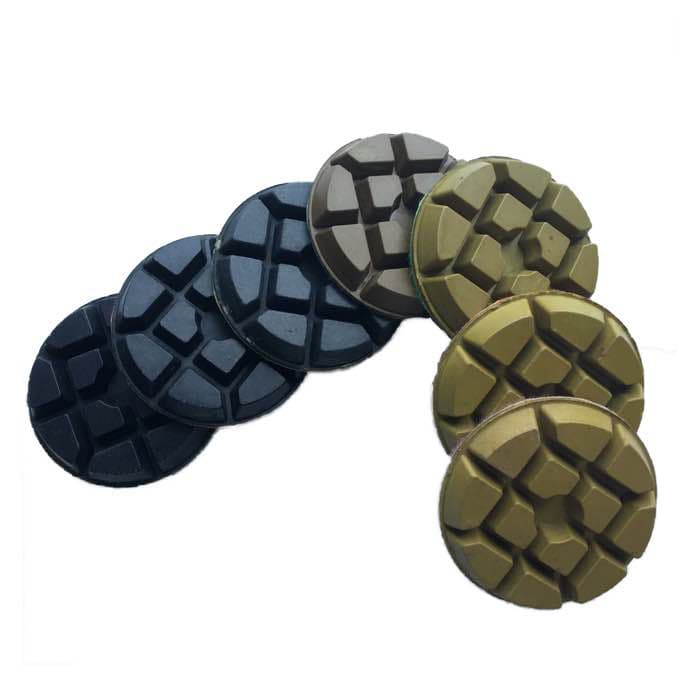
Choose the first grit by what must be removed, then keep the sequence consistent. A concrete and terrazzo resin pad covers the polishing steps; a two-ring concrete pad gives more cut on a rough floor.
Products used in this guide
Need this tool for your job?
MOQ 1 · 7–30 days by order quantity · FOB & CIF · free sample on request
Author & Manufacturer
Written and reviewed by JOY TECH — an SGS & BV audited, CE/RoHS certified diamond tools manufacturer founded in 2004, exporting to 50+ countries.
Quality & Compliance
Our factory and QMS are audited by SGS and Bureau Veritas. Products meet CE/RoHS requirements and every piece is 100% inspected before packing.
Verified Certificates
- SGS Audited Supplier — Report No. QIP-ASI227442 & QIP-ASR247051 (Audit Jan 29, 2024)
- Bureau Veritas Verified — Report No. MIC-ASR257059 (Audit Feb 20, 2025)
- CE & RoHS Certificate of Conformity — No. CS240925001HRZ (Issue Sep 25, 2024)