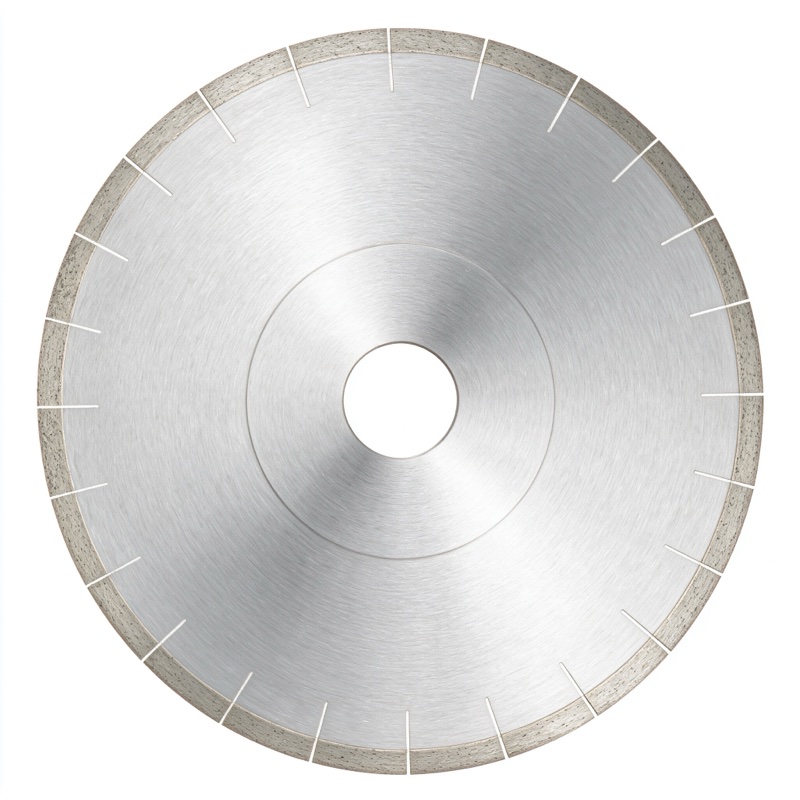
Cut an engineered quartz countertop with a sharp diamond blade designed for artificial quartz, cutting wet at a controlled feed. Quartz is a dense composite of quartz bound in resin, and it burns easily - the resin melts if the blade gets hot, leaving a blackened, chipped edge. Use a quartz-specific thin-kerf blade, keep water flowing, support the slab, and feed steadily so the rim stays cool. Never cut dry for long periods.
Engineered quartz is roughly 90% quartz crystals set in polymer resin. The diamonds cut the mineral, but the resin matrix is heat-sensitive. A dull blade, a dry cut or too-fast feed generates friction heat that melts the resin into a blackened, gummy edge - that is the "burn" everyone wants to avoid. Chipping comes from an unsupported exit and a blade not sharp enough for the abrasive quartz crystals.
Use a blade engineered for artificial quartz, not a generic granite blade. A sharp, thin-kerf blade with a bond tuned to free-cut abrasive quartz prevents loading and burning. We recommend the artificial quartz saw blade for countertop fabrication. For natural quartzite (a different, harder stone), use the natural quartzite blade instead - do not confuse the two materials.
| Symptom | Cause | Fix |
|---|---|---|
| Blackened gummy edge | Resin heat / burn | More water, sharper blade, slower feed |
| Chipped face edge | Dull blade / exit breakout | Sharp quartz blade, support exit |
| Blade loads up | Bond too hard / no water | Quartz-specific blade, wet cut |
| Uneven cut | Wandering blade | Stable feed, guide rail |
For sink and faucet cutouts, drill round relief holes at the corners first, then plunge or jigsaw along the line with a quartz blade. Rounded corners prevent stress cracks. Always support overhanging sections and finish from below if needed to protect the polished face.
Thin quartz slabs (12-20 mm) and large workpieces are the most burn-prone. The thinner the slab, the less material there is to carry heat away, so the resin edge scorches faster. Slow the feed, keep water generous, and never let the blade rub in one spot. If you see the edge darken, stop and let the blade cool - continuing will only worsen the burn.
For sink cutouts, round all internal corners generously to relieve stress, and support the overhanging cutout section so it does not flex. A sharp, dedicated quartz blade is worth the investment here: generic blades burn the resin matrix and leave a blackened edge that requires extensive polishing to fix. Plan the cut so the blade exits on a supported side rather than into empty space.
Quartz edges often need light polishing after the cut to remove any faint burn. Use fine resin pads by hand on the edge. With a sharp quartz blade, water control and slow feed, burn marks should be minimal and easy to polish out.
Let the blade breathe between cuts on thick quartz. Short cooling pauses prevent the resin edge from overheating on long rips.
Plan sink cutouts so the blade exits into waste material rather than into the finished corner, where breakout is most likely.
After cutting, check the edge under strong light for faint burn marks; polishing them out immediately is far easier than after installation.
For long production runs, a water-cooled bridge saw beats handheld angle grinders for consistent, burn-free quartz edges on every sink cutout.
A: It may cut but often burns the resin and chips. A quartz-specific blade is worth it for clean edges.
A: Very short trims only. Dry heat melts the resin; fabrication shops always cut wet.
Follow the blade rating; higher RPM increases heat. Use moderate speed with good water flow.
Clean quartz cutting is about a sharp quartz-specific blade, constant water and steady feed to avoid resin burn. Treat it as heat-sensitive engineered stone. The takeaway is that quartz cutting is all about controlling heat. A dedicated quartz blade, generous water and a slow feed prevent the resin burn that ruins so many edges. Contact JOY TECH for a quote on artificial quartz and quartzite blades for countertop fabrication.
