Average response time: under 24 hours
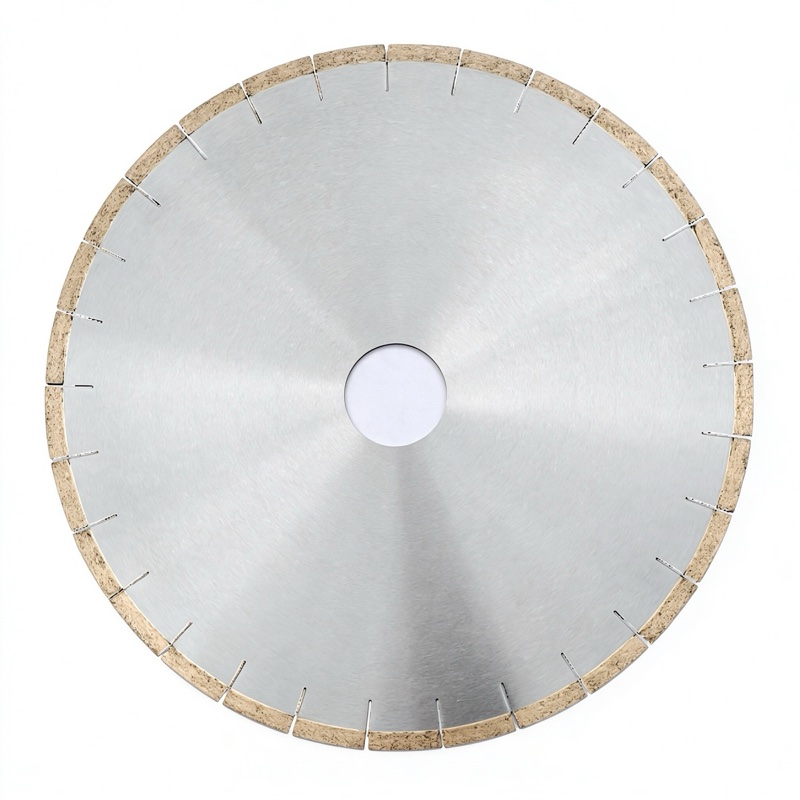
Yes, a diamond blade will cut through rebar in a concrete slab, but it is not the same job as cutting plain concrete. The steel strands abrade the segment sideways and pull diamonds out, so expect segment life to drop by half or more on heavily reinforced slabs. Use a laser-welded, hard-bond segmented blade, cut in shallow passes of 30 to 50 mm, keep the saw wet, and slow the feed rate when you feel the blade bite into steel. If the slab has mats of rebar thicker than 16 mm on both faces, plan for two or three spare blades rather than one.
Diamond grit cuts concrete by grinding hard mineral particles like quartz and granite. Rebar is mild steel, which is ductile rather than abrasive. When a diamond edge touches steel, it does not grind the same way; it rubs, heats up, and can round off the diamond crystal. The metal bond around the diamond also wears faster because of the heat. The result is a segment that looks worn on the sides, with flattened diamond tips and whole crystals missing from the face.
Rebar catches the leading edge of the segment and pulls the saw sideways. On a straight cut, this is the number one reason the line drifts: one side of the segment digs into the steel, the other side cuts concrete, and the saw wanders. Slow the feed the moment you feel the saw jump or the tone change, and let the blade chew through the steel in short bites rather than forcing it.
Not every diamond blade handles rebar well. The minimum spec for reinforced concrete is a laser-welded segmented blade with a hard bond and a tall segment:
The JOY LW-HH high-horsepower blade is built for this kind of work: thick core, laser-welded segments, and a bond tuned for reinforced concrete. For lighter rebar in residential slabs, the JOY CA-HF high-frequency welded blade is a more economical choice that still handles 10 to 12 mm rebar without issue.
Before you cut, locate the rebar. Use a cover meter or scan the slab with a rebar detector so you know where the mats sit. Mark the depth of the top and bottom steel on the saw guide. A cut that hits top rebar at 40 mm and bottom rebar at 180 mm needs a different feed strategy than a cut through unreinforced concrete.
Set depth per pass to 30 to 50 mm for handheld saws and up to 100 mm for walk-behind units. Run the saw at full rpm, never throttle down, because the diamonds need speed to shear steel. Walk the saw forward at a pace where the saw does the work; if you have to push, slow down or raise the blade out and re-cut. Keep water running the whole time, because heat is what kills the segment on rebar jobs. Treat full saw rpm as non-negotiable: dropping speed to force through steel is the fastest way to round off the diamonds.
Stop every few meters and look at the segment face. Healthy cutting shows fresh diamond grit on the surface. If the face is shiny and smooth, the bond has glazed; run the blade through a cinder block for 30 seconds to re-expose diamonds. If the segment has lost more than half its diamonds or the sides are rounded off, change the blade before it reaches the core. Cutting to the core on a rebar slab is a known way to crack a core and throw a blade.
Segment life on reinforced concrete is hard to predict, but rough numbers help with planning:
These are planning numbers, not guarantees. Aggregate hardness, wet versus dry cutting, and saw horsepower all shift the result. The diamond saw blade catalog lists the recommended bond for each level of reinforcement; do not run a soft-bond asphalt blade on a rebar slab, because the soft bond will dissolve in minutes. When in doubt, err toward the harder bond and the taller segment, and keep a spare blade on the truck.
The most expensive rebar mistake is cutting a blade down to the core. Once the segment wears off, the steel core rubs against the rebar, the saw jerks, and the core can crack. Replace the blade when the segment height is down to about 3 mm above the core, not when the core itself starts to touch. On a rebar slab, inspect the segment every 10 meters; on a plain slab, every 50 meters is enough. If you can see the core around the arbor hole, the blade is already too far gone.
Written and reviewed by JOY TECH — an SGS & BV audited, CE/RoHS certified diamond tools manufacturer founded in 2004, exporting to 50+ countries.
Our factory and QMS are audited by SGS and Bureau Veritas. Products meet CE/RoHS requirements and every piece is 100% inspected before packing.
Verified Certificates
