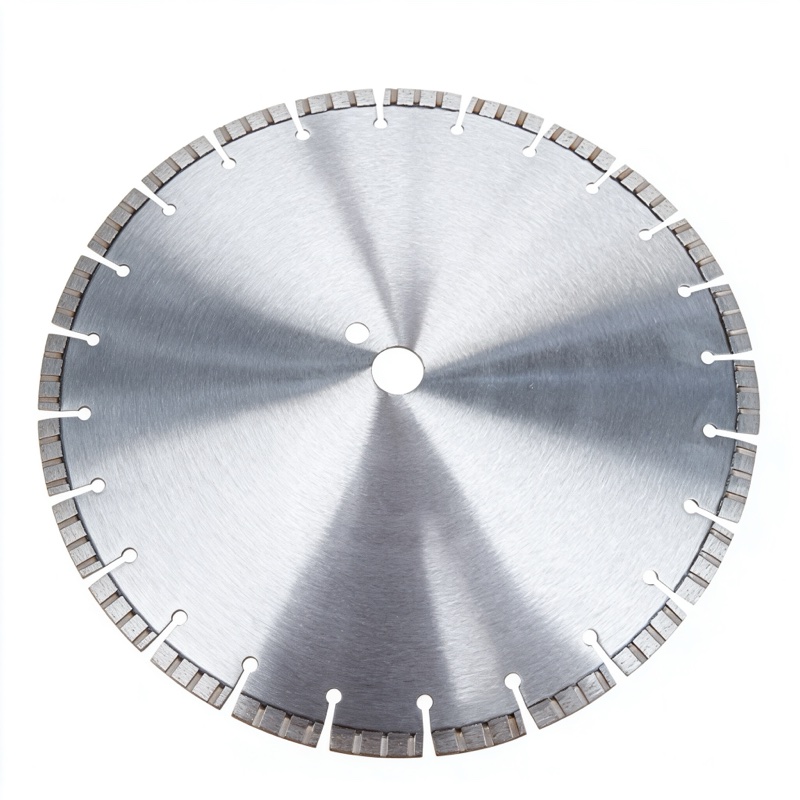
Yes, a laser-welded diamond blade designed for reinforced concrete can cut through light rebar (up to roughly #4 rebar, 13 mm), but it will wear faster than on plain concrete. Standard sintered or high-frequency blades will glaze, overheat, and lose segments when they hit steel. For regular rebar work, use a laser-welded blade with a hard, tough metal bond and a slightly higher diamond concentration, and keep water flowing to cool the steel-cutting zone.
Concrete is abrasive; steel is not. When a blade tuned for abrasive concrete meets rebar, the bond matrix around the diamonds cannot wear away to expose fresh grit, because steel does not abrade the bond. The diamonds dull, the segment polishes smooth (glazing), and the blade stops cutting. Worse, the friction of cutting steel spikes the heat, turning the steel bluish and can overheat the segment bond until it loses diamond hold entirely.
Look for a blade built for reinforced concrete and demolition, such as our laser-welded concrete & asphalt blade, or the aggressive high-horsepower laser-welded blade. Key specs:
| Feature | What to choose |
|---|---|
| Welding | Laser welded (segments cannot tear off under steel load) |
| Bond hardness | Hard bond, high diamond concentration |
| Segment height | Tall segments (10-15 mm) to absorb steel wear |
| Rim type | Wide segments, not thin turbo |
Cut concrete first. When the saw bites into steel, slow the feed and do not force the blade. Let the diamonds do the work; pushing harder only generates heat. If possible, cut from both sides of the slab so each rebar crossing is cut with a fresh, cool section of rim. Keep the cut shallow on rebar passes rather than forcing full depth in one plunge.
Wet cutting is strongly preferred when rebar is expected. Water washes steel swarf away, prevents glazing, and keeps the segment temperature under control. If you must cut dry, use short bursts and let the blade air-cool; never let it stall in the cut.
Because rebar shortens blade life sharply, price your job per meter of cut rather than per blade. On lightly reinforced floor slabs you may get 150-200 meters from a 350 mm laser-welded blade, while a bridge deck or retaining wall with dense mesh can drop that to under 100 meters. Track how many linear meters each blade delivers on your specific mix; that number is your real tool cost. Buying a slightly more expensive rebar-rated blade often beats running through cheap blades that lose segments on the first steel crossing.
When demolition crews do not know where rebar sits, a rebar-rated laser blade is non-negotiable. For planned utility trenching where engineers have shared the rebar drawings, you can cut concrete first and nibble the isolated bars separately. The worst approach is plunging a cheap blade into an unknown slab and hoping; segments will fly and the cut will stall. Always scan with a rebar detector before structural work, and mark steel crossings on the saw line so the operator knows when to slow down.
Cutting reinforcement is not about finding a magic blade that ignores steel; it is about using a laser-welded tough-bond blade at controlled feed with water, and accepting that rebar costs time and wear. With realistic quoting and the right tool, reinforced concrete cuts safely and predictably.
Say you need a 600 mm square opening in a 150 mm reinforced floor slab for a stairwell. First scan the slab to map rebar, then cut the perimeter with a 450 mm laser-welded blade in two depth passes. When each side crosses a bar, slow the feed and keep water on. After sawing, break out the core and patch any sawed edges. Budget roughly half a day for two people and expect the blade to lose about a third of its life on this single opening because of the mesh crossings.
A: You may get through one or two light bars, but expect rapid glazing and possible segment loss. For any regular reinforced-concrete job, switch to a laser-welded rebar-rated blade.
A: Most reinforced-concrete blades handle #3 to #5 rebar (10-16 mm). Heavier dowels or thick mesh are better served by a diamond wire saw or ring saw.
A: Friction heat from rubbing steel rather than cutting it means the blade has glazed or the bond is too hard. Dress the blade on an abrasive concrete patch or replace it with a rebar-rated bond.
Cutting rebar is manageable when you run the right laser-welded, hard-bond blade at controlled feed speed with water cooling. Match the blade to the reinforcement density and your saw horsepower, and segments will last instead of flying off. Contact JOY TECH for a quote on laser-welded reinforced-concrete blades sized for your saw.
