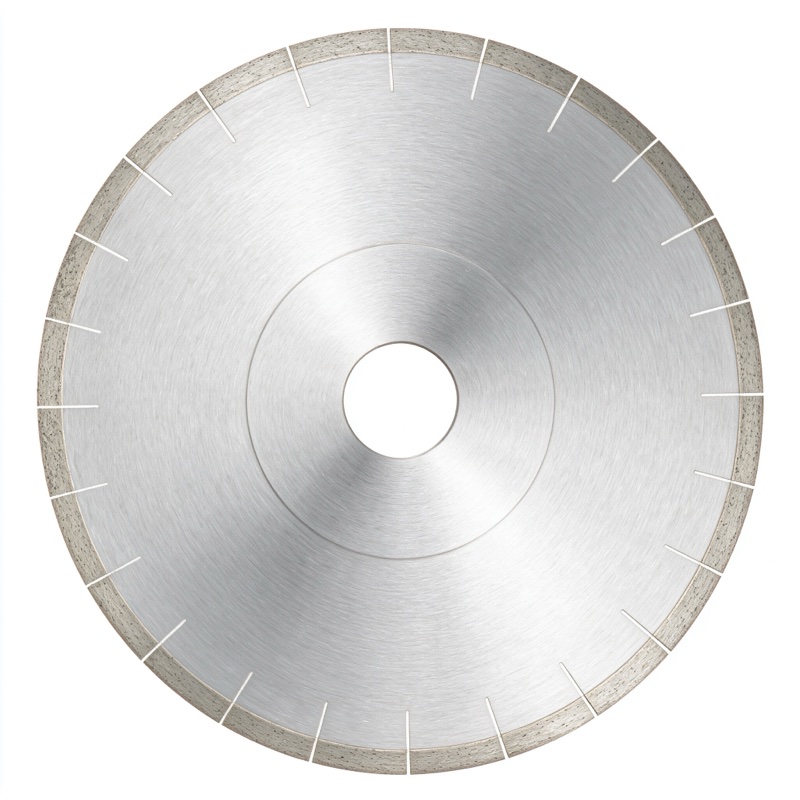
Cut engineered (artificial) quartz with a thin turbo mesh or continuous-rim diamond blade run wet on a rail saw at the correct RPM. Quartz is 93% quartz sand bonded with resin, so it's both extremely abrasive and heat-sensitive — a hard-bond diamond blade keeps cutting, while water keeps the resin from melting. Score the polished face first, then feed from the back. Never use a segmented blade on finished quartz — it chips the edge and exposes the filler.
Engineered quartz is abrasive (quartz sand) and resin-bonded (softens at ~150°C). A standard concrete blade wears out in a few slabs; a dry cut melts the resin and gums up the rim. The right blade is a hard-bond thin turbo with continuous chip clearance.
| Factor | Recommendation |
|---|---|
| Rim type | Turbo mesh or continuous rim |
| Bond | Hard — quartz is extremely abrasive |
| Blade thickness | 1.8-2.2 mm for 300-350 mm saw blades |
| Wet/Dry | Wet only — resin melts dry |
| Saw | Rail saw or bridge saw, supported cut |
| Feed rate | Slow, steady — don't force |
Our artificial quartz saw blade is engineered for 300-350 mm bridge saws, and pairs with the Dekton blade for ultra-compact surfaces.
A: For small trim cuts, yes with a 115-125 mm turbo blade. For long straight cuts, a rail saw gives the straight, chip-free edge you need.
A: Bond too hard, or not enough water. Add more water; if it persists, switch to a slightly softer bond.
A: Quartz is more uniform and abrasive but resin-bonded (heat sensitive). Granite is natural and varies — it can have harder minerals that need a tougher diamond.
A: A well-set rail saw cut needs only light edge profiling. Free-hand angle grinder cuts almost always need polishing.
Engineered quartz needs a hard-bond thin turbo blade, wet cut, and a supported saw. Browse our engineered stone cutting range for quartz, Dekton and sintered stone.
