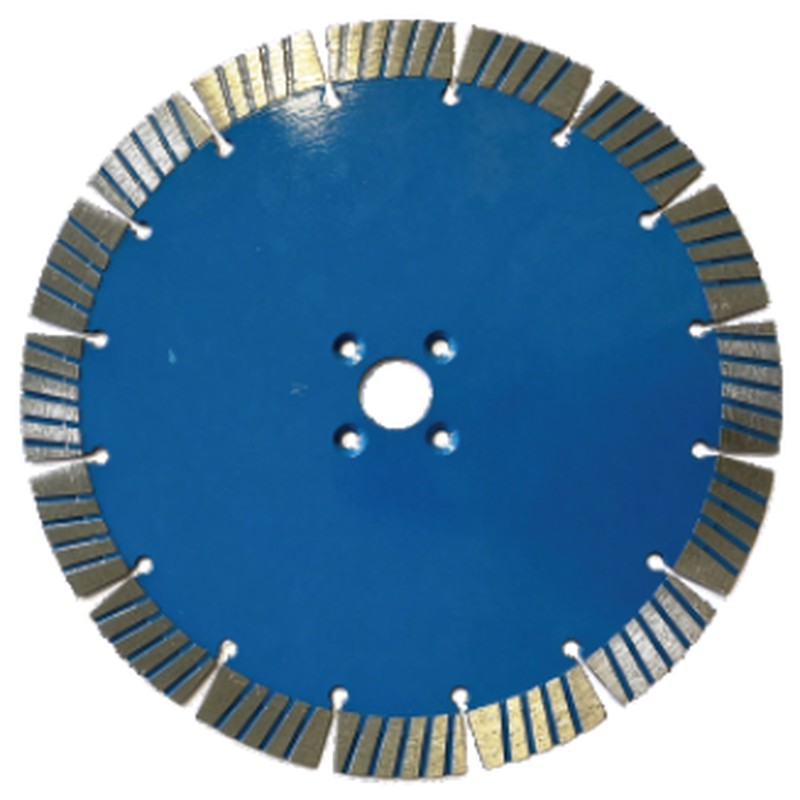
For clay brick and concrete block, use a segmented diamond blade on a cut-off saw or block saw — 350-450 mm for wall chasing and block saws, 115-125 mm for angle grinders on brick. Segmented blades cut faster than turbo on masonry and clear chips well. Wet cutting extends blade life and controls silica dust; for interior work, use a dust-extraction saw instead of wet cutting.
| Material | Blade Type | Bond | Notes |
|---|---|---|---|
| Clay brick | Turbo or segmented | Medium | Brittle — score first to avoid cracking |
| Concrete block | Segmented | Medium-hard | Aggressive segments clear chips |
| AAC / thermalite | Segmented wide slot | Soft | Very abrasive, soft bond |
| Stone-faced block | Turbo rim | Medium | Cleaner finish on the face |
A general-purpose turbo dry blade handles brick and block on angle grinders; for wall chasing, our wall chaser blade is designed for mortar and brick grooves.
A: It works but wears out in minutes. A diamond blade lasts 50-100x longer and cuts faster.
A: A turbo rim gives a clean cut; segmented is faster but chips the glaze. Score the face first.
A: Wet is best for blade life and dust. If water isn't possible, use a dust-extraction saw and P100 respirator.
A: Standard 100-150 mm block cuts through in one pass on a 350 mm blade. For thicker walls, cut from both sides.
Segmented and turbo diamond blades cut brick and block cleanly. Browse our masonry cutting range for angle grinders, cut-off saws and wall chasers.
