Average response time: under 24 hours
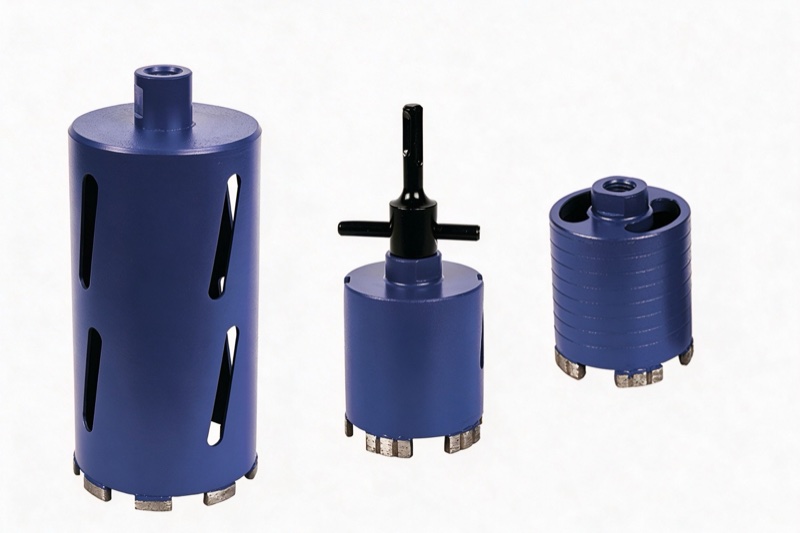
To drill through a brick or block wall for a fence bracket, wall-mounted handrail, or security light arm, use a 25-65 mm diamond core bit on an SDS rotary hammer or wet handheld core drill. A dry diamond core bit works on brick and hollow block for indoor or outdoor work where water is not available; a wet bit lasts longer and cuts cleaner on dense clay brick. Drill through mortar joints when possible, avoid the brick face, and use sleeve or toggle anchors sized for hollow CMU rather than wedge bolts that crack the masonry.
Brick veneer over a wood or steel stud wall is one brick thick (about 100 mm) and sits with a 25-50 mm cavity to the structure. A fence bracket on a brick wall only needs to anchor into the brick itself; a security light or sign bracket may need a longer anchor reaching the backup structure. Poured concrete or CMU block walls are structural and accept wedge or sleeve anchors directly.
Hollow CMU block is the trickiest. The cells are empty, so a wedge anchor spins freely unless you hit the web. A sleeve anchor or a machine screw with a plastic shield set into a cell works better, and you may need to inject epoxy for heavy loads. Always confirm what is behind the wall before drilling: electrical conduits often run through block cavities, and water pipes are common in foundation walls.
Fence brackets, rail brackets, and wall lights typically use 3/8 inch (10 mm) to 1/2 inch (13 mm) bolts. Larger wall-mounted trellises, camera arms, and gate hardware use 16-25 mm anchors. For conduits passing through the wall, 32-65 mm core bits are standard. Match the bit diameter to the anchor, not the other way around.
| Application | Bolt/anchor size | Core bit diameter | Depth |
|---|---|---|---|
| Wall light / camera | 10-12 mm sleeve | 10-12 mm | 60-80 mm |
| Fence bracket / handrail | 12-16 mm sleeve | 12-16 mm | 80-100 mm |
| Trellis / sign arm | 16-20 mm wedge | 16-20 mm | 100-150 mm |
| Conduit through wall | 25-65 mm pipe | 32-70 mm | Full wall thickness |
Brick faces are soft and spall easily. Start with a small pilot hole to prevent the bit from walking, then open up with the core bit at low speed. If possible, drill through the mortar joint between bricks, which is softer and less likely to chip the visible face. Apply masking tape over the mark to keep the bit from skating and to catch small chips.
On hollow block, stop when you break through into the cell. Measure the wall thickness so you do not drill deeper than needed. Blow out the hole with a bulb syringe, then insert the anchor. For a sleeve anchor in a cell, push the shield fully into the block and tighten until the sleeve expands against the web. For heavy brackets, use a chemical anchor injected into the cell with a mesh sleeve.
For repeated bracket holes on a long fence line, a dry diamond core bit on a small rotary drill speeds up the job versus a carbide bit, especially on dense engineering brick. Add a dust collector adapter to keep silica dust off the work site and out of the operator's lungs.
A fence bracket loaded sideways by wind must hold against dynamic loads. In solid brick, a 12 mm sleeve anchor set 60-80 mm deep typically carries 50-80 kg pull-out. In hollow block, use a toggle or chemical anchor, because a wedge anchor only bites the face shell. Never anchor a fence bracket just into the brick veneer; if the bracket carries a gate or tall panel, run a through-bolt with a backing plate into the structural wall behind the cavity.
Spacing matters too. Anchor holes should be at least 100 mm from the brick edge and 150 mm apart to prevent the brick from splitting. If the manufacturer's template puts holes too close to the mortar joint, shift the bracket rather than drilling into the joint, which crumbles under load.
Yes for small 10 mm anchor holes, but a diamond core bit cuts cleaner, faster, and without walking on dense brick. For 25 mm and larger holes, diamond core tooling is much quicker.
Dry is fine for anchor holes; wet is better for conduit penetrations because it suppresses dust and gives a cleaner edge. Wet drilling outside requires catching slurry to avoid staining the wall.
A sleeve anchor set in the web, a toggle bolt, or a chemical anchor with mesh. Wedge anchors spin in empty cells and do not hold.
Set the anchor 10-15 mm deeper than the anchor's embedment spec. A 12 mm sleeve anchor typically needs 70-80 mm depth in solid masonry.
Fence and bracket holes in brick or block are straightforward once you identify the substrate, choose the right anchor, and drill through mortar when possible. A diamond core bit gives clean edges that keep the bracket tight and the wall intact for years.
Written and reviewed by JOY TECH — an SGS & BV audited, CE/RoHS certified diamond tools manufacturer founded in 2004, exporting to 50+ countries.
Our factory and QMS are audited by SGS and Bureau Veritas. Products meet CE/RoHS requirements and every piece is 100% inspected before packing.
Verified Certificates
