Average response time: under 24 hours
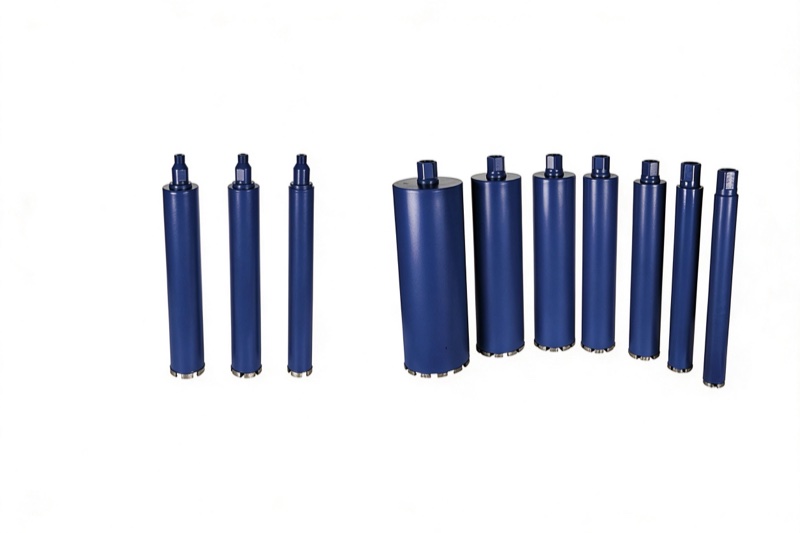
Choose wet core drilling for deep, large, or continuous holes in hard concrete and reinforced slabs — water cools the diamond segments, flushes debris, and extends bit life dramatically. Choose dry core drilling for shallow holes (under about 50 mm deep) in block, brick, or soft concrete where water is impractical, using a vacuum-brazed dry bit. The rule: if the hole is deep enough that the bit would overheat, or the material is hard, go wet; for quick shallow holes and overhead work where water is a problem, go dry.
Wet drilling feeds water through or around the core bit to the cutting face. The water does three jobs: it cools the diamonds (which fail above about 400°C), it flushes cuttings out of the annulus so the bit does not grind its own debris, and it keeps the hole straight by lubricating the barrel. Dry drilling relies on the bit's vacuum-brazed diamonds and a design that sheds dust through the segments — it works because shallow holes let the heat escape before it kills the bond.
Wet is the default for professional work because it protects the bit and the hole. Choose wet when: the hole is deeper than about 50-75 mm; the concrete is hard or reinforced; you are drilling many holes; or the hole diameter is large (the cutting face generates more heat). Wet drilling is also required for diamond bits designed only for water use — running a wet-only bit dry burns it out in seconds.
Use a wet diamond core drill bit on a drill stand with a water supply (gravity tank, pump, or a water swivel adapter). The slurry must be collected — use a water ring or vacuum attachment at the hole so the slurry does not run across the floor.
Dry drilling shines in three situations: shallow holes in masonry (brick, block, soft concrete) where heat has nowhere to build; overhead and vertical work where water would run down the wall and operator; and remote sites with no water supply. Dry bits are vacuum-brazed with a softer design that sheds heat and dust. They cut fast in the right material and the dust is manageable with a shroud and vacuum.
Never force a dry bit in hard concrete — it will glaze and stop cutting. If the bit smokes or the concrete glazes, switch to wet or accept slower progress with frequent cooling breaks. Dry bits also have a shorter life than wet bits per meter of hole, so the choice is a trade-off: convenience against bit life.
Quick guide: brick and block — dry is fine; soft concrete, shallow — dry works; hard concrete or reinforced — wet; any hole over 75 mm deep — wet; overhead — dry unless you have a water ring; multiple large holes — wet. When in doubt, wet. Water is cheap insurance for a bit that costs real money. For clean, straight holes in hard concrete, a wet core bit on a stand is also more accurate than a handheld dry bit — the stand keeps the barrel perpendicular. See core drill bit sizes: how to choose the right diameter for matching the bit size to the hole.
Drill deep holes wet with a wet diamond core drill bit to protect the segments.
Wet is better for hard concrete, deep holes, and bit life. Dry is better for shallow masonry holes, overhead work, and sites without water. Match the method to the material and depth.
No. Wet-only bits overheat and fail within seconds without water. Use a dry-rated bit if no water is available.
Roughly 50-75 mm in soft material before heat builds. Beyond that, or in hard concrete, switch to wet drilling to protect the bit.
Generally yes. Water flushes debris so the diamonds cut freely, which produces a cleaner wall and a straighter hole with less spalling.
Wet and dry core drilling are tools for different jobs: wet for deep, hard, and production work where water protects the bit; dry for shallow masonry, overhead, and remote jobs where convenience wins. Choose by material and depth, never run a wet bit dry, and match the bit to the hole size. The right method cuts faster, straighter, and makes the bit last.
Written and reviewed by JOY TECH — an SGS & BV audited, CE/RoHS certified diamond tools manufacturer founded in 2004, exporting to 50+ countries.
Our factory and QMS are audited by SGS and Bureau Veritas. Products meet CE/RoHS requirements and every piece is 100% inspected before packing.
Verified Certificates
