Average response time: under 24 hours
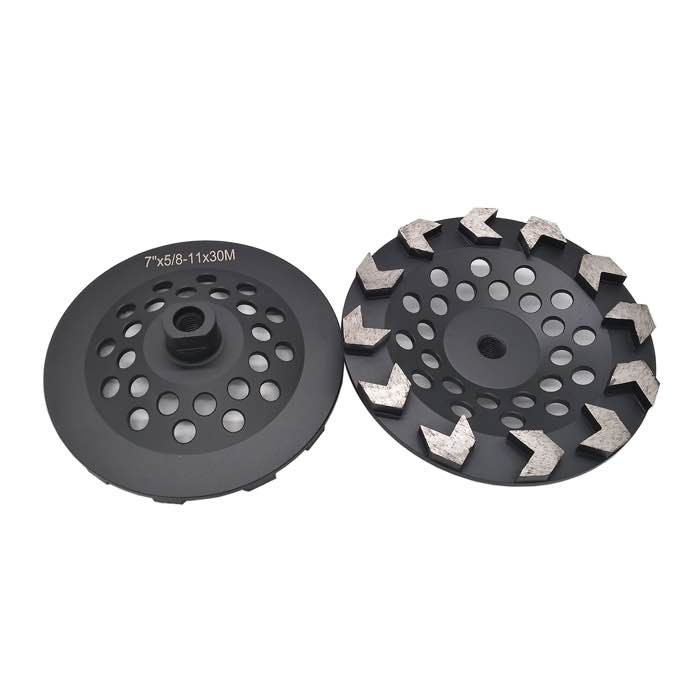
Choose a diamond cup wheel for your angle grinder based on three things: the substrate, the task, and the grinder RPM. For general concrete grinding, a double-row or turbo diamond cup wheel in 115/125 mm is the default. For aggressive coating or laitance removal on a 180 mm grinder, use a segmented arrow or turbo cup wheel. For light bush-hammer texture, use a bush hammer plate. Match the bore to your grinder (M14 in Europe, 5/8-11 in North America), never exceed the max RPM marked on the wheel, and use a vacuum shroud for indoor work.
Cup wheels come in several segment geometries, each with a job. Double-row wheels cut fast on general concrete and leave a moderate scratch pattern. Turbo (continuous turbo rim) wheels cut smooth and leave a fine finish — used on stone and for thin-coat prep. Arrow or segmented wheels are aggressive — used on laitance and heavy mortar. PCD cup wheels strip coatings. Bush hammer plates texture the surface for anti-slip.
| Segment style | Aggressiveness | Finish | Best for |
|---|---|---|---|
| Double-row | Medium-high | Medium | General concrete, laitance, mortar |
| Turbo / continuous | Medium | Fine | Stone, marble, thin-coat prep |
| Arrow / segmented | High | Coarse | Heavy concrete, coatings, hard aggregate |
| PCD | Very high on resin | Variable | Epoxy, glue, mastic stripping |
| Bush hammer | Texture | Rough | Anti-slip, decorative texture |
Common cup wheel sizes are 100 mm (4"), 115/125 mm (4.5/5"), and 180 mm (7"). Match the wheel to your grinder's rated capacity — a 180 mm wheel on a small 115 mm grinder draws too much current and vibrates. The bore is M14 (most of the world) or 5/8-11 (North America). Check the max RPM on the wheel label: a 125 mm wheel is usually rated 12 200 RPM; a 180 mm wheel around 8 500 RPM. Running over the rated RPM can shatter the wheel.
The bond is the metal matrix holding the diamonds. For soft concrete (C20-C25), use a hard bond — it holds the diamond longer. For hard, dense concrete (C40+), use a soft bond — it exposes fresh diamond. For very hard concrete or granite, use an extra-soft bond. Tell your supplier the concrete compressive strength and aggregate source when ordering; a wheel that glazes over (stops cutting) is almost always the wrong bond.
Tilt the angle grinder at a 15-30° angle so only a 10-20 mm strip of the segment contacts the surface. Flat contact grabs and stalling the grinder. Move in slow, overlapping passes — do not dwell in one spot, which digs a trench. Let the tool do the work; pressing down only generates heat. For indoor work, mount a vacuum shroud and connect to a HEPA extractor via a dust collector adapter. Wear face shield, hearing protection, and gloves.
If the job is to create a non-slip texture on a ramp, stairs, or decorative concrete, a cup wheel will not do it — you need a bush hammer. The 5-125 mm bush hammer plate with three tungsten-carbide rollers creates an even, pitted texture at 1-2 mm depth. It is also the right tool for opening smooth trowelled concrete before recoating, where a cup wheel would polish instead of profile.
Use a turbo or continuous-rim wheel on stone; a double-row concrete wheel is too aggressive and will chip stone edges. For marble, choose a soft-bond turbo cup wheel designed for stone.
European and Asian grinders are almost always M14. North American grinders are 5/8-11. Check the grinder flange before ordering — many cup wheels ship with a reducer ring, but the wrong bore will not bolt on.
Usually the bond is too hard for the concrete, or the wheel is glazed. Grind a cinder block or a brick for 30 seconds to expose fresh diamond. If it still does not cut, the bond is wrong for your substrate — order a softer bond.
Typically 40-80 hours on medium concrete, depending on bond and aggregate. On hard flint aggregate, expect 20-30 hours. It is still far cheaper than abrasive discs.
Selecting a diamond cup wheel is a three-way match: segment style to the task, bond to the substrate, and diameter/bore/RPM to your grinder. Stock double-row wheels for general work, turbo for stone, PCD for coatings, and bush hammer plates for texture. Done right, one cup wheel lasts a crew for a job; done wrong, it glazes in a week.
Written and reviewed by JOY TECH — an SGS & BV audited, CE/RoHS certified diamond tools manufacturer founded in 2004, exporting to 50+ countries.
Our factory and QMS are audited by SGS and Bureau Veritas. Products meet CE/RoHS requirements and every piece is 100% inspected before packing.
Verified Certificates
