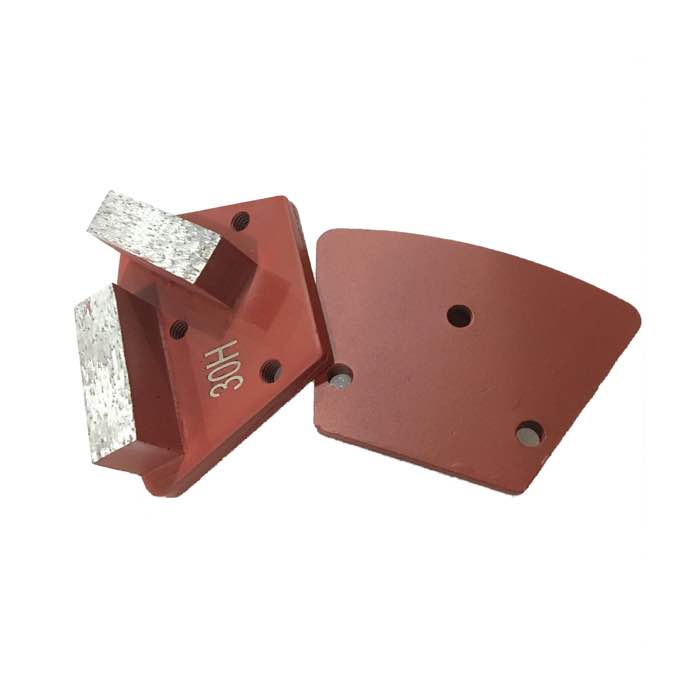
To grind out leveling variations on a concrete slab, first map the high spots with a laser level or straightedge, then spend most of your machine time on those marks rather than the whole floor. Use a 16/18 or 30/40 grit metal-bond shoe with aggressive segment geometry (single bar or rhombus) to remove 1-5 mm quickly. Cross the high spot in overlapping passes, checking with the straightedge every few minutes. For a 5 mm drop over a 3 m section, plan on 30-60 minutes of focused grinding per spot. Once the high spot is down, feather the edges so the transition is invisible, then run a full-floor 60/80 pass to blend the profile.
Removing 5 mm of concrete requires aggressive tooling. Single-bar or double-bar segments bite hard and clear swarf quickly. The WerkMaster Double Bar Segment (JOY-WMS-B2) double-bar segment and WerkMaster Single Bar Segment (JOY-WMS-B1) single-bar shoes are commonly used for this. Avoid three-segment shoes here; they spread the load too thin and will not cut down a 5mm bump in reasonable time.
| Variation | Recommended Fix |
|---|---|
| < 2 mm over 3 m | No action; normal tolerance |
| 2-5 mm high spots | Grind down the highs |
| > 5 mm low spots | Grind highs + fill lows with self-leveler |
| > 10 mm variation | Consult a structural engineer; grinding alone is impractical |
Stock removal generates enormous silica dust. Run a HEPA-rated dust extractor rated for concrete grinding, wear a P100 respirator, and wet-cut only if you can handle slurry cleanup. Watch motor load; aggressive shoes on hard concrete can stall a single-phase grinder.
A: Roughly 0.1-0.3 mm per pass on normal concrete. A 5 mm high spot therefore takes 15-30 focused passes, not one.
A: Only if you stay in one place. Move in overlapping sweeps and feather the edges; the surrounding floor stays flat.
A: For small spots yes, but it will leave a visible bowl. For anything over 0.5 m across, use a walk-behind planetary grinder.
A: A 3 mm gap under a 3 m straightedge is typical for garage epoxy. Commercial warehouse floors often demand 2 mm / 3 m per ACI 360.
On commercial leveling jobs, photograph the slab with the laser level before and after, and keep a written survey on site. This protects you if the owner claims you ground too much or too little. For large warehouses, prioritize high spots at expansion joints and column lines, where finishing crews tend to over-trowel. If you discover a low spot while grinding, do not try to fill it with epoxy; use a cementitious self-leveler after grinding and let it cure before the final polishing pass.
On slabs with actively curling edges at control joints, do not grind the curl away; it will come back. Grind the adjacent high spot flat, then saw-cut and fill the joint to stop the curl from progressing.
Measure again after grinding. Concrete shrinks and shifts over years, and a spot you thought was a high edge may actually be a low area around it. Trust the laser, not your memory of the survey.
Leveling a slab is mostly mapping, not grinding. Find the highs, attack them with aggressive single- or double-bar shoes, feather the transitions, then blend with a finer full-floor pass. Budget time per marked spot, not per square meter.
