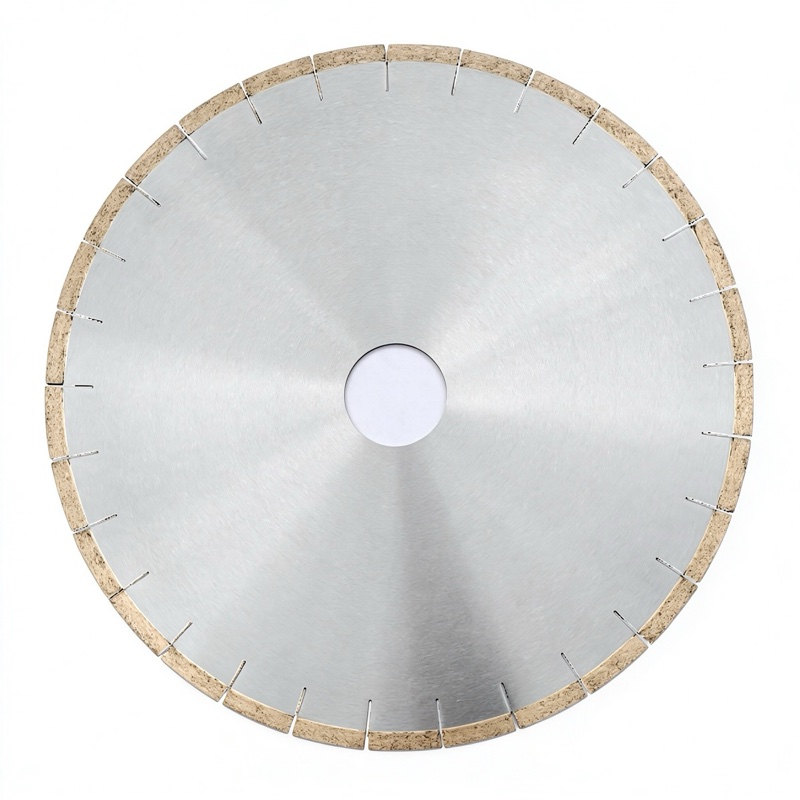
A typical diamond blade cuts between 5 and 50 linear meters per millimeter of segment height in concrete, and far longer in soft tile or marble. A 350 mm segmented concrete blade with 10 mm segments commonly delivers 150-400 meters of cut, while a tile blade may last thousands of linear meters. Actual life is governed mainly by how hard the bond matches the material, your RPM, water cooling, and how often you hit rebar or aggregate.
The diamonds in a diamond saw blade do not get dull so much as the metal bond around them wears away and exposes new grit. If the bond is too hard for the material, it does not wear, diamonds polish flat (glaze), and the blade stops long before the segment is gone. If the bond is too soft, diamonds fall out prematurely. Our short-segment granite blade is tuned so the bond wears at exactly the right rate in hard granite.
| Material | Typical blade life (350 mm blade) |
|---|---|
| Green concrete / soft block | Very long, 1000+ m |
| Reinforced concrete | 80-200 m (rebar shortens it sharply) |
| Hard aggregate concrete | 150-300 m |
| Granite | 40-120 m |
| Marble / soft stone | 300-800 m |
| Porcelain tile | Thousands of cuts |
Replace the blade when segments wear down to about 1.5-2 mm above the steel core, when cracks appear in the core, or when segments show uneven wear or undercutting. Do not wait until the core itself contacts the cut; it will bind and shatter.
Smart contractors track meters cut per blade and convert that to cost per linear meter. Suppose a blade costs $80 and cuts 200 meters; tool cost is $0.40/meter. If a competing blade costs $120 but lasts 400 meters, it is actually cheaper at $0.30/meter. Always compare on cost per cut, not sticker price, and factor in downtime from glazing or segment loss on the cheaper option.
Blades rust and warp when left on a damp saw bench. Clean slurry off the core after wet cutting, dry the blade, and hang it flat or on edge rather than stacking heavy blades on top. A warped core runs out of true and cuts poorly long before the diamonds are worn.
Do not judge blade life only by remaining segment height. When cut quality drops, the blade wanders, or it needs more feed pressure to bite, it is time to retire it even if segments look thick. A blade that is losing segments, undercutting the core, or cracked must be discarded regardless of remaining height.
Track meters per blade, match bond to material, and cool consistently. Blade life is predictable once you stop comparing sticker prices and start comparing cost per cut.
Three hidden killers rarely show up on the spec sheet: running dry, cutting rebar, and using the wrong bond for the aggregate. Hard river rock in concrete wears segments fast; soft cinder block barely wears them at all. Ask your supplier what aggregate your local concrete contains, and they can recommend a bond that matches. Also, a blade left on the spindle while the saw is idle still faces rust; wipe and store it dry.
Mark each blade with the date and record meters cut in a notebook. After a few jobs you will know exactly how many meters to budget per blade, which turns tooling from a guess into a line-item cost.
A: Almost always a bond mismatch or glazing, not broken diamonds. Dress the blade and confirm the bond suits the material.
A: Yes. Cooling lowers segment temperature and preserves diamond retention; wet blades often last 30-50% longer.
A: Each rebar crossing can drop life by several percent on a regular blade; a laser-welded rebar-rated blade absorbs it far better.
Blade life is predictable once you match bond to material, control RPM and heat, and dress glazed edges. Budget tool cost per meter of cut rather than per blade, and you will stop overpaying for disposable blades. Contact JOY TECH for blades bonded precisely to the materials you cut every day.
