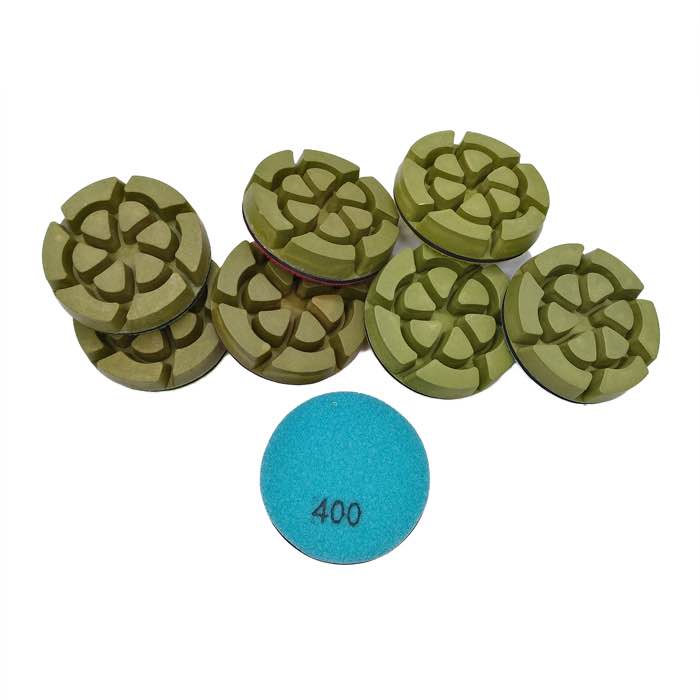
As a rule of thumb, a set of diamond resin polishing pads lasts roughly 1,000 to 3,000 square feet (about 100-300 square meters) per grit step on average concrete. Coarse and transitional pads wear faster than fine grits; soft pads on hard concrete wear quickest, while hard pads on soft concrete glaze instead of wearing. Real life depends heavily on concrete hardness, bond match, pressure, dust control and whether you are polishing raw or already refined concrete.
There is no single number because pad life is a balance between two things: how fast the resin bond wears to expose fresh diamonds, and how abrasive the concrete is. If the bond is too hard for the concrete, diamonds cannot wear out - they glaze over and stop cutting long before they look used. If the bond is too soft, diamonds are pulled out prematurely and pads wear in minutes. Matching bond to concrete is the single biggest lever on cost per square foot.
| Stage | Approx. life per set | Note |
|---|---|---|
| Coarse metal / transition | 200-600 sq ft | Aggressive, wears fast |
| 200-400 resin | 800-1,500 sq ft | Cuts more, loads easier |
| 800-1500 resin | 1,500-3,000 sq ft | Refines gentle, lasts longer |
| 3000 / burnish | 2,000-5,000+ sq ft | Minimal cutting, long life |
These are planning estimates for medium-hard concrete under normal pressure with vacuum dust control. On very hard, siliceous concrete, expect 30-50% less life; on soft, creamy concrete, pads may last longer but glaze more often.
Using matched, good-quality pads such as our Resin Floor Polishing Pads with consistent bond grades gives the most predictable life. For metal-to-resin bridging, 8-Triangle Resin Pads expose diamonds efficiently and wear evenly across the head.
Track area per set on your first few jobs and calculate your real cost per square foot, because local concrete varies. Keep one spare set of each grit on the truck mid-job so a worn pad does not stall production. Replace a pad when it loses cut rate or leaves inconsistent swirls - pushing a dead pad wastes more labor than the pad costs.
Published square-footage estimates are a starting point, but your own jobs will tell the true story. Keep a simple log: record the concrete hardness, the pad bond used, the grit step and the area completed per set. After three or four floors you will have a reliable cost-per-square-meter figure for your specific conditions, which lets you quote jobs confidently instead of guessing.
Also factor labor, not just pad cost. A pad that cuts faster may cost more per set but saves expensive machine and operator hours. On tight-margin jobs, slightly over-specing to a sharper, longer-lasting pad often wins overall. Finally, buy pads in full grit sets rather than one grit at a time - running mismatched, worn pads through a sequence wastes more money than it saves.
Replace a pad when it stops cutting at the expected rate, leaves uneven swirls, or the diamond layer is visibly worn to the backing. Running pads past their life wastes operator time and can leave scratches that require extra grit steps to fix. Buying in bulk by the grit set also lowers unit cost for recurring work.
Reorder pads before you run out mid-job, especially the finishing grits. Running out of 1500 or 3000 on site delays delivery far more than the cost of keeping spares in stock.
A: Resin pads cannot be dressed like metal bonds. Once the diamonds are consumed, replace them.
Water cools and can extend life on hard concrete, but only on pads designed for wet use.
It stops cutting, leaves uneven haze, or the diamond layer is visibly gone down to the backing.
Budget roughly 100-300 m² per resin grit set as a starting point, then refine from your own job tracking. Match the bond to your concrete, control dust, and replace pads promptly. The takeaway is that pad cost is predictable once you track it on your own jobs. Budget per grit step, buy in sets, and replace pads promptly so labor time is not wasted on worn tooling. Contact JOY TECH for a quote on cost-effective resin polishing pads in full grit ranges.
