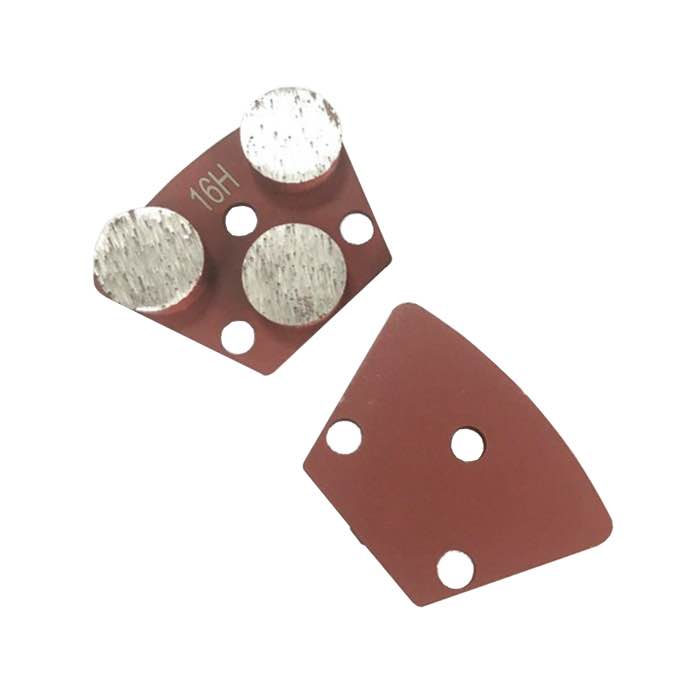
Choose diamond grinding segments by matching three factors to your concrete: bond hardness (soft bond for hard concrete, hard bond for soft concrete), grit size (16#-30# for aggressive removal, 40#-80# for general grinding, 120#+ for smoothing), and segment style (trapezoid, rhombus, arrow or bar segments for different machines and surface conditions). For most commercial floor projects, start with a medium bond at 30#-40# grit, test on a small area, then adjust.
Diamond grinding segments are the working teeth of floor grinders. If any of the three parameters is wrong, you get one of two failures: the tool wears out too fast, or it glazes over and stops cutting. Understanding each variable prevents wasted time and money on a large floor.
The golden rule: the harder the concrete, the softer the bond. Hard, dense concrete (PSI 5000+) resists the diamond, so a soft bond wears away quickly to expose fresh crystals and keeps cutting. Soft, porous concrete (PSI 2500-4000) wears the bond itself, so you need a hard bond to slow that wear.
| Concrete Hardness | Recommended Bond | Typical Grit | Job Type |
|---|---|---|---|
| Hard / dense (5000+ PSI) | Soft bond | 16#-30# | Heavy grinding, leveling |
| Medium (4000-5000 PSI) | Medium bond | 30#-40# | General surface prep |
| Soft / porous (under 4000 PSI) | Hard bond | 40#-80# | Lighter grinding, smoothing |
| Coated / contaminated | PCD or aggressive metal bond | Coarse | Coating & epoxy removal |
Grit determines both speed and finish. Coarser grits remove material fast but leave deep scratches; finer grits smooth the surface and prepare it for polishing.
Always step down grit sizes gradually — never jump from 30# to 120# or you will leave scratches that are expensive to remove.
Segment style is dictated mainly by your machine and the segment holder. Common styles include trapezoid, rhombus, arrow, bar and zigzag segments. Trapezoid and rhombus segments give aggressive cutting with good balance; arrow and S-shaped segments reduce vibration and run smoother on large grinders; bar segments offer maximum contact for soft concrete. Match the segment footprint to your machine's plate, and keep all segments on one plate the same height for even wear.
A: Most concrete grinding jobs start at 30#-40# grit for surface prep, then move to 80# and finer for smoothing. If the floor has heavy coatings, start at 16#-20#.
A: If segments wear out unusually fast, the bond is too soft for your concrete — switch to a harder bond. If the tool glazes and stops cutting, the bond is too hard — switch to a softer bond.
A: Not ideal. Bond should match concrete hardness. Medium-bond segments are a reasonable compromise, but matching bond to concrete always gives better performance and lower cost per square meter.
A: Trapezoid segments cut more aggressively with better coverage and balance; bar segments have maximum surface contact, suit softer concrete and run smoother. Choose based on your machine type and the job.
Choosing the right diamond grinding segments is a three-step decision: match bond to concrete hardness, pick the grit for your target removal rate and finish, and select the segment style compatible with your machine. If you are unsure, ask your supplier for a recommendation with a small test set — most quality manufacturers like JOY TECH's grinding segment range will help you select before you commit to a large order.
