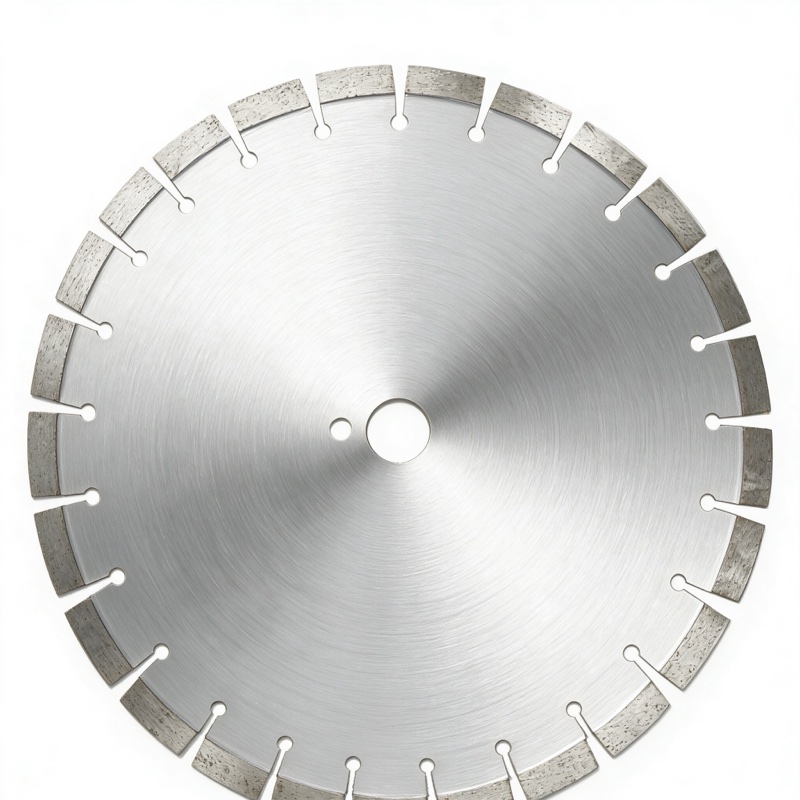
Cut control joints in concrete slabs to control where shrinkage cracks form. Use a walk-behind saw with a 300-450 mm diamond blade, cut 1/4 of slab thickness deep, and space joints 24-36x the slab thickness apart (a 150 mm slab = joints every 3.6-5.4 m). Cut as early as possible after placement (6-24 hours) before random cracking begins. True expansion joints — which allow slabs to move apart — are formed at construction, not sawn afterward.
| Type | Purpose | When Made |
|---|---|---|
| Control joint (sawn) | Guide shrinkage cracks | After placement, 6-24 hours |
| Expansion joint | Allow thermal movement between slabs | At construction (formed) |
| Construction joint | Between separate concrete pours | At pour boundaries |
Spacing = 24-36 × slab thickness. For common slabs: 100 mm slab → 2.4-3.6 m; 150 mm → 3.6-5.4 m; 200 mm → 4.8-7.2 m. Also cut around columns and changes in slab geometry.
Our laser-welded concrete blade is the workhorse for control joints, and the high-frequency welded blade handles higher RPM saws.
A>No — expansion joints must be formed during placement. You can only saw control joints afterward.
A>Deeper than 1/4 of thickness wastes blade life and doesn't help. Shallower than 1/4 may not control cracking.
A>Cut as soon as possible — late cuts are better than no cuts, but random cracks may already have formed.
A>Most walk-behind saws follow a string line. Use a chalk line for layout.
Cut control joints early, at 1/4 depth, and space them by the 24-36x rule. Browse our concrete cutting range for walk-behind saw blades.
