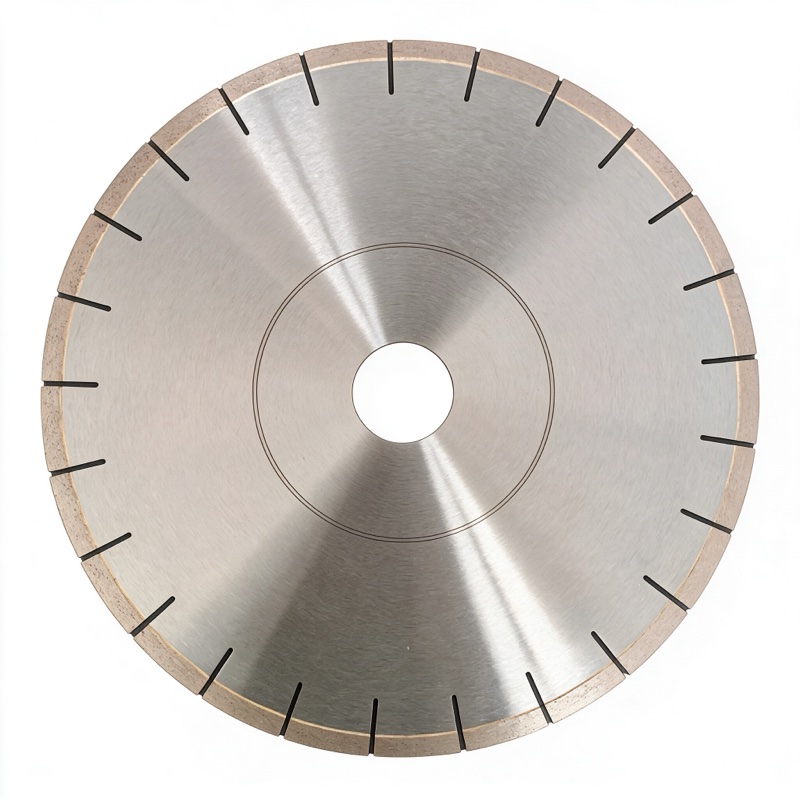
To cut concrete blocks and bricks cleanly, use a segmented diamond masonry blade on an angle grinder or circular saw, mark and score the line first, then cut through in controlled passes. A diamond blade gives a far cleaner, faster cut than a chisel and lump hammer, and it handles solid block, brick and paver. For the cleanest edges, cut wet where possible and support the piece so it does not break unpredictably as the blade exits.
A brick set and hammer works for occasional cuts but leaves irregular, crushed edges and is slow. A segmented diamond blade cuts straight through block, brick and cinder unit with a clean kerf, and can follow a marked line precisely. It is the standard on modern masonry jobs for bed-joint cuts, vent openings and trim work.
Use a segmented general-purpose diamond masonry blade. Segmented rims cool well and cut fast on abrasive block and brick. For angle grinders, a 4-1/2 or 5 inch segmented blade is standard. Our Universal Stone Cutting Blade handles brick, block and pavers, while the high-frequency welded masonry blade is built for longer life on abrasive block. For light masonry and insulating units, our foamed/light-unit blade gives clean cuts without crumbling soft material.
| Material | Blade type | Tip |
|---|---|---|
| Clay brick | Segmented / turbo | Cut from face side |
| Cinder block | Segmented masonry | Cut through shell, then web |
| Pavers | Segmented diamond | Wet cut for cleanest edge |
| Light / foam block | Sharp general blade | Light feed to avoid crumble |
Masonry cutting creates silica dust. Use a dust shroud with a HEPA vacuum indoors, or wet-cut outdoors. Wear eye, hearing and respiratory protection, and keep the guard on the grinder. Never force the blade through a thick block in one shove - let the segments cut.
Not all block cuts are alike. Hollow cinder block has a concrete shell over webs, so the cut loads up when you reach the hollow cells and then bites again on the far web - keep the feed steady and let the blade clear each section. Solid brick and pavers cut more evenly but chip the face glaze if the blade is dull. Always cut brick from the faced side so any micro-chipping lands on the hidden edge.
Lightweight and insulating blocks crumble easily, so use a sharp blade and a light feed rather than forcing through. For mortar joints and old crumbling walls, a segmented diamond blade still outperforms a chisel, but expect shorter blade life because old masonry is abrasive and often buried with debris. Dust control is non-negotiable: these materials release silica, so use extraction or wet cutting and wear respiratory protection.
For a few cuts, an angle grinder is fine. For a whole wall or patio, a walk-behind masonry saw or table saw cuts faster, straighter and with less effort. Either way, a segmented diamond blade beats a chisel for clean, repeatable masonry cuts.
Wear a dust shroud and HEPA vacuum on indoor masonry cuts. The silica dust from block and brick is the real long-term hazard, not the cut itself.
For repetitive brick work, a table masonry saw is worth the rental. It cuts straighter and faster than a handheld grinder on volume jobs.
For clean breaks, score both faces on hollow block so the web separates evenly rather than tearing out unexpectedly as you finish the cut.
Yes, with a diamond masonry blade, but depth is limited. An angle grinder is more portable for small cuts.
Score both sides deeply, then make the final pass from one side; support the waste to avoid tearing.
Block is abrasive, so a quality segmented blade lasts a long time versus abrasive discs, but expect gradual wear.
Clean block and brick cuts come from a segmented diamond blade, scored guide lines and controlled passes. It is faster and tidier than chiseling. The takeaway is that a segmented diamond masonry blade makes block and brick cuts far cleaner than a chisel. Cut from the face, support the unit and control dust, and the work speeds up. Contact JOY TECH for a quote on masonry and universal diamond blades for angle grinders and circular saws.
