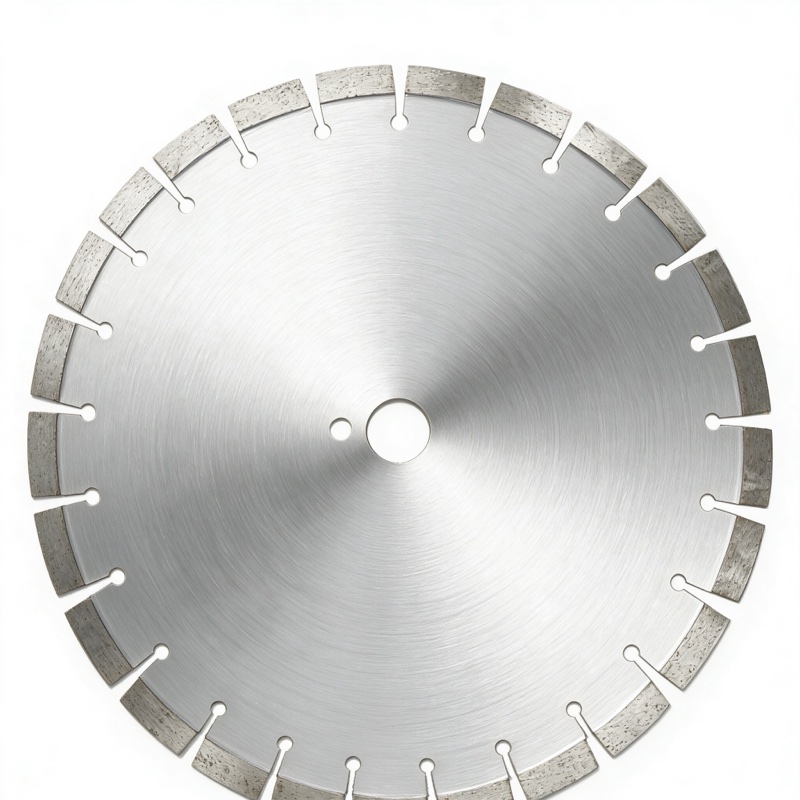
Yes, you can cut concrete pavers and patio stones with an angle grinder fitted with a diamond segmented or turbo rim blade. Mark the cut, score a shallow line on both faces, then cut through in controlled passes. For laying many pavers, a guillotine splitter is faster but leaves rougher edges; a diamond blade gives the clean, tight joints patio work demands.
Pavers vary: dense concrete paving stones, clay brick, and natural flagstone each cut differently. A general masonry blade such as our high-frequency welded masonry blade handles most pavers, while PC brick and ceramic saw blade is tuned for pressed clay and brick. Use a segmented rim for speed on thick pavers; switch to a turbo rim if visible edges must be smooth.
Paver cutting throws huge amounts of respirable silica dust. Wet cutting or a vacuum shroud is strongly recommended, indoors or near neighbors. Wet cutting also cools the blade and reduces chipping on colored paver faces.
Chipping happens when the blade exits the far side. Cut the decorative face up, support the waste side fully, and ease the blade through the last few millimeters. For very thin or tumbled stone, use a turbo or continuous-rim blade and a slower feed.
For patios, curved steps, or rounded borders, pavers cannot be cut in one straight pass. Make repeated straight relief cuts up to your curved line, knock out the waste with a brick chisel, then smooth the arc with a turbo blade or cup wheel. Dry lay the border before permanent bedding so you can test each cut; trimming after bedding wastes pavers and time.
Paver cutting generates silica dust that triggers OSHA-style exposure limits in most markets. A vacuum shroud on the grinder, a wet cut, or both are no longer optional on commercial sites. Failing to control dust shuts jobs down faster than a dull blade.
Even outdoor paver cutting benefits from a light water feed. It suppresses silica dust that drifts into neighboring yards and cools the blade through the dense aggregate. A simple hose with a shutoff valve aimed at the cut is enough; you do not need a full wet saw.
Paver cutting is a guide-cut and dust-control problem more than a blade problem. Score first, step the depth, wet or vacuum, and the patio goes down straight and clean.
Place the paver on compacted bedding sand. Mark the cut, set a clamped straightedge 115 mm from the blade edge for a 125 mm grinder. Score a shallow groove, then deepen in three passes. Support the waste side so it does not snap and chip the kept half. After cutting, tap any burr off the edge with a rubbing stone before laying.
Concrete interlock pavers cut fast with a segmented masonry blade; natural flagstone chips more easily and wants a turbo rim. Clay brick dust packs the kerf, so clear swarf often. Match the blade to the densest material you cut, not the softest.
Before bedding, dry-lay the entire border so you can adjust cuts on the ground. Nothing wastes pavers like cutting after the mortar is set. On curves, use a template to mark each paver, then cut one at a time. Keep a few spare pavers whole for the most visible rows, and use cut pieces for hidden edges.
A: An abrasive masonry disk cuts but wears fast, loads up, and creates uneven cuts. A diamond blade cuts straighter and lasts far longer.
A: A 115-125 mm grinder handles most 40-60 mm pavers; for 80 mm-plus slabs, step up to a 230 mm grinder or a walk-behind saw.
A: Make repeated straight relief cuts up to the curve, knock out the waste with a chisel, then smooth the arc with a cup wheel or turbo blade.
Clean paver cutting comes from a sharp diamond masonry blade, scored guide cuts, gradual depth passes, and dust control. For laying crews buying blades by the case, match the bond to your local paver density. Contact JOY TECH for paver, brick, and block blades at wholesale pricing.
