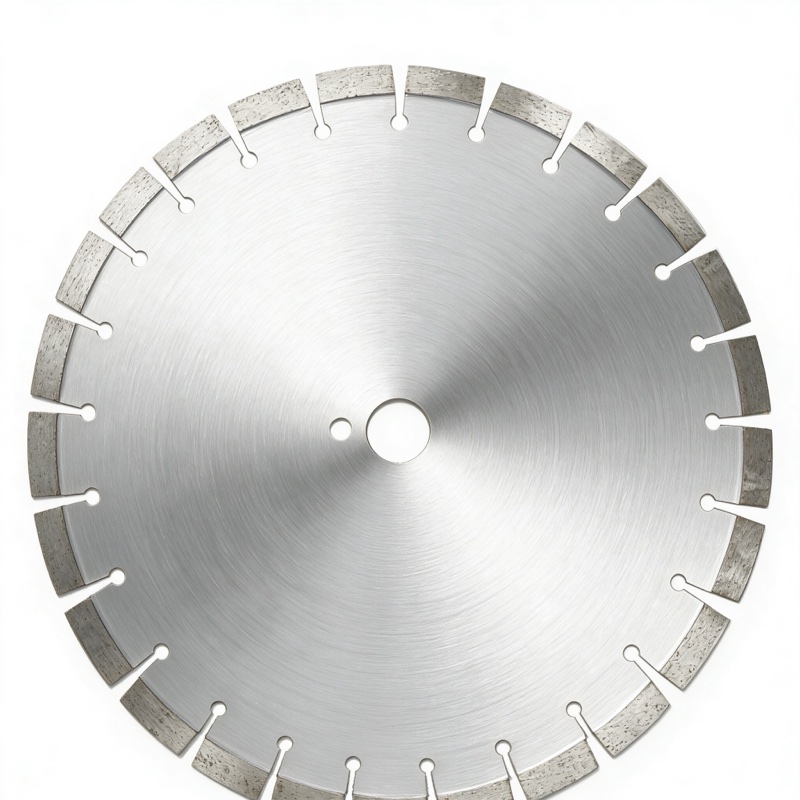
A 350 mm (14") hand-held cut-off saw cuts to about 120 mm deep; a 400 mm blade reaches 145 mm; a 450 mm blade reaches 160 mm. Never try to reach full depth in one pass — cut in 2-3 incremental passes, let the saw spin at full RPM, and keep it wet for blade life and dust control. Hand-held saws are for utility cuts, openings and trenches where a walk-behind saw can't fit.
| Blade Diameter | Max Depth | Typical Saw |
|---|---|---|
| 300 mm (12") | 100 mm | Small cut-off saw, 60-75 cc |
| 350 mm (14") | 120 mm | Standard cut-off saw, 75-85 cc |
| 400 mm (16") | 145 mm | Large cut-off saw, 95 cc+ |
| 450 mm (18") | 160 mm | Heavy saw, often on a cart |
A hand-held saw has no weight to hold the blade down, and the operator can't feed as steadily as a walk-behind. Trying full depth causes: the saw to bog down, the blade to bind and kick back, and the core to overheat. Incremental passes let the blade clear chips and stay cool.
For hand-held concrete cutting, use a high-frequency welded blade for general concrete, or step up to a laser-welded blade when you hit rebar or reinforced concrete. Laser welded is safer for hand-held work because it can't shed segments under load.
A: Not safely with a single hand-held saw. Cut from both sides, or use a walk-behind saw for trenches over 150 mm.
A: Typically 4,500-5,500 RPM no-load. Check the max RPM on the core and match the saw.
A: Gas for portability outdoors; electric (with water) for indoor utility cuts where fumes are a problem.
A: Likely too soft a bond for the concrete, or dry cutting. Match the bond to aggregate hardness and always wet-cut.
Hand-held saws are precision tools for utility cuts, not floor saws. Match the blade diameter to depth, use incremental passes, and always wet-cut. See our hand-held concrete blade range in 300-450 mm.
